
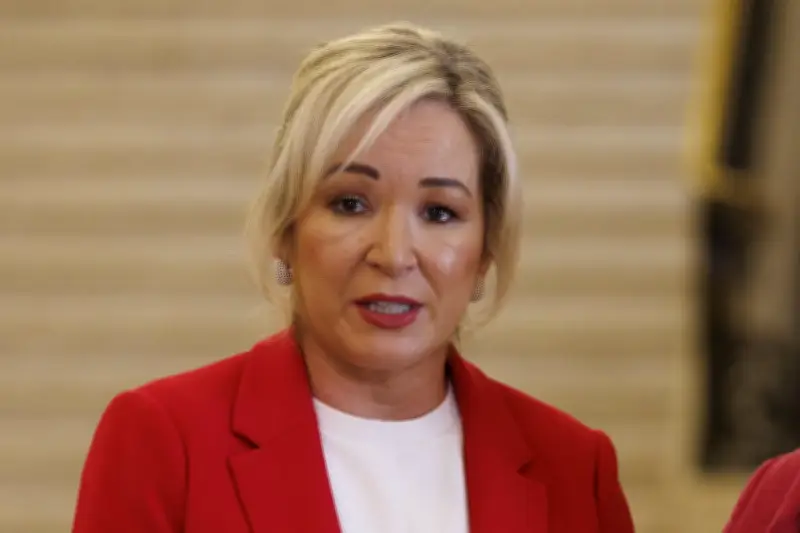
Northern Ireland’s First Minister Michelle O’Neill has accused outgoing Prime Minister Sir Keir Starmer of treating people from the region as “second-class citizens,” citing his refusal to meet with the Stormont Executive in recent years. Speaking to media at Parliament Buildings on Monday, O’Neill said Starmer “refused to meet” with her and deputy First Minister Emma Little-Pengelly to discuss the cost-of-living crisis, among other issues.
O’Neill’s Criticism of Starmer’s Engagement
“Throughout the course of the last few years Keir Starmer has refused to meet with this Executive to discuss the very issues that are concerning people here,” O’Neill stated. She added that this lack of engagement suggests Northern Ireland is not a priority for any British prime minister. “What does that say about the people here? It says that they’re second-class citizens and they’ll never be up the priority list of any British prime minister,” she said.
Despite her criticism, O’Neill expressed willingness to work constructively with the next prime minister, but reiterated her view that Northern Ireland’s future is “better served by breaking our links with Britain.”
DUP Leader Accuses Starmer of Unfulfilled Promises
DUP leader Gavin Robinson also criticised Starmer, accusing him of “leaving behind a record of unfulfilled promises” regarding Northern Ireland. Robinson said Starmer “failed to deal with the root cause of the problems created by the (Northern Ireland) Protocol and Windsor Framework, namely restoring Northern Ireland’s full place within the United Kingdom and ending the application of EU laws over part of our country.” He also criticised the government’s handling of illegal migration and called on the next prime minister to fund Northern Ireland properly, back workers, restore border confidence, and strengthen the Union.
Alliance and SDLP Responses
Alliance leader Naomi Long expressed concern about potential instability during the transition to a new prime minister. She urged a quick resolution to ensure progress on issues like the cost-of-living crisis, health service challenges, and financial difficulties facing the devolved Assembly. “We also need to see wider renewal of politics across the UK if people are going to be genuinely confident that Westminster can deliver for them,” she said.
SDLP leader Claire Hanna offered a more balanced view, acknowledging that Starmer had been “more engaged and respectful of the island of Ireland and more interested in this region” than previous premiers. However, she noted that he “failed to communicate and connect with his electorate” and highlighted structural challenges facing the UK.
Ulster Unionist and TUV Perspectives
UUP leader Jon Burrows said Starmer had been on “borrowed time,” noting that while the country voted for change in 2024, the government “too often failed to deliver.” He cited record tax rises on working families and called for the next government to treat Northern Ireland as a “full and equal partner in our Union.”
TUV leader Jim Allister raised constitutional concerns, claiming Starmer “ran away from” the issue of Northern Ireland’s continued application of EU laws under the Windsor Framework. He argued that a prime minister’s first duty is to ensure sovereignty over all of the United Kingdom, and that the next premier must address this.
Financial Challenges and Budget Disputes
The Stormont Executive has consistently complained that Northern Ireland is not funded to need, and ministers have been unable to agree a budget. This financial strain has compounded political tensions, with O’Neill and other leaders calling for fairer funding from Westminster.
As the UK prepares for a new prime minister, Northern Ireland’s political leaders are urging stability, engagement, and a renewed focus on the region’s needs within the Union.




