

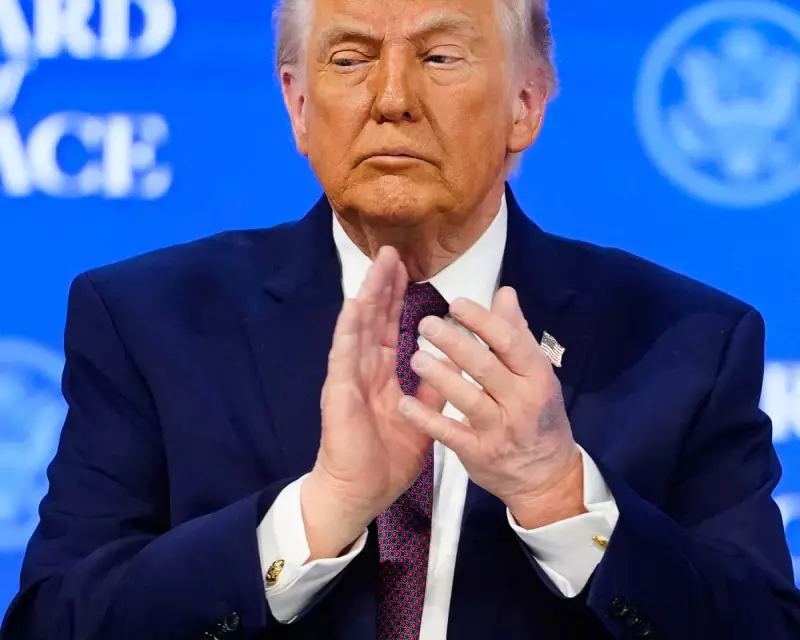
The fundamental architecture of international relations, constructed painstakingly over decades, rests upon a foundation of mutual trust and predictable behaviour between nations. According to veteran journalist and former MP Zoe Daniel, that essential trust has been catastrophically shattered. "The global order is built on trust," she writes. "The United States, under Donald Trump, cannot be trusted." This stark assessment frames a new and perilous reality where traditional alliances are no longer reliable, leaving countries like Australia exposed and strategically adrift.
The Unraveling of a Rules-Based World
The disintegration of the established international system is accelerating at an alarming pace. A telling illustration occurred at the World Economic Forum in Davos, where French President Emmanuel Macron, in a clear reference to Donald Trump, invoked a line from the film Love Actually: "A friend who bullies us is no longer a friend." This theatrical moment underscored a profound geopolitical shift. The incident stemmed from Trump leaking a conciliatory text message from Macron, who was attempting to engage the US president to bolster the crumbling global framework.
Provocation as Power: The Greenland Gambit
Trump's approach to statecraft was vividly demonstrated in the affair concerning Greenland. In a classic manoeuvre, he threatened to impose severe tariffs on several European nations—including Denmark, Norway, France, Germany, and the UK—over their opposition to American control of the territory. This provocative act, designed solely to showcase his power, achieved its intended effect, sending European capitals into a frenzy of contingency planning involving retaliatory tariffs and troop deployments.

Trump subsequently cited a vague "deal" with NATO and withdrew the threat, boasting, "We probably won't get anything unless I decide to use excessive strength and force, where we would be, frankly, unstoppable." This episode lays bare a disturbing truth: the world's predominant power, under this leadership, operates outside the norms of diplomacy, protocol, and consequence. The question must be asked: had he acted on those threats, economic or military, who indeed could have stopped him?
A Catastrophic Loss of Trust and Its Global Repercussions
The removal of trust in the United States as the lynchpin of the global order represents nothing short of a catastrophe. As Canadian Prime Minister Mark Carney stated in his landmark Davos address, "the old order is not coming back." His speech resonated precisely because it articulated the obvious reality many were reluctant to confront.
This reality has direct and profound implications for Australia. The Atlantic alliance, which has underpinned security in Western Europe for nearly eighty years, is evaporating. To believe this does not alarmingly affect Australian security and foreign policy is a dangerous delusion. Recent conflicts in Ukraine and Gaza, alongside actions by leaders like Putin and Netanyahu, have further tattered the rules-based system. Trump has consistently frayed these boundaries since 2015, normalising previously unthinkable actions through control of the information landscape.
Australia's Strategic Dilemma in the 'New Normal'
This "new normal" leaves Australia in a precarious position—marooned by its values and principles. With its closest ally threatening other allies with blatant disregard for rules, ethics, or consequences, Australia faces an existential bind. The nation's defence, security, technological, and economic systems are deeply enmeshed with America's. Disentangling them now seems, at best, extraordinarily complicated and, at worst, an impossible task.
This calls into question the very value of key alliances. What, for instance, is the worth of the AUKUS pact? To date, it arguably makes Australia a greater target for a first strike while funneling billions of dollars to an administration that casually discards foundational commitments, like Article 5 of the NATO treaty. Reports of Canada modelling a hypothetical US invasion may seem extreme, but as Carney warned, his nation was among "the first to hear the wake-up call" that historic alliances are no longer guaranteed.

The Imperative for Middle Powers to Unite
In this volatile environment, Carney issued a crucial directive for nations like Australia: "Middle powers must act together because if we're not at the table, we're on the menu." He is leading by example, pursuing a trade deal with China while pragmatically stating, "We take the world as it is, not as we wish it to be." This philosophy underscores that hope is not a viable strategy in the Trump era.
The sentiment cuts both ways. Comments from Trump ally Steve Bannon, who claimed Australia's Covid-19 response damaged its image among Trump's supporters, reveal a breathtaking lack of self-awareness. They also signal that Australia cannot rely on nostalgic "mateship" under the current US administration. The nation must forge its own path, building coalitions with other middle powers to navigate a world where the old certainties have vanished and trust in the traditional guarantor of order has been irrevocably broken.





