

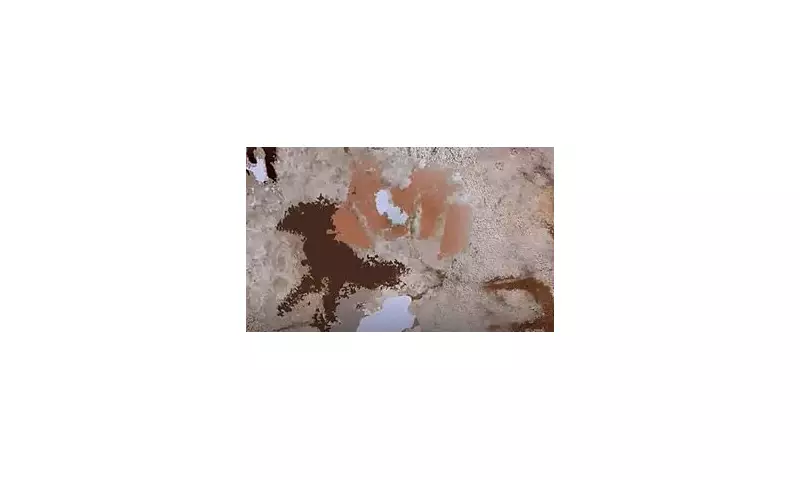
A remarkable discovery in an Indonesian cave is fundamentally reshaping our understanding of early human creativity and migration patterns. Archaeologists have identified a red hand stencil found on the island of Sulawesi as the world's earliest known rock art, dating back at least 67,800 years.
Unprecedented Age and Artistic Significance
This extraordinary find predates the previous oldest known cave art from the same region by approximately 15,000 years, establishing a new benchmark for the origins of human artistic expression. The stencil was meticulously created by deliberately narrowing the negative outlines of the fingers, producing a distinctive claw-like appearance that continues to puzzle researchers.
Professor Adam Brumm, co-lead author of the study from Griffith University, suggests this artistic choice might reflect early symbolic thinking. "This art could symbolise the idea that humans and animals were closely connected," he explained. "We already seem to see this in the very early painted art of Sulawesi, with at least one instance portraying figures that we interpret as representations of part-human, part-animal beings."

Advanced Dating Techniques Confirm Ancient Origins
The research team employed sophisticated uranium-series dating methods to analyse microscopic mineral deposits within the limestone caves of southeastern Sulawesi, specifically on the satellite island of Muna. Their rigorous scientific approach yielded a minimum age of 67,800 years, making this the oldest reliably dated cave art ever discovered anywhere in the world.
Professor Maxime Aubert, another co-lead author, emphasised the broader implications of this finding. "It is now evident from our new phase of research that Sulawesi was home to one of the world's richest and most longstanding artistic cultures," he stated. "This culture has origins in the earliest history of human occupation of the island at least 67,800 years ago."
Implications for Human Migration to Australia
Beyond its artistic significance, this discovery provides crucial evidence about the peopling of Australia. The hand stencil suggests that modern humans were present in Sulawesi much earlier than previously documented, supporting theories about northern migration routes into the ancient supercontinent of Sahul, which encompassed present-day Australia, Tasmania, and New Guinea.
Dr Adhi Agus Oktaviana, team lead for the research, clarified the migration connection. "It is very likely that the people who made these paintings in Sulawesi were part of the broader population that would later spread through the region and ultimately reach Australia," he explained.
Settling Longstanding Archaeological Debates
For decades, scientists have debated both the timing and routes of human arrival in Australia. Some researchers have argued for arrival at least 65,000 years ago, while others maintained a more conservative estimate of around 50,000 years. Similarly, migration theories have been divided between northern routes through Sulawesi and the 'Spice Islands' versus more southerly routes via Timor.
Professor Renaud Joannes-Boyau, co-lead author of the study, highlighted how this discovery helps resolve these debates. "With the dating of this extremely ancient rock art in Sulawesi, we now have the oldest direct evidence for the presence of modern humans along this northern migration corridor into Sahul," he stated.
Contextualising Global Cave Art Traditions
While Europe's famous Upper Palaeolithic cave art dates to approximately 21,000 years ago, and previous Indonesian discoveries were believed to be about 40,000 years old, this new finding dramatically extends the timeline of human artistic expression. The Muna cave site reveals evidence of artistic activity spanning an exceptionally long period, with researchers discovering additional paintings created around 20,000 years ago alongside the ancient hand stencil.
This Indonesian discovery challenges previous assumptions that Europe was the primary cradle of early human creativity, demonstrating instead that sophisticated artistic traditions developed simultaneously in multiple regions as modern humans spread across the globe.






