
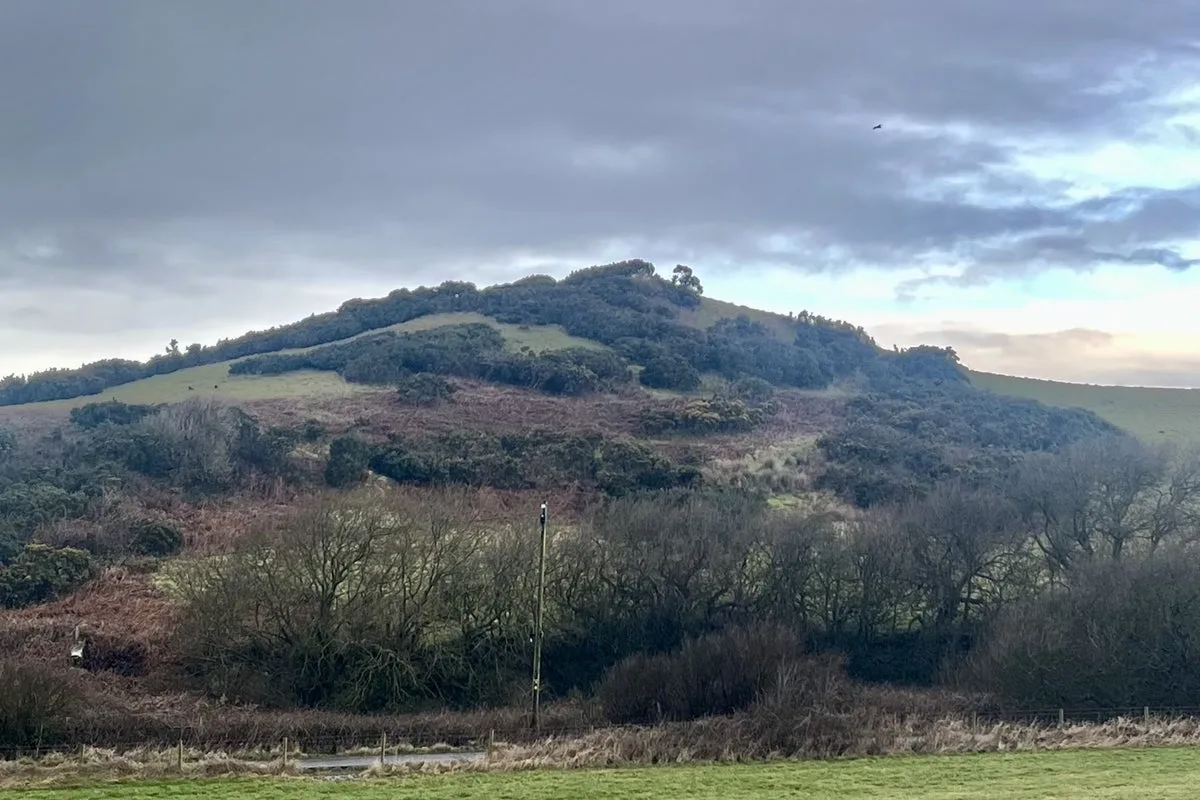
A hill on the west Cumbrian coast could be the long-sought burial mound of Ivarr the Boneless, one of the most powerful Viking leaders to have ruled in Britain, an archaeologist has claimed. Ivarr, also known as Ivarr the Legless or Ivarr the Dragon, was a formidable ninth-century Viking warlord who established a ruling dynasty in Dublin and played a pivotal role in leading the Great Heathen Army during its campaigns across England. Despite his historical significance, his grave has never been conclusively identified.
Independent archaeologist Steve Dickinson believes the Viking leader may have been interred with his ship beneath a large mound, known in medieval records as “The King’s Mound”. This site is considered by Mr Dickinson to be part of an extensive and previously unrecognised Viking burial landscape. Only 16 pre-Viking and Viking Age monumental ship burials are currently known in the region, and none has yet been confirmed in the UK.
Historians have long argued that Vikings not only raided but settled in Cumbria, a theory supported by the high concentration of Scandinavian place-names across the county. In 2001, a BBC television programme examined DNA samples from locations across England; of all the sites tested, only Penrith in east Cumbria showed strong evidence of Norwegian Viking ancestry in the modern population. More than a quarter of men sampled were found to share a direct male ancestor from Norway.
Even so, archaeological evidence for Viking settlement and burial in Cumbria has remained limited. The first radiocarbon-dated Viking Age longhouse in England was identified in the Kentmere valley in the 1980s, and a small Viking cemetery uncovered at Cumwhitton near Carlisle was later published by Oxford Archaeology North in 2014. Since the early 2000s, metal-detecting has begun to reveal new evidence, particularly along the west Cumbrian coast. Several Viking Age silver hoards have been discovered, including one at Beckermet now held at the Beacon Museum in Whitehaven.
The Beckermet Hoard, which includes silver from the Carolingian Empire and coins originating in Baghdad, appears to have been weighed out beside The King’s Mound. Nearby are 39 smaller satellite mounds. Surveys suggest the area forms a large Viking Age necropolis, with the main mound potentially covering a high-status burial. Further discoveries have strengthened the case for west Cumbria as a major Viking centre. Satellite imagery, LiDAR and ground surveys have revealed what archaeologists believe to be Viking fleet bases and large timber hall complexes. In early 2025, a 50-metre-long late Viking Age hall was identified near Wigton by a Cumbrian heritage agency, and an even larger hall, measuring about 63 metres, has been detected south of Gosforth. Archaeologists say this would be the largest pre-Norman hall known in the UK and Ireland. Professor Neil Price, Chair of Archaeology at Uppsala University, has described the complex as comparable to royal Viking Age palaces in Scandinavia.
Dickinson said his research began with medieval documents that repeatedly referred to a place called “Cuningeshou”, an Old Norse term meaning “The King’s Mound”. In August 2024, he visited the site and confirmed the mound still exists, measuring about 60 metres across and nearly six metres high, overlooking the coast. Its precise location has not been disclosed to prevent looting. Metal-detecting in the surrounding area has uncovered lead weights used to measure silver, along with large ship rivets and fittings, which Mr Dickinson says support the theory of a ship burial. He links the site to Ivarr through Icelandic sagas and contemporary Irish annals. One saga records that Ivarr was buried in a mound on a boundary in England, while Irish annals describe Ivarr and his brother Óláfr as sons of the king of Laithlind. Some historians have placed Laithlind in Norway or Scotland, but Mr Dickinson argues instead that Irish sources point to the eastern shores of the Irish Sea. “So I consider Ivarr’s home kingdom was in West Cumbria, and it figures that he would have been buried there,” he said.




