

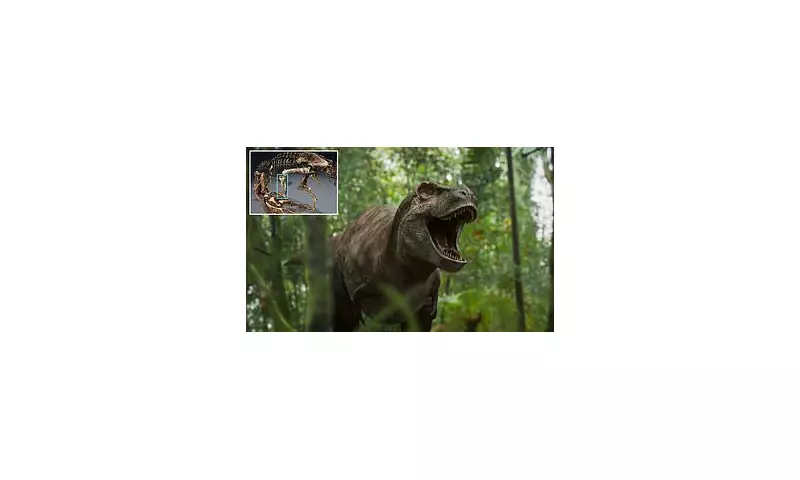
A revolutionary scientific study has fundamentally altered our understanding of the Tyrannosaurus rex, showing these iconic predators grew far more slowly and lived much longer than previously believed.
New Methods Uncover Hidden History in Bone
The research, conducted by three US-based scientists, involved a meticulous re-examination of fossilised leg bones from 17 tyrannosaur specimens. These fossils, including famous dinosaurs nicknamed 'Jane' and 'Petey', were mostly sourced from museums in Montana and North Dakota.
To unlock their secrets, researchers sliced the bones and polished the sections until they were translucent. They then examined them under a polarising light microscope, a technique that uses special filters to create bright colours and sharp contrasts. This method revealed previously hidden growth rings with stunning clarity, similar to the annual rings found in trees.

Nathan Myhrvold, a mathematician from the Oklahoma State University Center for Health Sciences and study co-author, explained the challenge: "Interpreting multiple closely spaced growth marks is tricky. We found strong evidence that the protocols typically used in growth studies may need to be revised."
A Four-Decade Journey to Adulthood
By counting every single mark and using advanced computer models to combine data, the team constructed a new, more accurate growth curve. The most reliable model showed a dramatic shift in the T. rex lifespan timeline.
Previously, experts believed T. rex stopped growing by around age 25. This new study, published in the journal PeerJ, concludes they did not reach their full, massive adult size until approximately age 40. This indicates the oldest individuals likely lived well beyond their 40s.
The growth pattern was not uniform. The dinosaurs experienced a rapid growth spurt between ages 14 and 29, potentially gaining an astonishing 800 to 1,200 pounds per year. After this, they entered a prolonged 'subadult' stage, slowly adding size and weight for another 10 to 15 years before final maturity.
Ecological Implications and Lingering Questions
This extended adolescence may have been key to the species' success. Jack Horner of Chapman University, another co-author, suggested: "A four-decade growth phase may have allowed younger tyrannosaurs to fill a variety of ecological roles within their environments." Younger, smaller T. rex could have hunted different prey, possibly aiding their rise as apex predators in the Cretaceous Period.
The research also raised intriguing questions. The unusual growth patterns in the smaller 'Jane' and 'Petey' specimens suggest they might belong to a different species, such as the proposed 'Nanotyrannus'. Furthermore, the study examined fossils from the broader 'Tyrannosaurus rex species complex,' meaning the new timeline might represent an average across slightly different species or subspecies.
Ultimately, this groundbreaking work rewrites the life story of one of history's most formidable creatures, painting a picture of a dinosaur that matured steadily over decades, enjoying a long and powerful reign.






