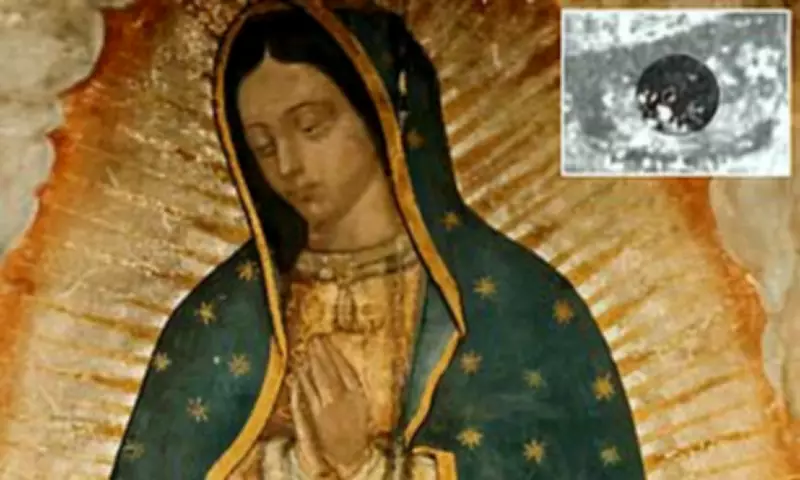
In a stunning revelation that challenges conventional understanding, scientists examining one of the world's most revered religious artifacts have uncovered a mysterious detail hidden within the eye of the Virgin Mary's image. The Tilma of Guadalupe, a cactus-fiber cloak believed by Christians to bear a miraculous depiction of the Virgin Mary, has long been a subject of fascination and devotion. Now, researchers claim to have discovered at least 13 minuscule human figures embedded within the eye's reflection, visible only through advanced digital enlargement techniques.
The Discovery of Hidden Witnesses
After digitally processing high-resolution images of the tilma, investigators reported that these tiny reflections bear a striking resemblance to witnesses who were allegedly present when the artifact was first revealed in the 16th century. The figures are so small that they cannot be seen with the naked eye, yet their presence has ignited intense debate among scientists and believers alike. According to a recent report titled 'Miraculous Image of Our Lady of Guadalupe,' published by St Michael the Archangel Catholic Church in Texas, these findings summarize various historical examinations conducted over centuries, adding to the artifact's enigmatic legacy.
Scientific Analysis and Unexplained Phenomena
Scientists have been analyzing the Tilma of Guadalupe for decades, with studies dating back to 1751. Despite extensive investigations, researchers have consistently noted that the image defies scientific explanation. In 1936, Nobel Prize-winning chemist Richard Kuhn examined a fiber sample and found that the pigments did not match any known colorants from plants, animals, or minerals. Later, in 1979, biophysicist Philip Serna Callahan and art specialist Jody B Smith used infrared photography to capture high-resolution scans, revealing that large portions of the image appear unusually uniform, without the layering patterns typical of traditional paintings.

Their analysis showed that the pigments interact differently with light than conventional paints, producing subtle brightness shifts depending on the viewing angle. The team concluded that the technique used to create the image could not be easily explained using standard 16th-century painting methods. Furthermore, sections of the face, hands, robe, and mantle appear to have been applied in a single step, with no visible brush strokes, sketches, or corrections.
The Artifact's Remarkable Durability
Made from coarse maguey cactus fibers, a material that normally decays within a few decades, the tilma has survived for nearly five centuries without significant deterioration. Measuring roughly five feet by three feet, the cloak consists of two pieces sewn together by a simple seam through the center of the image. Despite centuries of exposure to candle smoke, humidity, dust, and handling by pilgrims, the fabric has remained intact and resistant to insects and dust. The colors have retained their brightness even without protective coverings, unlike 18th-century replicas that deteriorated within decades.
Skepticism and Ongoing Debate
While many hail the tilma as a miracle, with some online users calling it 'the second greatest relic in history,' skeptics urge caution. Critics argue that the hidden figures could result from visual interpretation or image processing artifacts rather than intentional details. One user on X suggested that 16th-century artists understood how images distort on curved surfaces, potentially explaining the reflections. However, believers point to the lack of scientific explanations as evidence of divine intervention, with one commenter noting, 'Science keeps confirming what faith already knew.'
Regardless of perspective, the tilma continues to attract intense scrutiny from both researchers and the faithful. Its origins trace back to Juan Diego, a 16th-century Indigenous convert who reported seeing the Virgin Mary near Mexico City in 1531. According to tradition, the image suddenly appeared on his cloak when presented to Juan de Zumárraga, stunning witnesses and cementing its status as a cherished religious artifact in the Americas. As investigations persist, the Tilma of Guadalupe remains a profound mystery at the intersection of science and spirituality.