Chimpanzee's Musical Drumming Reveals Origins of Human Music Evolution
Scientists have documented an unprecedented musical performance by a chimpanzee at Japan's Kyoto University, providing groundbreaking insights into how music may have first emerged among early humans. The discovery marks a significant milestone in understanding the evolutionary roots of musical expression.
Primate Removes Floorboards for Drumming Performance
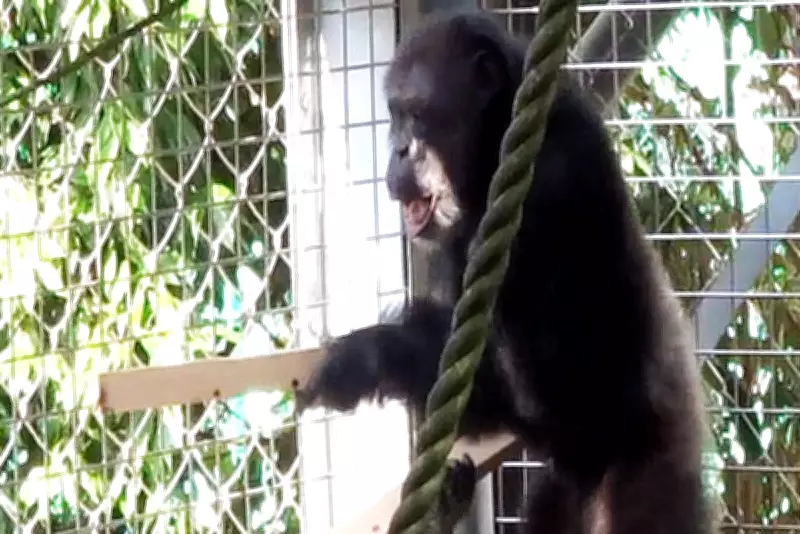
Ayumu, a 26-year-old male chimpanzee, was observed systematically removing floorboards from a walkway and using them as tools to create rhythmic drumming sounds while simultaneously vocalising. This behaviour represents the first documented instance of a chimpanzee exhibiting coordinated rhythmic vocal expressions alongside instrumental performance.
Researchers documented nearly 90 spontaneous performances by Ayumu between February 2023 and March 2025. The study, published in the journal Annals of the New York Academy of Sciences, reveals that while chimpanzees have been previously observed drumming with sticks and other objects, this is the first time the primate has been seen combining tool use with vocal displays in this manner.

Externalising Emotional Expression Through Tools
"It was fascinating for me to see how the chimpanzee used tools to produce various sounds, while also expressing a vocal display," said study first author Yuko Hattori. The observation supports the theory that music, particularly instrumental performance, evolved as a result of externalising emotional expression through vocalisation combined with tool use.
Since ancient percussion instruments were typically made from perishable materials like wood and animal skins, tracing their origins directly through archaeological evidence has proven challenging. This observation of musical behaviour in our primate relatives offers a crucial key to understanding the evolution of musicality that has previously eluded researchers.
Analysing Rhythmic Patterns and Emotional Expression
The comprehensive study examined how vocal expression in the chimpanzee might have transitioned into instrumental sound. Scientists employed a meticulous methodology:
- Assessing Ayumu's behaviour and breaking it down into specific elements including striking, dragging, and throwing
- Evaluating connections between these elements to determine which transitions occurred by chance versus deliberate action
- Analysing intervals between strikes and comparing rhythmic stability of tool use with hand or foot drumming
- Observing the chimp's facial expressions, particularly the "play face" indicating positive emotions during performances
The research revealed that the sequence of sounds produced by the instruments was not random and that intervals between strikes maintained a constant tempo similar to a metronome. This confirmed that emotional expressions conveyed vocally by the chimpanzee were likely being externalised and developed into structured tool sounds.
Evolutionary Continuity Between Primates and Humans
The findings suggest that non-human primates may possess the previously unrecognised ability to externalise their emotions through instruments. "Our research highlights the evolutionary continuity between primate acoustic displays and the human capacity for music," scientists wrote in their study.
This discovery provides compelling evidence for the theory that human musicality developed gradually through evolutionary processes shared with our primate ancestors, rather than emerging suddenly as a uniquely human trait. The research opens new avenues for understanding how rhythm, tool use, and emotional expression converged to create the foundation for human musical traditions across cultures and millennia.