
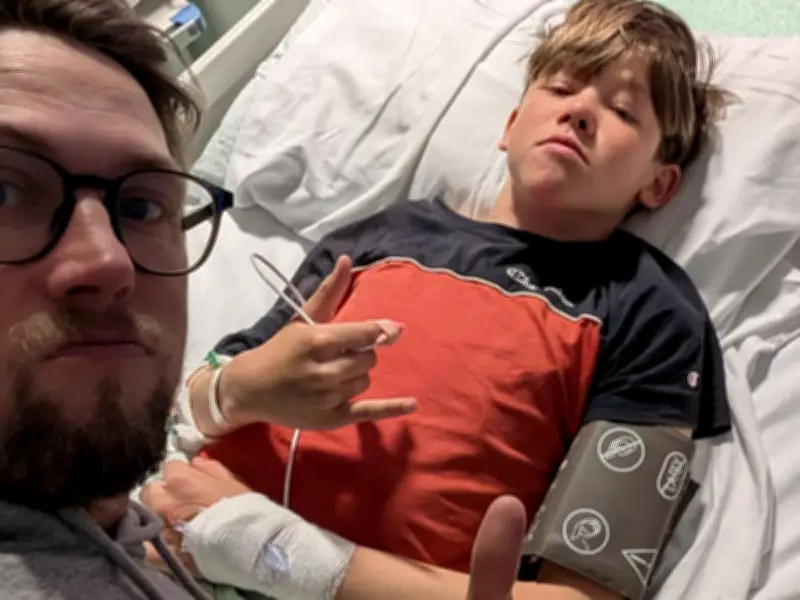
Ruben Shears, a 13-year-old from Cornwall, experienced a major stroke and 19 transient ischaemic attacks (TIAs) after falling on a trampoline. He required emergency surgery and spent weeks in hospital relearning basic movements.
Discovery and Emergency Response
Ruben, now 14, was found on his bathroom floor by his parents, Andy and Chantal Shears, a week after the trampoline accident on June 4, 2025. He was shaking, with the left side of his face drooping, unable to move his left side, and his speech was slurred. An ambulance rushed him to the Royal Cornwall Hospital in Truro, where a CT scan confirmed a stroke.
Medics identified a tear in his carotid artery, likely from high impact, which caused a blood clot. Ruben recalled hurting his neck during the trampoline fall. He then suffered nine mini-strokes in two hours before being transferred to Southmead Hospital in Bristol for specialist care.
Surgery and Recovery
Ruben was given blood thinners and blood pressure medication but suffered 10 more mini-strokes two days later. He underwent a four-and-a-half-hour thrombectomy to remove the clot and insert a two-inch stent in his damaged carotid artery. The main clot was 2.5 centimetres long, and seven smaller clots broke off during surgery, one requiring removal from his brain.
After the operation, Ruben had no movement on his left side. Two days later, his father felt Ruben's left hand squeeze his—an emotional milestone. Ruben spent five weeks at Bristol Royal Hospital for Children relearning how to move before returning home. He continues to struggle with tiredness and slightly slower speech.
Family's Perspective
Andy Shears, a carpenter, said: "We're so lucky he's alive. It was horrendous, and such a shock. We were an absolute wreck. We nearly lost him. It was like being brought to the edge of an abyss." He added: "It's absolutely amazing that he survived it. Doctors said a small blood vessel in his brain was feeding the right side from the left to keep him alive, they said that's a miracle."
Ruben's mini-strokes, or TIAs, were caused by bits of the clot breaking off and travelling to his brain. Around 400 children in the UK are diagnosed with a stroke each year, according to the Stroke Association. Warning signs include headaches, neck pain, and faintness.
Medical Details and Recovery
Ruben's major stroke resulted from carotid arterial dissection, where blood gets trapped between layers of a torn artery lining, forming a clot. A scan revealed that the blood vessel between the two halves of his brain was failing, and part of his brain was damaged. The thrombectomy involved inserting a camera and tiny tools through his femoral artery to remove clots and place the stent.
Ruben had to lie flat for ten days post-surgery, then completed five weeks of rehabilitation. He has full movement back but tires easily and cannot participate in sports as intensely as before. His father expressed gratitude: "We honestly can't thank the medical teams enough. This has really woken me up to how lucky we are to have the NHS."
Andy also shared: "I tore myself up with parent guilt—I've always pushed them to do sport. You think you're doing the right thing by them but you just never know what's going to happen. Ruben loves his sport and is very competitive. I think that competitive nature helped him with his recovery because he's good at setting goals for himself to meet."




