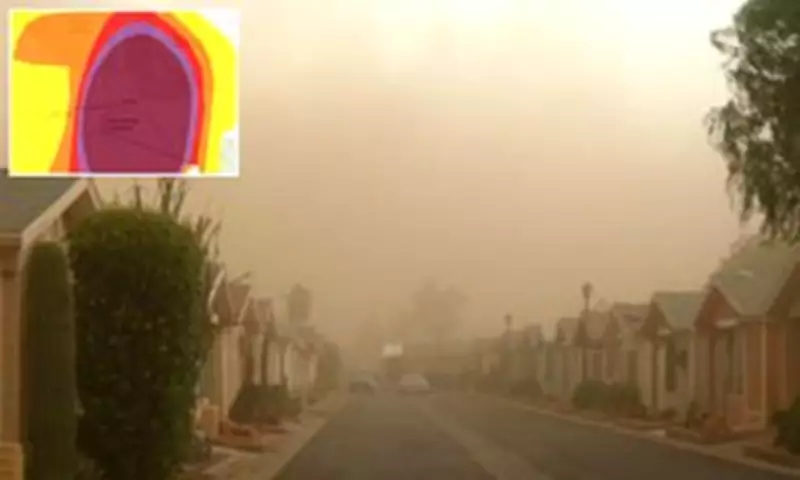
Nearly a million residents in the southwestern United States have been advised to keep windows shut and remain indoors as levels of airborne toxic particles surge on Monday morning. The US Environmental Protection Agency (EPA) reported that a vast plume of 'hazardous' air has enveloped an approximately 100-mile-wide stretch spanning California and Arizona, laden with dangerous fine particulate matter.
What Is Fine Particulate Matter?
Fine particulate matter consists of microscopic particles of toxic compounds or heavy metals, often emitted by factories and vehicle exhaust. These particles are small enough to penetrate deep into the lungs. In the Southwest, significant amounts of desert dust also contribute to this pollution.
Inhaling such pollution can cause inflammation, breathing difficulties, and other health issues. Days with severe hazardous air can worsen respiratory conditions like asthma and contribute to heart attacks and strokes, leading to premature death.

Affected Areas and Population
Approximately 400,000 people reside in the largest hazardous air zone, which includes Yuma, Arizona—home to over 220,000 Americans—and California's Imperial County, where about 180,000 people live along the US southern border. Additionally, the National Weather Service (NWS) has issued an air quality alert for California's Coachella Valley, where more than 400,000 people live in cities such as Indio, Palm Springs, Cathedral City, Palm Desert, La Quinta, and Coachella.
Cause of Hazardous Air
The hazardous conditions are driven by windblown dust across the region over the past few days, with gusts reaching 45 to 50 mph. The NWS warned: 'Everyone can be affected, but sensitive groups such as people with lung or heart disease, older adults, pregnant individuals, children, and those who spend a lot of time outdoors are at greater risk.'
This is a developing story. More details to follow. Over 220,000 people live in the areas of California and Arizona deemed 'hazardous' by the EPA on May 4, 2026. Dust and polluted air flowing through Yuma County in Arizona were captured in stock images.
Health and Travel Impacts
Melissa Zaremba from NBC News 11 added on Sunday that strong westerly winds would carry this unhealthy dust into the region through Monday morning, affecting both health and local travel. 'Wind Advisories and Air Quality alerts are issued for parts of Imperial County. Yuma County's highest gusts are around 30 MPH,' Zaremba said on social media.
Dust storms at the US-Mexico border are a common problem. The EPA warned that air quality levels in the region had deteriorated to 'hazardous' levels, the worst rating on its air quality measurement scale.
Particulate Matter Levels
Along with high levels of smaller particulate matter, known as PM2.5, the dust has also elevated levels of larger particles called PM10. PM10 consists of tiny solid particles or liquid droplets in the air, less than 10 micrometers in diameter—thinner than a human hair but noticeably larger than PM2.5.
While Yuma is at the center of the alert, the nearby city of Brawley, California, has seen air pollution levels skyrocket into extremely dangerous territory on Monday. According to air quality tracking website IQAir, at least one monitor recorded an air quality index of 1,365, fueled mostly by PM10 over the city of 28,000 people.
Typically, air quality levels are measured on a scale from 0 to 500: good (0–50) carries little risk, moderate (51–100) may affect sensitive individuals, unhealthy for sensitive groups (101–150) poses increased risk, and unhealthy (151–200) impacts everyone, limiting outdoor activity. A large zone in the Southwest has been affected by high winds carrying thick dust clouds.
Safety Recommendations
When outdoor air quality reaches the hazardous zone of 300 to 500 or beyond, the EPA advises everyone to avoid all physical activity outside. Along with the alert for the Coachella Valley, the NWS recommended that those in affected areas keep windows and doors closed, run air conditioners or air purifiers, and avoid using house fans or swamp coolers that draw in outside air.

'Avoid other sources of pollution such as fireplaces, candles, incense, grilling, and gasoline-powered lawn and garden equipment,' the NWS added in a statement. The alert in California is expected to last until 11:59 PM local time Monday night. Officials also advised carpooling or telecommuting if possible, reducing outdoor trips, or using public transportation.