
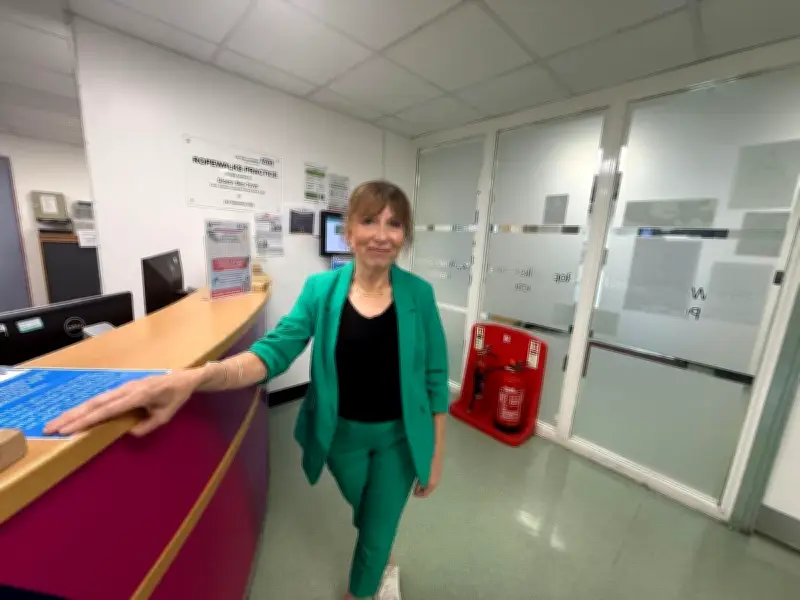
Dr Deborah Faint, a GP who has spent decades caring for Liverpool's homeless population, has shared her experiences of helping the most vulnerable people on the city's streets. Currently working at Brownlow Health, a network of NHS practices across Liverpool, Dr Faint's route into the profession came after leaving the University of Liverpool and studying to become a GP in Cheshire. After Dr Ed Gaynor set up Brownlow Health in 1994, Deborah was enlisted a year later to help run Brownlow's Pembroke Place site, where she cared for the city's homeless community and helped operate an outreach service at the Whitechapel Centre.
Deborah told the ECHO: "Initially, we were just working out of a little cupboard in the Whitechapel Centre and now we've got an outreach team that go into hostels, and an in-reach team that support patients who are admitted to hospital. We also have our weekly drop-in clinic where patients who otherwise couldn't access medical services can come to us without an appointment. It's a non-judgmental space where we support their medical needs."
Since starting at Brownlow over three decades ago, she has seen firsthand how the struggles of the city's homeless community have shifted. She said: "I think the complexity of the patients experiencing homelessness has massively increased over the years. The physical, social, mental health, addiction, that's definitely more complicated now than it was then." She added: "The nature of drug use has probably changed over the years. There's lots of heroin, crack, spice, the nature of the drugs changes the nature of the problem. Socially, I think social housing is more difficult to acquire now, there are more pressures on all of the systems. There's more pressures on the benefit system, so I don't think there's one single factor, there are lots of factors that play into the complexity."
Often meeting people in some of their most vulnerable moments, Deborah said "success" can be very difficult to measure. She said: "It depends what they want to achieve, so it depends what their goals are. I think we will try to work out what they actually want. It might be as simple as they can keep their dog with them in a hostel, that might be a massive achievement." She added: "It might be we can get them to take regular medication and find a way to support them with that even if they're living on the streets. It might be that we engage them with and support them around their alcohol and their drugs, link them with services like We Are With You, who are a local addiction service. The outcome depends on what their goal is. Obviously, the ultimate outcome is that they no longer experience homelessness and they're living a life that's fulfilling for them. And people can make amazing changes, they turn their lives around."
While success means different things for each patient, the work of Deborah and her team has not gone unnoticed over the years. She said: "I've had cards from people who've moved out of the city and years later will say 'actually, you made a difference'." She added: "I think it's just very reassuring, isn't it? It feels like you must be on the right track. You must be doing something right."
While she continues to help the homeless community firsthand, one of Deborah's major tasks has been helping the next generation of GPs follow in her footsteps. She said: "One of the messages I always try to get to my trainees is, when you see somebody who's in dire straits, there's always a story behind that." She added: "I think the work that we do with our more junior colleagues is vital. They might not be working in general practice, they might be seeing patients in A&E, or they might be seeing patients in another specialty. But again, they need to understand that what they're seeing is a whole background of events that, if they can just understand that, it can be the route to helping them, because they need to treat those people as individuals, they've got problems as much as anybody else."
Just two weeks ago, while she was going about her day, a letter in the post revealed that she had been awarded a Member of the Order of the British Empire (MBE) in King Charles' birthday honours. She said: "I found out a couple of weeks ago, but it came with a note saying you can't tell anybody. Holding that secret for a little while was really difficult. I was absolutely overwhelmed, shocked and surprised, that people would do that for me." However, she is not the first person in her family to be recognised with an MBE. Back in 2011, Deborah's sister, Susan McTaggart, who is the current chief executive for Merseyside's Police and Crime Commissioner, was awarded the same accolade for her services to policing. Deborah said: "My mum and dad brought us up to be kind to people, considerate, and really hard working. Both of us have got very strong work ethics and hopefully I have passed that on to my kids, Matthew, Edward, and Rachel."




