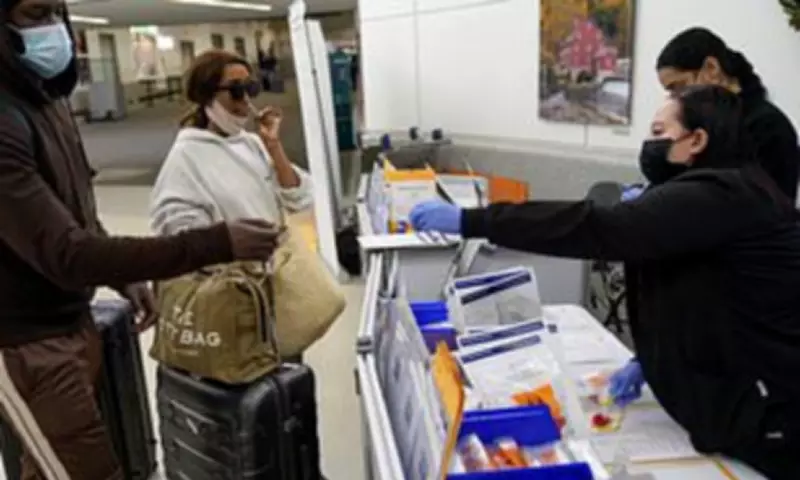
The Centers for Disease Control and Prevention announced on Friday that its voluntary travel bio surveillance initiative has now enrolled more than one million participants, representing what the agency calls a major advancement in America's border health security capabilities.
A Voluntary Programme for Early Threat Detection
The Traveler-Based Genomic Surveillance system, known as TGS, operates by collecting anonymous samples from international arrivals at selected United States airports. Launched in 2021, this programme specifically targets the early identification of communicable diseases, with particular emphasis on emerging variants of seasonal respiratory viruses and other pathogens that could pose public health risks.
In an official statement, the CDC emphasised that TGS "provides early insight into emerging pathogens and variants before they spread broadly within the United States." The programme's voluntary and anonymous nature has been crucial to its success, with over a million travellers now contributing to its expanding database.

Enhanced National Biosecurity
Health and Human Services Deputy Secretary and Acting CDC Director Jim O'Neill highlighted the programme's significance, stating: "The United States is the world's leading authority in public health. The broad participation of travelers enhances our ability to safeguard the nation using tools that are developed, operated, and governed here at home without reliance on unaccountable global bureaucracies."
The CDC's announcement reinforced this position, noting: "As President Trump has made clear, the United States will remain the global leader in public health by strengthening domestic capabilities, advancing health innovation, and ensuring rapid response to infectious disease threats. Programs like TGS reflect that commitment by enhancing national biosecurity."
How the Surveillance System Operates
Bio surveillance activities are currently taking place across eight major international airports located in:
- Seattle
- San Francisco
- Los Angeles
- Boston
- New York City
- Newark, New Jersey
- Washington, DC
- Miami
The programme employs multiple sampling methods across these locations:
- Nasal Swabs: Travellers voluntarily self-collect two nasal swab samples and complete a brief survey. These are then shipped to laboratories for testing against pathogens including influenza A, influenza B, RSV, and SARS-CoV-2.
- Wastewater Analysis: The CDC has examined more than 26,000 airplane wastewater samples as part of its surveillance efforts, collected either from individual aircraft lavatories or from central disposal points known as triturators.
Different airports employ different combinations of these methods. For instance, Seattle, Newark and Miami focus on nasal swabs, while San Francisco collects both triturator wastewater and nasal samples. Los Angeles specialises in airplane wastewater collection, Boston concentrates on triturator wastewater, Washington DC uses both nasal swabs and airplane wastewater, and New York City implements all three collection approaches.
From Detection to Detailed Analysis
The testing process involves multiple stages. Initial samples are screened for pathogens of public health concern. Positive samples then undergo further testing to identify specific virus strains, such as new variants of influenza or COVID-19. Selected samples are subsequently forwarded to the CDC for more comprehensive investigation into variants, strains and mutations.
Proven Effectiveness in Early Detection
The programme has already demonstrated its value in providing early warnings. The CDC cited one notable example where TGS detected the first two instances of influenza H3N2 subclade K – sometimes referred to as 'super flu' and responsible for severe illness this virus season – a full week before the next publicly reported sequence.
Previous reports generated through TGS surveillance have identified multiple new COVID-19 variants alongside novel influenza strains, showcasing the system's capacity to provide crucial advance notice to public health authorities.

This milestone achievement of one million participants represents a significant expansion of America's frontline defence against emerging health threats, creating what officials describe as an increasingly robust early warning system at the nation's borders.