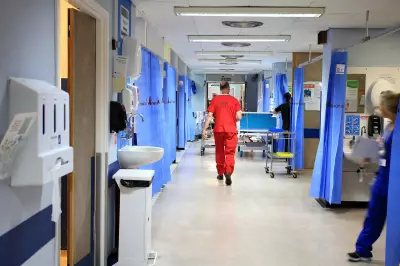
Health authorities at the centre of a devastating child death scandal have delivered what critics are calling a 'hollow' and 'meaningless' apology after years of persistent denials and alleged cover-ups. NHS Greater Glasgow and Clyde has finally acknowledged this week that contaminated water at Glasgow's flagship Queen Elizabeth University Hospital was the probable cause of serious infections in young cancer patients, marking a significant U-turn in a tragic saga that has spanned nearly a decade.
A Long-Awaited Admission
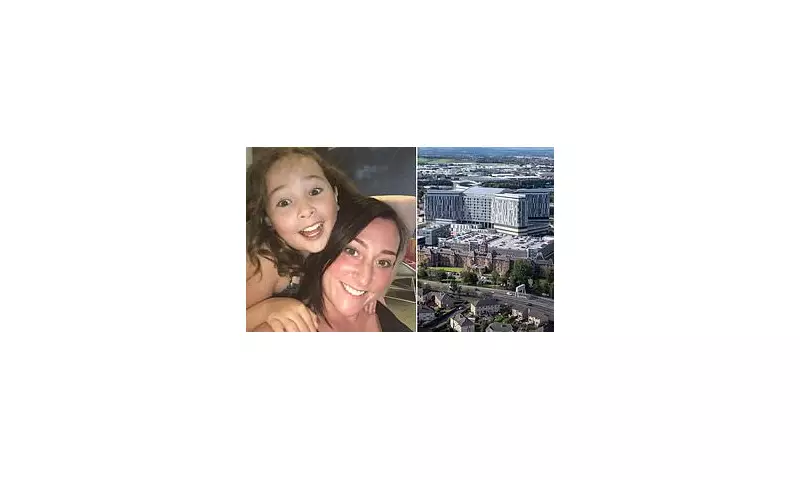
The health board followed its initial admission with what it described as a 'full and unreserved apology' while simultaneously claiming the £1 billion superhospital was 'not ready' when it opened to patients. This belated recognition comes after two children died and at least 84 fell seriously ill after contracting infections that health officials now accept were probably linked to the building's water system. The victims included ten-year-old Milly Main, who developed an unusual bacterial infection while receiving treatment for leukaemia in 2017.
Years of Denial and Delayed Accountability
Despite the children dying shortly after the hospital's controversial opening, health board officials maintained for years that the building itself was not to blame. The Scottish Hospitals Inquiry, which has been examining the design and construction of the QEUH since 2020, heard how prosecutors instructed police to launch a criminal investigation in 2021 looking specifically at four deaths - including Milly's, two other children, and 73-year-old Gail Armstrong. The health board was formally named as a suspect in this ongoing investigation during 2023.

In a final statement to the inquiry, the board's counsel Peter Gray KC stated: 'NHSGGC is the largest health board in Scotland, providing a vital public service to in excess of 1 million people. It has been clear from the evidence led that there have been significant failures on the part of NHSGGC. These failings are acknowledged and accepted.' He continued: 'It is a matter of profound regret that those NHSGGC cared for have experienced distress, anguish and suffering. NHSGGC offers a full and unreserved apology for the distress and trauma experienced by patients and families during this time.'
The 'Hollow' Nature of the Apology
However, Mr Gray proceeded to tell the hearing that the health board still refused to accept blame in any individual cases, stating: 'No evidence was led to demonstrate any link between the hospital environment and any individual patient.' This qualification prompted immediate condemnation from affected families and opposition politicians, who branded the apology as fundamentally insincere.
Louise Slorance, whose husband Andrew contracted a fatal fungal infection during cancer treatment at the hospital in 2020, responded with powerful criticism: 'These are hollow words. This was an apology retracted in minutes. It is meaningless when they do not accept the failures that led to so many deaths. The Scottish Government and Greater Glasgow and Clyde Health Board need to answer to the families.' Shockingly, it emerged that the board had spent £15,000 of public money to monitor Ms Slorance's social media activity after she discovered through reviewing her husband's medical notes that aspergillus had been deliberately concealed from her.
Political Pressure Mounts
The scandal has increasingly drawn in senior political figures, with pressure mounting for the investigation to include politicians who were in power during the hospital's problematic opening. The QEUH admitted its first patients just ten days before voters went to the polls in 2015, with Nicola Sturgeon serving as health secretary when she signed off the project and as First Minister when it opened. Then health secretary Shona Robison had publicly boasted about the 'state-of-the-art facilities' that would 'transform the care patients receive from their NHS.'

Scottish Tory health spokesman Dr Sandesh Gulhane stated: 'A hollow apology from a lawyer is too little too late when the health board spent years trying to cover up this huge scandal. But ultimately the buck stops with SNP ministers who cannot escape responsibility for their part in this shocking saga.' At Holyrood, Scottish Labour deputy leader Dame Jackie Baillie emphasised: 'When the Queen Elizabeth university hospital opened in 2015, Nicola Sturgeon was the First Minister, Shona Robison was the health secretary and John Swinney was the finance minister. Their fingerprints are all over this.'
Systemic Failures Exposed
In a written submission to the inquiry, NHSGGC claimed that design and construction failures meant the board 'did not receive the building it asked for or paid for,' with 'numerous issues' at handover and more than 200 contractors still on site when the hospital opened. The submission stated: 'Pressure was applied to open the hospital on time and on budget, and it is now clear that the hospital opened too early. It was not ready.' An 'obvious example' cited was faulty air filters being installed in a ward where vulnerable children with blood disorders and cancers were being treated.
The board acknowledged: 'Management, and the project board, failed to anticipate the challenges. They did not resource or manage the project properly. They ought to have done.' Despite these admissions, Mr Gray KC insisted at the inquiry that no NHSGGC staff member had put personal or board interests before patient safety, that there had been no 'cover-up,' and that the QEUH was now 'safe.' Inquiry chair Lord Brodie indicated he would need to be satisfied that both the 'culture' and the building were safe before reaching such a conclusion.
Ministerial Accountability Questioned
Senior counsel to the inquiry Craig Connal KC suggested that while he hadn't used the term 'cover-up,' he believed 'statements were made which were not accurate and known to be not accurate.' He also noted that NHSGGC appeared unwilling to criticise specific individuals, maintaining that people 'were just doing their best in good faith' and that 'nobody can be blamed for anything.' Mr Connal submitted that this position was 'close to being untenable.'
In a particularly damning assessment, Mr Connal branded SNP ministers as 'unrealistic' for claiming that guidelines on good governance were sufficient to prevent future tragedies. Ministers had submitted in writing that ten principles for NHS boards to follow represented 'a solid foundation for the adequate and effective oversight of large-scale infrastructure projects.' Mr Connal responded: 'Frankly, we disagree. The creation of principles of a general, non-obligatory nature of this kind, we suggest will not do what is being suggested to ensure effective oversight in an adequate fashion of major infrastructure projects. That is an unrealistic submission.'
He further observed that ministers appeared 'quite keen to stay hands off' when dealing with NHS boards, despite being viewed as 'ultimately responsible' by the voting public. Health Secretary Neil Gray repeatedly declined to discuss the health board's admission at Holyrood, stating it would be 'completely inappropriate' to comment on matters subject to both a live public inquiry and an ongoing Crown Office investigation.
Scottish Liberal Democrat leader Alex Cole-Hamilton summarised the widespread frustration: 'The scale of failings at the health board are truly appalling, and for many this apology will come as too little, too late. There are still so many questions. Families deserve answers.' As the corporate homicide probe into four deaths at the QEUH continues, with NHSGGC formally named as a suspect, the search for genuine accountability in this heartbreaking scandal appears far from over.