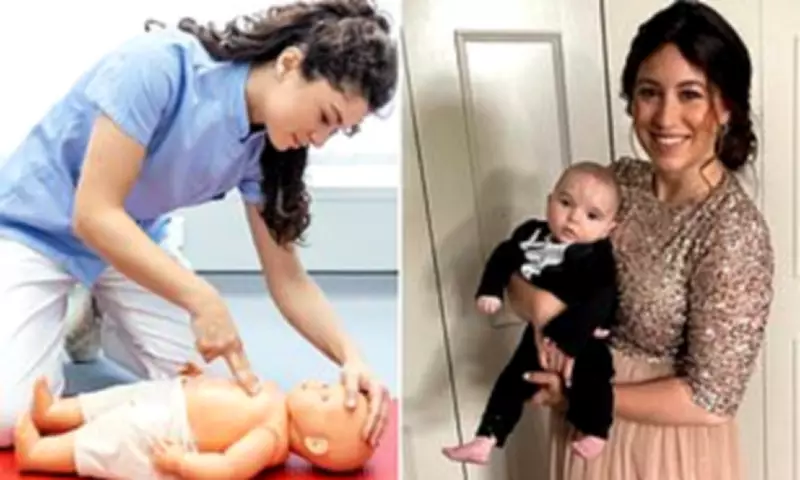
When Jess Goldberg completed a community first-aid course several years ago, she left feeling completely overwhelmed by the information. As a 36-year-old maths teacher and mother of four, she had enrolled thinking it was a responsible step, but doubted her ability to recall the techniques in a real emergency.
'There was so much going on: visual aids, practising on mannequins – I felt completely overwhelmed,' she recalls. 'I thought: "How could I ever do this in real life or even remember what to do?"'
A Terrifying Real-Life Test
In June 2021, six years after taking that course, Jess faced the ultimate test. She discovered her then five-month-old son, Ori, blue and lifeless in his cot at their Manchester home.

'All the children were in bed and my husband was out,' says Jess, who lives with her husband Rafi, 39, an optician, and their three older children, aged seven to 14. 'I'd decided to have a shower and went into our room where Ori was sleeping, when I heard him making a strange sound. I picked him up and was shocked to see how blue he looked. He wasn't breathing.'
Instinct Takes Over
In that terrifying moment, Jess says she went on autopilot. She instinctively began performing cardiopulmonary resuscitation while calling emergency services.
'I grabbed my phone to call the emergency services, while continuing CPR,' she remembers. 'The fear was all-consuming – but somehow, I just kept doing what I had to do. I remembered from the class that I had to do a ratio of two breaths for every 30 compressions, so that's what I did until help arrived about seven minutes later – by which time, thankfully, Ori was breathing.'
Doctors later confirmed that Jess's actions had saved her son's life. 'Once Ori was stable in hospital and I could take it all in, I couldn't get over the fact the training from years earlier had stayed with me,' she says.
The Critical Importance of CPR Knowledge
In a cardiac arrest – where the heart stops pumping blood around the body – CPR is vital for any chance of survival, buying crucial time until either a defibrillator is used or medical professionals arrive.
'The brain needs oxygen to survive – when you give CPR the aim is to try to keep blood flowing and, therefore, oxygen going to the brain,' explains Dr Ian Higginson, president of the Royal College of Emergency Medicine.
Yet research by St John Ambulance reveals only 43 per cent of people know how to give CPR. This is particularly concerning given that 30,000 cardiac arrests occur outside hospitals annually, with fewer than 7.8 per cent surviving to 30 days according to a 2018 Warwick University study.
Rapid Response Saves Lives
'A person's chance of survival decreases by 10 per cent per minute once they're in cardiac arrest,' explains Richard Lee, a spokesman for the Royal College of Paramedics. 'And with 80 per cent of cardiac arrests happening in the home, it is vital that you know how to start CPR immediately if a patient is unresponsive and has stopped breathing.'
With British Heart Foundation data showing average ambulance-response times for heart attacks and strokes reached 47 minutes in 2024, knowing how to perform CPR could be genuinely lifesaving.
'Fast action from a bystander can double a person's chances of survival,' adds Adam Benson-Clarke of Resuscitation Council UK, which promotes CPR awareness among the public. However, the council's research shows only a third of Britons would attempt CPR on someone who stopped breathing.
The Tragic Reality Without Intervention
Doctors in emergency medicine witness the devastating consequences when bystanders lack CPR knowledge.
'We get patients in A&E when it's too late, having suffered too much heart or brain damage,' says Professor Rob Galloway, a consultant in emergency medicine at University Hospitals Sussex NHS Foundation Trust. 'Bystanders make the difference between living and dying. I remember someone who had a cardiac arrest during an amateur football game. No one knew what to do. By the time he reached A&E, he was too unwell and died. Had he had CPR early, he would have survived.'

A Devastating Diagnosis
Following the initial incident, Jess and Rafi were mistakenly told that Ori had stopped breathing due to a reflux problem. After five days of tests to rule out infection or damage, Ori was allowed home.
'Straight after we got home, I messaged the man who had run the community first-aid course years before to tell him how his sessions had saved Ori,' Jess says.
But two weeks later, Ori stopped breathing again. This time, further tests revealed a devastating diagnosis: pulmonary hypertension, high blood pressure affecting the lungs resulting from blood vessels not opening properly after birth.
After the diagnosis, Jess remained in hospital with her son for six months as he was so unwell. Over the next few years, Ori's condition was managed with different medication and oxygen, but the family were warned he would ultimately need a double lung transplant. Sadly, Ori became too ill for a transplant and died in April last year, aged four.
Precious Time Gained Through Preparedness
Despite her crushing grief, Jess reflects on how CPR gave the family precious years with their son.
'Ori was such a lovely little boy, he had so much personality,' she says. 'We all miss him desperately, but we would have only had five months with him had it not been for that first-aid course.'
Jess's skills helped others too. After explaining basic first aid to a friend during their children's swimming lesson, she received a message saying that friend had successfully helped her son who was choking on a lollipop.
A Call for Widespread Training
Professor Galloway emphasises the need for CPR training to become widespread across society.
'The training should be in schools, sports clubs, community centres, workplaces,' he says. 'In fact, as part of getting a driving licence you should have to know how to do CPR. The cost is tiny, compared to the huge cost of emergency care, long-term disabilities and the possibility of losing a life.'
Jess is determined that some good should come from her family's loss. 'I feel so strongly that everyone should know first aid, including CPR,' she says. 'There should be posters on the walls in restaurants showing people what to do if someone is choking. You never know when it might save a life.'
As well as in-person first-aid courses, organisations including the British Red Cross, British Heart Foundation and Resuscitation Council UK offer CPR training online, making these vital skills more accessible than ever before.