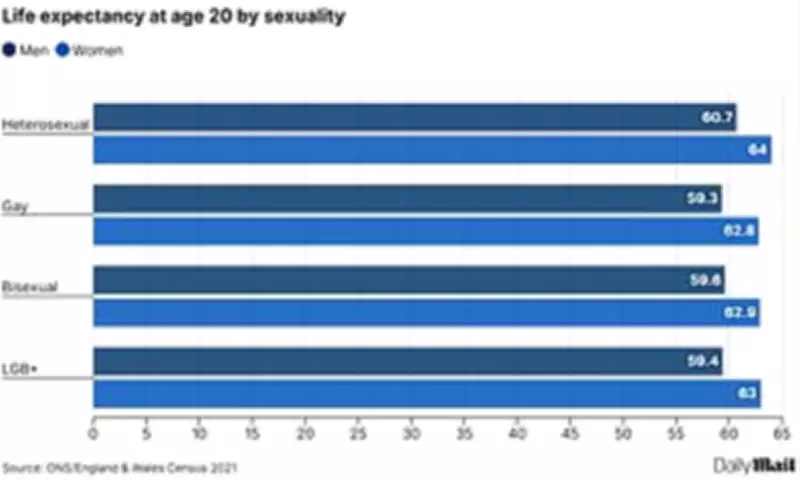
Official statistics have revealed a significant disparity in life expectancy between Britons who identify as lesbian, gay, or bisexual (LGB+) and those who identify as straight or heterosexual. The Office for National Statistics (ONS) conducted a pioneering analysis by linking responses from the 2021 census with death registration records to estimate life expectancy based on sexual orientation for the first time.
Key Findings from the ONS Analysis
The comprehensive study uncovered notable differences in projected lifespans. For men aged 20 in England and Wales, those identifying as LGB+ can expect to live an average of an additional 59.4 years. In stark contrast, heterosexual men of the same age are likely to live for 60.7 more years – a difference exceeding twelve months.
Gender-Specific Disparities
Women identifying with an LGB+ orientation also face a reduced life expectancy compared to their heterosexual counterparts. The analysis indicates that a 20-year-old LGB+ woman can anticipate living approximately 63.0 more years, whereas a heterosexual woman of the same age is projected to live 64.0 additional years.

Breakdown by Specific Orientations
Delving deeper into the data reveals more granular insights. Men identifying as gay or lesbian have a life expectancy of 59.3 additional years, while women in this category can expect 62.8 more years. Both figures are lower than the heterosexual benchmarks of 60.7 years for men and 64.0 years for women.
For those identifying as bisexual, the estimates show 59.6 additional years for men and 62.9 years for women. Once again, these numbers fall short of the life expectancy figures for individuals identifying as straight.
Methodology and Limitations
The groundbreaking analysis utilised voluntary responses to the sexual orientation question included in the 2021 census, which was directed at individuals aged 16 and over. Consequently, life expectancy estimates commence from age 20. The ONS emphasised that its findings are based on substantial sample sizes with consistent patterns across various age groups, aligning with previous research in this area.
However, statisticians caution that the analysis cannot definitively establish whether sexual orientation itself acts as a contributing risk factor for shorter life expectancy. Greg Ceely, ONS Head of Population Life Events, clarified: 'Life expectancy can be impacted by a range of factors, so we can't tell from this analysis whether sexual orientation is the driver of the difference seen.'
Important Interpretative Notes
The ONS stressed that the data should be interpreted strictly as reflecting how individuals responded to the census question, rather than necessarily indicating their actual attractions or relationship dynamics. The analysis deliberately avoids making assumptions about sexual relationships, behaviours, or the public versus private nature of someone's sexual orientation disclosure.
This landmark study marks the first occasion that the ONS has estimated life expectancy according to sexual orientation, providing crucial data that could inform future public health strategies and social policies aimed at addressing health inequalities across different demographic groups in the United Kingdom.