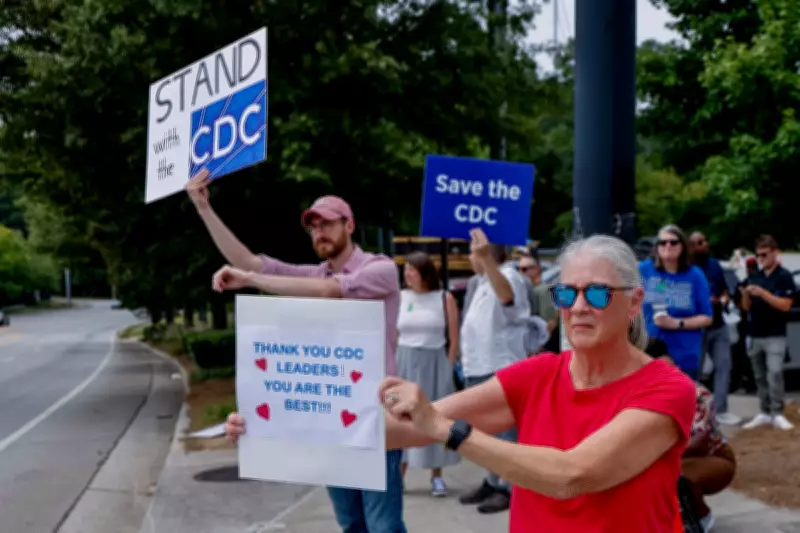
Fired CDC Workers Unite to Combat Trump's War on Science
In a striking display of resilience, current and former employees of the US Centers for Disease Control and Prevention, along with supporters, gathered outside the CDC headquarters in Atlanta, Georgia, on 28 August 2025. They were there to greet recently resigned leaders Daniel Jernigan, Debra Houry, and Demetre Daskalakis, symbolising a broader movement against the administration's cuts.
From Dream Job to Dismissal: Abby Tighe's Story
Abby Tighe believed she had secured her lifelong career when she joined the CDC in December 2023. Managing a national youth substance abuse prevention program focused on rural communities, Tighe, with family roots in Appalachia, felt proud to serve overlooked areas. "The CDC was different than anywhere else I've worked," she recalls. "People cared deeply about the mission over personal ambitions. It was always my dream to work there."
That dream shattered on 14 February of the following year, when Tighe received a form email informing her of her termination by the Trump administration. As a probationary worker, she was among the first casualties in a sweeping downsizing that has since affected over 4,000 CDC employees—approximately one-third of the agency's workforce.

Birth of the National Public Health Coalition
In response to their firings, Tighe and colleagues initially formed Fired But Fighting, a mutual aid network. However, as the administration, led by US Health Secretary Robert F Kennedy, transformed the CDC into an unrecognisable entity, they pivoted. "We saw there was a need for an organization that stands in the gap," explains Aryn Backus, a former health communication specialist fired on the same day as Tighe.
Last October, the group rebranded as the National Public Health Coalition, adopting a less confrontational name advised by Jerome Adams, Donald Trump's former surgeon general. Adams warned that the term "fighting" might alienate Republicans, highlighting the coalition's aim for nonpartisan, evidence-based advocacy.
Applying CDC Skills to New Advocacy
The coalition's members, uncertain if they will regain their jobs, now apply their expertise in novel ways:
- Data scientists run the CDC Data Project, tracking budget and staffing cuts impacting areas from cancer research to disease outbreaks.
- Communications experts lobby Capitol Hill, explaining how programs like Alzheimer's research are being dismantled.
- Former press officers alert media to real-world effects, such as the elimination of childhood lead prevention programs during crises.
"It felt like a CDC response," Tighe notes, describing their "ghost structure" for operations. This effort is part of a larger "shadow CDC" involving medical associations and academic institutions filling the void left by federal retreats.
Building a Foundation for the Future
With about 100 regular volunteers, the coalition focuses on long-term goals beyond job recovery. "We want to drive forward the rebuilding of trust, the reimagining of this system," says Backus. "It's going to be a decades-long thing, but we have to start building a foundation now."
Marie, a former health scientist fired in a mass reduction, exemplifies this shift. She now leads data analytics for the coalition, translating complex budget cuts into public-friendly visuals. "The administration can say they're prioritizing chronic disease, but you can see in the budget they're cutting all those programs," she explains, emphasising the need to counter misinformation.
The Shadow CDC and Public Trust
As the Trump administration issues health recommendations many deem misinformation, groups like Yale's PopHive and state agencies bolster the "shadow CDC." Jerome Adams observes, "We're in a moment where authority for health policy is pushed down to the local level. It breaks my heart, but groups like this coalition are imperative for trust."

Yet, Tighe acknowledges limitations: "An organization is not a government. We can't represent the US at the WHO or fund health departments." Instead, the coalition aims to help rebuild a stronger, non-partisan public health system, whether called the CDC or otherwise.
Reflecting on their journey, many members doubt they would return to their old jobs even if reinstated. "Not in the current circumstances," Backus admits. "Maybe in a few years, after we've worked to build something stronger—something better for everyone."