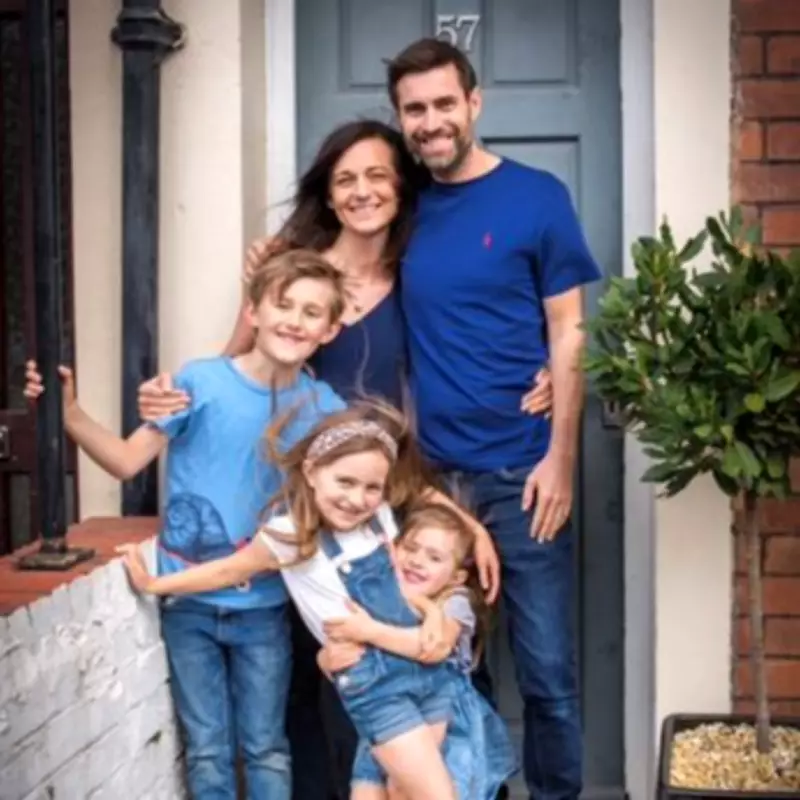
A seemingly healthy father's shoulder pain turned out to be a devastating sign of advanced bowel cancer, leading to his death just eleven months after diagnosis. This tragic story highlights how the disease can strike without warning symptoms and the crucial support needed for families facing terminal illness.
From Tennis Injury to Terminal Diagnosis
Rich Baillie, a 41-year-old father of three from Bristol, initially visited his doctor about shoulder pain he believed resulted from playing tennis. The physician suggested a pulled muscle, but as the discomfort intensified and spread to his side, Rich returned for further examination in January 2020.
"My husband was the most tremendous man ever in the world," said his widow Louisa Baillie, 43. "He was super healthy, fit and active with no blood in his stools or other typical bowel cancer warnings."

Earth-Shattering News
During that January appointment, Rich reported new symptoms including blood in his stool. Placed on a two-week cancer pathway, scans revealed stage four bowel cancer that had metastasized to his liver. The enlarged liver was pressing against his diaphragm, causing the shoulder pain that initially seemed like a sports injury.
"The oncologist said, 'You have stage four bowel cancer. There is nothing we can do. This is terminal,'" Louisa recalled. "It was like a total nuclear bomb had gone off in our life."
Navigating Treatment During Pandemic Isolation
Rich underwent six rounds of chemotherapy over several months, often attending appointments alone as COVID-19 restrictions limited family presence. The treatment concluded in July 2020, with doctors recommending a summer break before October scans.
"It was so isolating," Louisa explained. "Wherever I looked, there was nobody like us. There was nobody that could appreciate or even begin to imagine what we were facing."
Finding Specialized Support
Feeling dismissed by conventional medical support systems and traditional cancer charities, the family discovered the Ruth Strauss Foundation. Established by former England cricket captain Sir Andrew Strauss in memory of his wife who died from non-smoking lung cancer, the charity focuses on emotional support for families preparing for a parent's death.
"I called lots of charities when Rich was poorly and they said, 'You have to call us when he's died,' which is a horrific thing to hear," Louisa revealed. The Ruth Strauss Foundation responded within an hour of her contact, offering immediate practical and emotional guidance.
Preparing Children for Loss
The foundation provided specialized resources to help the couple have difficult conversations with their children, then aged 4, 6 and 8. They received booklets for Rich to complete with the children and guidance on age-appropriate honesty about terminal illness.
"When a child has a parent that is terminally ill, my view is to be as open and as honest with them as possible," Louisa emphasized. "I never wanted the children to afterwards say, 'Why didn't you tell us?'"
Louisa began documenting everything the children did for their father, from fetching water to helping with compression socks, creating precious memories during his final months.
Rich's Final Peace
"For Rich, we were his absolute world, and the one thing that broke his heart was that he was going to leave us," Louisa shared. "Him knowing that we had that support from the charity allowed him to think, 'It's okay, we've done right by the kids.'"
Rich died in November 2020, just eleven months after his diagnosis. The foundation continued supporting the family through bereavement, becoming what Louisa describes as "one of a kind" in their understanding of family needs during terminal illness.
Transforming Grief into Purpose
Five years later, Louisa has channeled her experience into professional development, completing a Masters in psychology and neuroscience to research childhood grief. She now works as a child therapist in schools, while advocating for the foundation's Schools Programme that trains educators to support students facing anticipatory grief.
"I haven't ever stopped talking to them," Louisa said of the charity. "I'm just so eternally grateful for filling that huge gap for us as a family."

Expert Perspective on Family Support
Deepa Doshi, Director of Client Services at the Ruth Strauss Foundation, explained their approach: "We know 'doing death well,' giving families the chance to have open conversations about grief, death and dying, has a hugely positive impact on childhood and later life."
"They will be some of the toughest conversations a family ever has but also the most important, and we are here to support that," Doshi added.
Lessons for Other Families
Louisa offers crucial advice to families facing similar situations: "Start these hard conversations as one family unit rather than leaving it for the sole parent to navigate from a standing start in the aftermath of death."
"The more you can go through it as a family and deal with it as a family, you feel like you come out the other side as a unit," she concluded. "Because you've done everything you can together that you possibly could."
This heartbreaking story underscores both the unpredictable nature of bowel cancer presentation and the transformative power of specialized family support during terminal illness. While Rich's cancer showed no typical early symptoms, his family's experience demonstrates how open communication and professional guidance can help families navigate even the most devastating circumstances together.