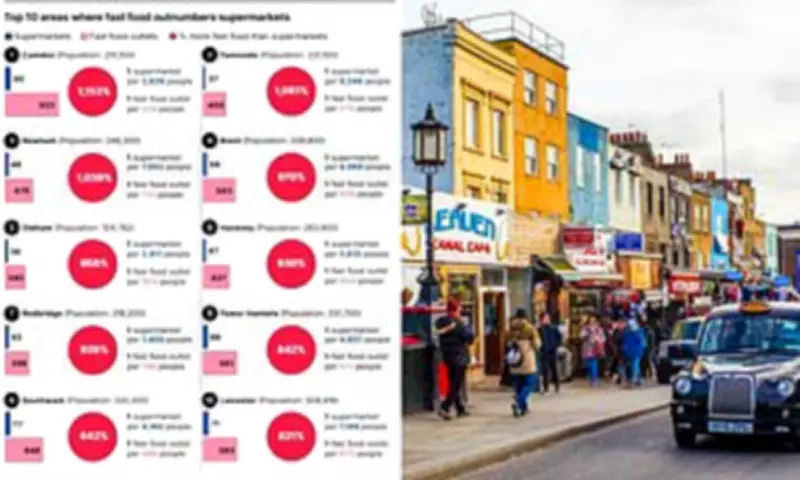
A new study has exposed the overwhelming dominance of fast food restaurants across Britain's high streets, revealing they outnumber supermarkets by a staggering 534 percent nationwide. This proliferation is directly fueling the country's obesity crisis, which costs the National Health Service an estimated £11 billion each year.
The Scale of the Problem
Latest data shows there are currently 49,254 takeaway and fast food establishments operating across the United Kingdom, representing an increase of more than two percent in just the last year alone. This comes as more than half of the UK population is classified as overweight or obese, with over one in five Britons admitting to consuming takeaways or ready meals more than three times weekly.
Regional Disparities Revealed
Analysis of government ONS data across 123 locations has identified areas with the most extreme imbalances between supermarkets and fast food outlets. Camden in north London tops this concerning list, with the study revealing a shocking 1,153 percent more takeaways than supermarkets in the borough.

This means Camden residents have access to just one supermarket per 2,626 people, while there is one takeaway available for every 228 individuals. Tameside in Greater Manchester ranks second with 1,081 percent more fast food outlets than supermarkets, where one supermarket serves 6,246 people compared to one takeaway per 578 residents.
Newham in London completes the top three with a 1,039 percent disparity, as one supermarket serves an average of 7,953 people while there is one takeaway for every 731 residents. Leicester also features in the top ten, with one fast food restaurant available per 873 people.
Public Attitudes and Behaviors
The survey conducted by MedExpress revealed troubling attitudes toward food choices among the British public. Some 47 percent of respondents admitted that health considerations were the least important factor when selecting what to order, while nearly one third cited convenience as their primary motivator.
Only three percent of people claimed they never consume takeaways, highlighting the widespread dependence on fast food options. Perhaps most concerning is that just 13 percent of Britons across all age groups reported cooking from scratch daily, meaning 87 percent rely on some form of pre-prepared, frozen, or fast food alternative.
Generational Cooking Skills Gap
The findings reveal a significant generational divide in cooking abilities. While 85 percent of over-55s can chop an onion without guidance, only half of 18-24-year-olds possess this basic culinary skill. However, the most confident skill among younger adults was using an air fryer, with 70 percent reporting proficiency with this modern appliance.
Health Consequences and Costs
Doctor Sophie Dix, head of medical affairs at MedExpress, expressed deep concern about the findings. She emphasized that regular consumption of fast food, typically high in calories, salt, sugar, and unhealthy fats, leads directly to weight gain and obesity.
This increases the risk of serious health conditions including type 2 diabetes, heart disease, and high blood pressure, all of which place significant strain on NHS resources. Beyond the direct £11 billion annual cost to the health service, wider societal costs from obesity-related ill health are estimated at £74.3 billion each year.
By specific health condition, heart failure proved the costliest per patient, ranging between £3,650 and £4,320 across different weight classes. This was followed by kidney disease, costing between £2,900 and nearly £4,200, and cardiovascular disease, coming in at approximately £2,700 to £3,500.
Child Obesity Statistics
New government figures highlight the scale of child obesity in the UK, with 10.5 percent of reception-age children and 22.2 percent of Year 6 pupils living with obesity. A third of 18-24-year-olds are also recorded as obese or overweight, indicating the crisis extends to future generations.
Calls for Action and Solutions
Doctor Dix believes the first step in addressing Britain's obesity crisis must be improving education and accessibility among young people. She stated that while convenience eating and modern cooking tools are now part of everyday life, the survey shows a hunger for practical cooking education.

Katharine Jenner, executive director of the Obesity Health Alliance, added that when unhealthy food is everywhere, people simply don't have a fair choice. She called for councils to have stronger powers to limit all fast food businesses, not just traditional takeaways, but also multinational chains and any outlet selling predominantly unhealthy food.
Government Response
A Department of Health and Social Care spokesperson outlined the government's comprehensive approach to tackling obesity as part of their 10 Year Health Plan. Measures include giving local authorities clearer powers to block new fast food outlets opening near schools, extending the soft drinks industry levy, restricting junk food advertising on TV and online, limiting volume price promotions on less healthy foods, and introducing mandatory reporting on sales of healthy food.
The spokesperson emphasized that creating a healthier nation will mean less pressure on the NHS, a stronger economy, and a happier society for all Britons.