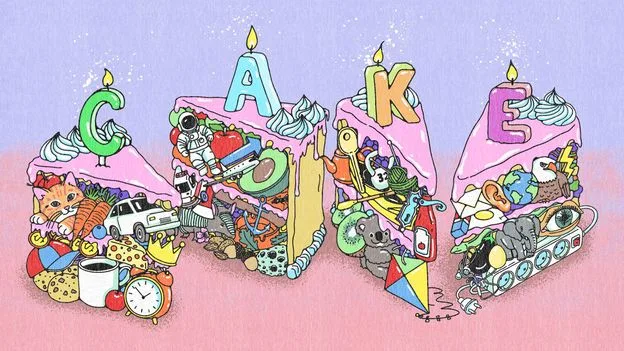
If you are an anxious over-thinker, lying in bed at night can be prime time for ruminating. Cognitive shuffling, a technique invented by an academic and popularised on social media, has long claimed to help people switch off their busy brains. The method involves thinking of a random, emotionally neutral word, such as 'cake', then taking the first letter and listing as many items as possible beginning with that letter, visualising each one. Once you run out, you move to the next letter.
It is not a guaranteed fast-track to sleep, but many users report success. Alanna Hare, a consultant in sleep medicine at Royal Brompton Hospital in London, says cognitive shuffling is 'super somnolent', deploying a push-and-pull mechanism on the mind – both pulling you towards sleep while quietening intrusive worries.
The technique, also known as 'serial diverse imagining', was developed over 15 years ago by Luc P Beaudoin, an adjunct professor at Simon Fraser University in Canada. It is based on his theory of 'somnolent information-processing', which argues that people with insomnia often dwell on perturbing thought patterns that keep the brain alert, and that these can be countered with neutral, random images.

Beaudoin says he developed the concept via 'a long process of guessing about the mechanisms underlying sleep onset' and 'trial and error on myself'. He identified a problem with existing imagery training – it was too slow. 'If people have an insistent worry, they would have difficulty focusing on a single image for a couple of minutes. Better to mix it up more quickly,' he says.
In 2016, Beaudoin and colleagues tested the technique in a study of 154 university students struggling to sleep. One group used an app voicing random words for them to visualise; another group journalled about worries. The image shuffling approach was 'just as effective' at improving sleepiness, with the added advantage of being doable in bed.
Cognitive shuffling works by diverting attention away from interfering thoughts, says Eleni Kavaliotis, a sleep researcher at Monash University. 'It attempts to mimic the scattered, disconnected and random thought patterns the brain naturally starts to generate as you fall asleep.' These natural patterns, called hypnagogic mentation, occur in the boundary between wakefulness and sleep – what Beaudoin calls 'micro-dreams'.