Breaking Down Barriers: The Off-Road Wheelchair Revolution
On a crisp October morning in New York's Mohonk Preserve, something remarkable was happening. Among the vibrant autumn foliage and peaceful forest trails, a group of adventurers were experiencing the wilderness in a way many had thought impossible. They were pioneering a new era of outdoor accessibility using revolutionary off-road wheelchairs.
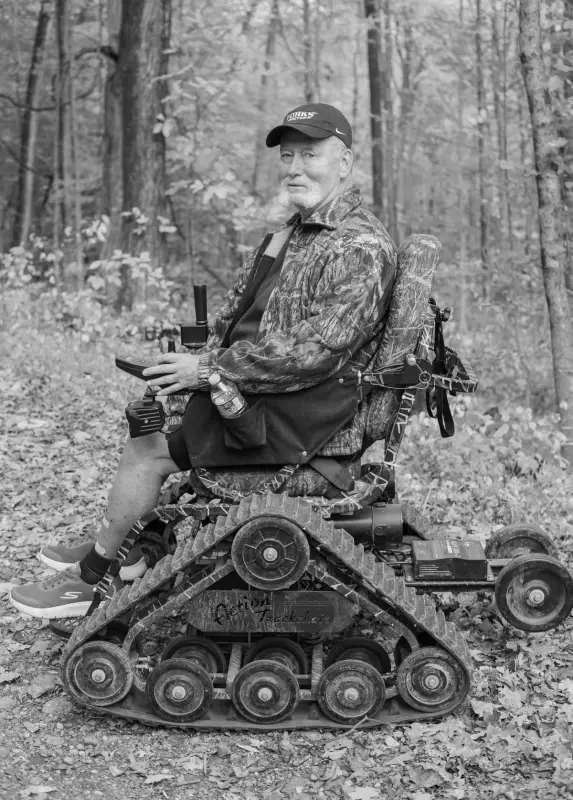
The scene featured Eddie Slick posing for portraits along densely forested trails, capturing a moment that symbolised triumph over physical limitations. These weren't ordinary wheelchairs but rugged, battery-powered machines capable of conquering rough terrain that would typically be inaccessible to those with mobility challenges.
From Despair to Mountain Trails
Among the participants was Gina Kothe, a 53-year-old Army veteran and former firefighter whose life changed dramatically in 2010. During a blaze in Kingston, New York, an aerial-ladder accident crushed her right foot. After months of struggling with failed treatments, doctors made the difficult decision to amputate.
"I had a slight addiction to painkillers," Kothe recalled of her subsequent depression. "I would shower every three or four days, and wear the same barbecue-stained T-shirt for two or three days in a row."
Her recovery began unexpectedly when her husband brought home baby chicks, forcing her to engage with life again. She credits outdoor activities with pulling her out of despair, and now participates in adaptive sports including rock climbing and bobsledding.
The Trackchair: Engineering Freedom
The motorised guided tour through Mohonk's 8,000-acre wilderness was organised by Soar Experiences, a non-profit specialising in adaptive outdoor recreation. The name stands for "Specialised Outdoor Adaptive Recreation" and represents a growing movement to make nature accessible to all.
The Trackchairs used in the excursion function as crossbreeds between wheelchairs and tanks. While their top speed reaches only 3mph, they steadily navigate rocks, tree roots, gravel, sand and mud that would stop conventional wheelchairs in their tracks.
Before embarking, participants received thorough training in the joystick-controlled chairs, practised manoeuvring through an obstacle course of orange traffic cones, and heard safety advice from experienced users like John Vacca, who lost his left leg below the knee to cancer.
The Vision Behind the Movement
Peter Gagliardo, adaptive sports coordinator for Helen Hayes hospital, understands the challenges intimately. Paralysed from the waist down after a 2006 motorcycle accident, he noted that "the wood doesn't care about ADA compliance" when it comes to natural obstacles.
About seven years ago, Gagliardo and a colleague approached Scott Trager, who operates an off-road driving school, about installing hand controls in one of their Jeeps. The experiment proved so successful that Trackchairs were soon added to the fleet, eventually leading to the creation of Soar Experiences.
Trager, a 63-year-old former Wall Street trader who describes himself as a "solutionist," finds his new career as a social entrepreneur deeply rewarding. "It makes me better understand that life can change in the blink of an eye," he reflected.
Life-Changing Moments in Nature
The emotional impact of these experiences became clear during an event at Green Lakes State Park, where Trager encountered a woman born with stunted limbs who had never felt sand before. When he scooped some into her hand, she began crying from the profound experience.
At Mohonk, the mood among participants was visibly joyful as sunlight filtered through the colourful canopy of oaks and maples. Stephen Fray, 61, who has ALS, exclaimed "I could get used to this" despite concerns about the equipment's substantial cost ranging from $13,000 to $27,000.
David Daw, a former stage manager who retired due to muscular dystrophy, described the experience as liberating: "I feel free. I don't feel sick when I'm out here." Daw now runs a popular Instagram account called Things My Wheelchair Saw, advocating for disability rights.
The Insurance Battle
Despite research showing that adaptive sports significantly benefit mental health—with data from the Centers for Disease Control indicating people with disabilities experience frequent mental health distress 4.6 times more often than those without—insurance coverage remains a major obstacle.
Gagliardo expressed frustration that insurers routinely refuse to cover adaptive equipment, even basic home modifications. "They will not pay to modify your bathroom," he stated angrily. "So that means when you're being discharged from the hospital, you need to put a ramp in yourself."
Daw recently fought his insurance company for 16 months to receive reimbursement for his motorised chair, facing repeated demands for specialist confirmations of his diagnosis. "They're hoping you give up," Daw worried. "Because most people give up. Some of them commit suicide. I almost did."
Kothe demonstrated the lengths to which people go to avoid insurance battles when she recently fell and reopened the scar on her residual limb. Rather than risk hospital doctors altering her $23,000 prosthesis with stitches that might affect its fit, she treated the significant wound herself with skin glue and antibiotic cream.
The Science Supporting Access
Research consistently demonstrates the value of nature engagement for wellbeing. A metanalysis in Healthcare journal found that "engagement in adaptive sports showed a positive impact on the mental quality of life among adults with physical disabilities."
The American Psychiatric Association cited a Japanese study showing that forest walkers had 12% lower stress hormone levels along with decreased blood pressure and heart rate, plus boosted immune function compared to urban walkers.
Dr Brooke A Slavens, director of the mobility laboratory at the University of Wisconsin-Milwaukee, explained that advanced equipment like lightweight carbon fiber wheelchairs—often denied as "not medically necessary"—actually prevent long-term injuries. She estimated that 90% of adult manual wheelchair users eventually develop shoulder problems that often require covered surgeries.
Looking Forward
Now that Soar has secured non-profit status, Trager hopes to attract philanthropic support to expand programmes that consistently have waiting lists. The organisation recently held 15 free public hikes primarily in New York and Connecticut parks.
"The more we started working with this particular demographic," said Trager, "the more we realise they are drastically underserved."
For participants like Eddie Slick, who drove two-and-a-half hours to reach Mohonk, the value is immeasurable. "If I had to stay indoors, I'd probably be gone," said the 73-year-old avid hunter and fisherman.
As Gagliardo observed at Soar's headquarters, the transformation in participants is visible and profound: "When you do get into an off-road Jeep or an off-road wheelchair, everybody's face just absolutely lights up. They're tackling something that everybody told them was impossible. That they told themselves was impossible. Until they come out here and realise—it's all possible."