
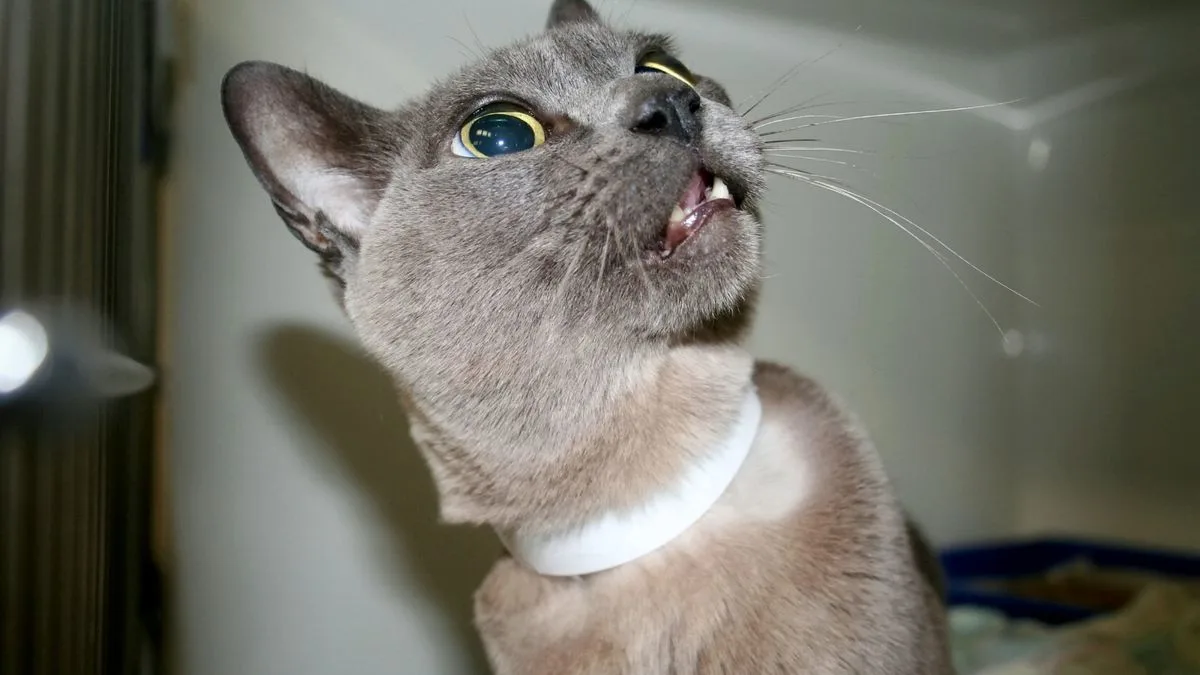
A cat's life was saved by an innovative operation that had previously only been performed on human heart patients. Ten-year-old Burmese feline Alan was fitted with a metal stent after being rushed to the vets with life-threatening breathing problems.
Veterinary surgeons reopened Alan's collapsed windpipe in a £4,000 operation that is regularly carried out on humans to open up blocked arteries. The pet was rushed from his home in Skipton, North Yorkshire, to surgeons at Dick White Referrals in Cambridge.
Alan was diagnosed with tracheal stenosis (narrowing), described by the vets as an uncommon condition. It left the cat barely able to get oxygen through his windpipe, which had narrowed to just 2mm in some sections.
Vets used interventional radiology (IR) to guide a mechanically woven stent made of a memory-metal alloy into the cat's windpipe. The nickel/titanium alloy can be formed into medically useful shapes for use in the body.
Jon Wray, who performed the procedure, said: 'The trickiest part, and the time of greatest jeopardy for Alan, was the moment that we had to pass the catheter through this very narrow gap in his windpipe.' He added that the windpipe had narrowed to the same size as the collapsed stent, completely blocking the airway until the stent was opened.
Alan's owner, Ian Mills, said: 'We are so glad that we were referred to a centre able to offer this technique. It cost around £4,000 but, given the expertise and equipment used, and the outcome achieved, we feel that it was money very well spent.' The stent took seconds to insert, and Alan is now recovering at home on medication to reduce coughing.




