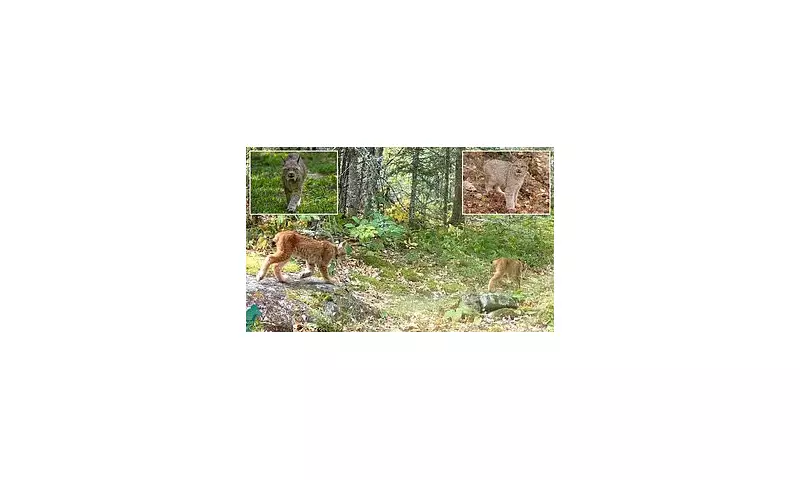
In a heartening development for conservationists, a remarkable video has revealed a pair of ultra-rare lynx kittens playfully exploring the wilderness of Voyageurs National Park in Minnesota. This significant sighting, the first evidence of kittens in the area for years, has ignited hopes that the endangered cat population may be starting to recover.
A Groundbreaking Discovery on Camera
The precious footage, captured in September 2025 but only recently reviewed by researchers, shows the brown and white kittens with distinctive black-spotted underbellies. They were seen bounding and prancing through the snow on the Kabetogama Peninsula, closely following what appeared to be an adult lynx. The Voyageurs Wolf Project, which made the discovery, confirmed this is the first confirmed evidence of lynx reproduction in the park in recent memory.
Tom Gable, project lead for the Voyageurs Wolf Project, emphasised the rarity of the event to the Star Tribune, stating, "It’s just not a common thing." For decades, while individual lynx have been sporadically spotted, researchers concluded most were transitory animals simply passing through. A 2015 study even noted that "it does not appear that there are currently resident lynx" in the national park.

Technology Reveals a Hopeful Sign
The discovery was made possible by modern trail camera technology, a tool that was unavailable for earlier studies. Researchers from the Voyageurs Wolf Project, funded by the state’s Environment and Natural Resources Trust Fund, sifted through months of video from roughly 400 outdoor trail cameras to find the crucial clip.
This sighting is particularly encouraging given the precarious state of the species. The Minnesota Department of Natural Resources estimates there are only between 100 and 300 lynx left in the entire state. The presence of kittens strongly suggests that this endangered population is not just surviving but attempting to reproduce and expand within the Greater Voyageurs Ecosystem.
Challenges for a Cyclical Species
However, experts caution that the future remains uncertain. Research Biologist John Erb explained that lynx, like wolves, are a cyclical species, meaning their populations naturally fluctuate. He added that warming winters in Minnesota have made the habitat less suitable for lynx, while allowing other predators to encroach on their territory.
Despite these challenges, the video proof that lynx are breeding in Voyageurs is a powerful symbol of resilience. It provides vital data for conservation efforts and offers a rare glimpse of hope for the recovery of these elusive and majestic cats in the American North. For now, the lynx are still here on camera—and, optimists hope, they may finally be here to stay.