
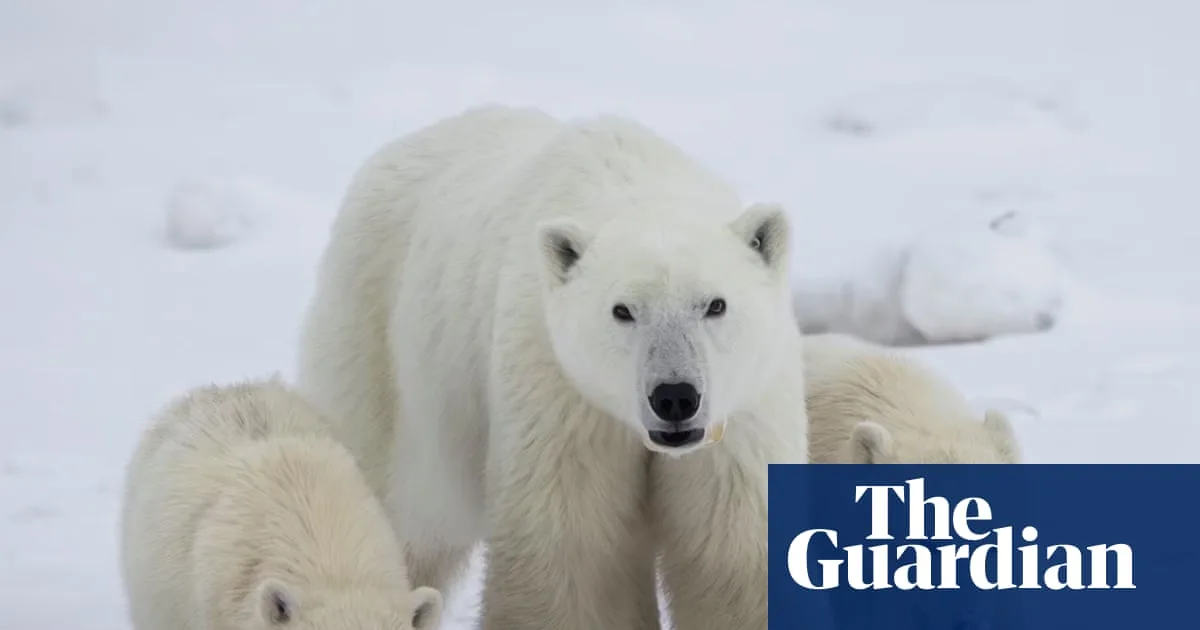
Scientists in Canada have documented a rare case of a female polar bear adopting a cub, an event described as “curious behaviour” that sheds light on the complex social dynamics of the Arctic predators. The adoption was observed in the Western Hudson Bay subpopulation, one of the most studied polar bear groups in the world.
The mother, known as bear X33991, was first fitted with a GPS collar in the spring while accompanied by one young cub. When researchers spotted her last month with two cubs of roughly the same age, they realised they were witnessing an exceedingly rare adoption. Only 13 such cases have been recorded in 45 years of studying nearly 4,600 bears.
Evan Richardson, a research scientist with Environment and Climate Change Canada, said female polar bears are “really good moms” and may be primed to care for a lost cub. “We think if there’s a little cub that’s bawling on the coast and has lost its mother, these females just can’t help themselves but to take them on,” he said.
The two cubs, believed to be 10 or 11 months old, appear healthy and well-nourished. They are expected to stay with their mother for another 1.5 years, learning to hunt seals on the sea ice. However, survival is challenging: half of all cubs born do not reach adulthood, and of the 13 documented adoptions, only three cubs have survived.
Researchers plan to analyse genetic samples from the adopted cub to determine if its biological mother is still alive. In some previous cases, a “switching of litters” occurred rather than true orphanhood. Alysa McCall of Polar Bears International expressed mixed feelings but called the adoption “amazing” and a reason for hope, noting that “polar bears are looking out for each other.”




