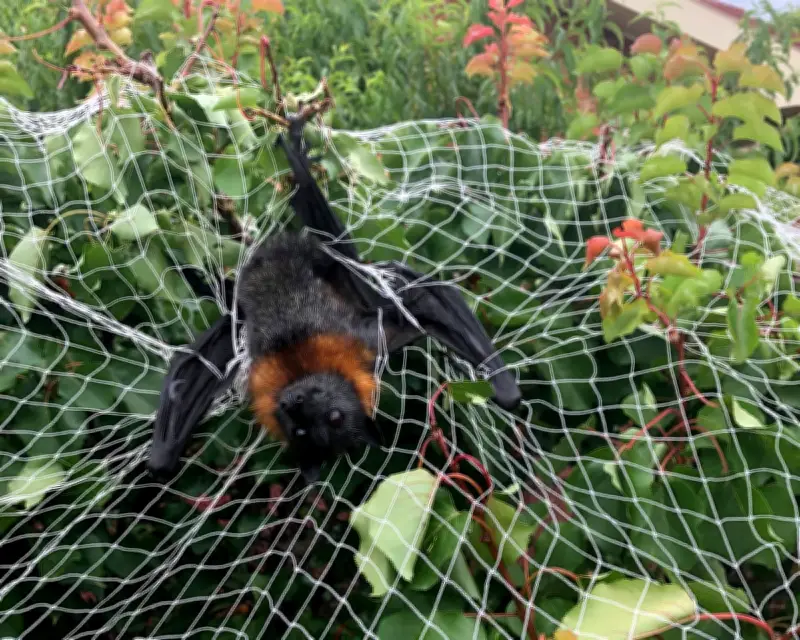
Flying foxes make up two-thirds of all entanglement cases in NSW, a study in Pacific Conservation Biology has found, especially grey-headed flying foxes, which are listed as vulnerable under national environment laws. Thousands of native animals get snared in fruit tree netting, fencing and fishing gear every year in Australia – events that frequently result in injury or death.
Rising Entanglement Cases Across Australia
Wildlife entanglements are rising, with at least 3,500 cases annually in New South Wales, and more than 2,000 last year in Victoria. “These issues are just so much greater than people realise,” says Jasmine Vink, an ecologist and bat rehabilitator.
Flying foxes get badly tangled in back yard nets, Vink says, and caught on barbed wire in regional areas. “Very, very few of those bats are able to be treated,” she says. “They die of exposure, heat, dehydration, blood loss, predation. You have raptors that come down and eat them from the fences.”
But it’s not just flying foxes – entanglements affect hundreds of different species, mostly mammals and birds, including kangaroos, platypus, raptors and gliders.
Preventable Emergencies
Lisa Palma, the chief executive of Wildlife Victoria, says these are some of the more preventable wildlife emergencies. “They are the result of everyday human activity – not deliberate harm – but they can cause devastating injuries and unnecessary suffering to wildlife,” Palma says. “The good news is that [through] simple actions like disposing of rubbish appropriately, using wildlife-friendly netting and fencing, we can reduce the number of native animals injured or killed by entanglement.”
Fruit Tree Netting: A Major Threat
Back yard netting is a popular way of protecting homegrown fruit and vegetables from native animals or pests, and even to prevent damage from sunburn, wind and hail. But hungry animals, especially flying foxes, birds and possums, are attracted to flowers and fruits, and get easily caught in “large-aperture” nets, where the mesh size is greater than 5mm. “The rule of thumb is that if you can poke a finger through it, it’s not safe for wildlife,” Vink says.
Flying fox entanglements are “really, really awful”, she says. “The constriction is incredibly painful for them, those parts of their wings just slowly start to die.” Some of the worst cases involve mums and pups, she says, where “the pup’s been entangled and passed, and they’re just rotting next to the mother as she’s still struggling”.
Safer alternatives have a smaller mesh, and cross-weave design. Wildlife Victoria also encourages the use of fruit tree protection bags, which protect some branches, while leaving others free for wildlife. White or light-coloured materials are also recommended by most state environment departments, as these are easier for birds and mammals to see and avoid at night. Nets should ideally be taut, so they can’t sink and fold around animals, and be checked regularly.
Some state and territory governments and bat rescue organisations run free “net swaps”, where people can bring in their lethal netting and exchange it for wildlife-friendly alternatives. One program in Victoria last year saw more than 600 lethal nets surrendered, and 359 replacements provided free of charge. In Victoria and the Australian Capital Territory, it is illegal to use or sell large-aperture fruit netting. Victoria’s conservation regulator encourages community members to report illegal netting, and has investigated 37 reports in the past year.
Fishing Gear and Hair Ties: Hidden Dangers
Aquatic debris makes up about 10% of entanglement cases, according to NSW wildlife rescue data. For platypus, it’s a serious threat, especially in urban waterways. Animals frequently get tangled in fishing gear and human rubbish, which is responsible for 8% of platypus mortalities in Victoria.
“Because of those big webbed feet, they are very poor at getting litter off them once it gets around them,” says Dr Geoff Williams at the Australian Platypus Conservancy. “Fishing line is probably the most difficult type of litter for platypus to cope with, and causes horrendous injuries – it basically just cuts through the skin.” Litter, especially anything with a ring or a loop, is a big problem. “Platypus are amazing in their ability to get their heads and shoulders through small loops.”
Hair ties, the kind used for ponytails, are a growing concern, he says. “Particularly in places where people go swimming in the summer, what happens is they shake their hair out and drop the thing in a creek and then that ends up around a platypus.” “Elasticated hair ties are a really significant problem because no matter where they get dropped, they tend to get swept along in the rain, go down in the drains, [and] end up in creeks.”
Most people are responsible, he says. But it’s important to retrieve fishing line and dispose of it properly – don’t just cut it and leave it in the water. For rubbish, especially anything with loops, his recommendation is to “snip it and bin it”. Perhaps surprisingly, even flying foxes get caught in fishing line. “They skim on their bellies on the water,” Vink says. “They’re just flying along and they get hooked up in this fishing gear. So, you do get a lot actually going through their mouths.”
Western Australia’s Department of Biodiversity, Conservation and Attractions runs a Reel It In program that has installed 192 yellow bins at popular fishing spots for fishers to safely dispose of unwanted fishing line and tackle, and has so far collected more than 250km of line. Most states, except Queensland, have now banned the sale of enclosed yabby nets, also known as opera house traps, which were particularly deadly to native wildlife including turtles, platypus and rakali (water rats).
Barbed Wire: A Fatal Fence for Wildlife
Outside the cities, barbed wire poses a serious risk. More than 800 kangaroos were rescued from fences by Wildlife Victoria in the past year. “As a land-based species they are often confined by fencing and need to jump over fences to navigate around and through properties. Unfortunately, if a kangaroo is startled or travelling at speed, their hind legs can clip top wires, causing their legs to become entangled,” the rescue organisation says.
“There’s just so much barbed wire, just thousands and thousands of kilometres,” Vink says. “For example, up here in north Queensland, we had close to 250 little red flying foxes caught in a single week, just on one property.” Flying foxes often can’t see fences, especially in windy or foggy conditions, she says. The vast majority get caught on the top strand, so most solutions involve replacing that strand with plain wire, or installing reflective or brightly coloured poly tape or reflective discs to make the fence more visible.
What to Do If You Find Trapped Wildlife
If you encounter trapped or entangled wildlife, avoid approaching or touching the animal as that may cause stress. Contact your local wildlife rescue, or use the International Fund for Animal Welfare’s wildlife rescue app to find the closest licensed carer. Flying foxes should only be handled by appropriately vaccinated and trained individuals, and using the proper protective equipment. With the arrival of H5 bird flu in Australia, members of the public are urged to avoid contact with any dead or sick birds or animals showing signs of the virus. Report those sightings to the emergency animal disease hotline 1800 675 888 or birdflu.gov.au.