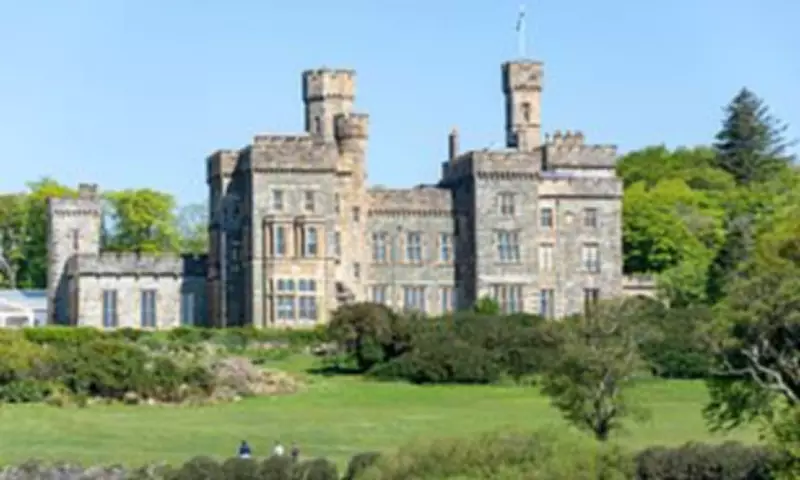
The other day, snatching forty serene minutes away from my duties, I took my little dog for a walk to the beechwood, a special corner of the afforested Lews Castle Grounds only a few minutes from my home. No native woodland, but an arboretum, conceived and planted by a new Lewis laird from 1844. And, for all the employment he created, Sir James Matheson should not be glamourised. He had made his ruthless fortune out of China’s Opium Wars and two crofting villages were blithely cleared to make room for these rides and glades and vistas, the lofty pines and murmuring sycamores and stately maples.
Much opened up these days by a network of mountain-bike trails, hewn through rock and moss around 2012. Many delightful corners now became readily accessible, and the beechwood is my favourite. You pad into it, under a timber arch, through a pleasant glade cleared long ago as a camping ground by local Scouts. And there you are, under the whispering canopy of the lofty trees, of particular beauty at this time of year as the leaves just shyly emerge and the sunlight can still warm the forest-floor.
You would know you were in a beechwood even were you blindfolded. The fallen leaves take years to decompose. They crunch beneath you at every step like cornflakes. The silver bark is smooth to the touch. And a beechwood has its own music, as the branches nod to each other in each probing breeze. At this time of year it is a whisper. Come summer, and in full leaf, it is an insistent murmur, like schoolchildren mustered just before morning prayers. And in winter, at least before the first stripping storm and when the dead leaves still clot most twigs and limbs, it is like the ocean beating on a shingle shore.

There are many delights to be found in the Lews Castle Grounds. Each grove or bank has its own atmosphere. Willows bend or buckle and hiss. There is something very still about a mossy stand of alders; something gigglesome in the air around downy or silver birches. But when you linger amidst mature beech trees, trunks soaring like columns into the sky, the sunlight having all sorts of play with or through or about the leaves – well, it is as if you have entered a green, silver and brilliant cathedral.
Indeed, I have a vivid memory of an outdoor art-class in Jordanhill around May 1978. Our gentle teacher shepherded us to a wooded corner, complete with brushes, paper and aromatic watercolour, and directed us to paint a pile of abandoned, rusting machinery. I was far more interested in the lofty beeches around and above us, and painted them instead, trying to catch the light and dappled green – and, to the credit of that young master, he did not mind.
The Queen of the Woods
The ‘Queen of the Woods’ has long been beloved. Beeches, unlike the stately oak or the sensible sycamore, have a feminine beauty. The logs make excellent firewood. Easily pliable with some steaming, beech can be crafted into furniture. Non-toxic, the wooden spoons and spatulas in your kitchens are almost certainly beech. There are other culinary applications, especially prized on the Continent. Beech chippings are used to smoke certain cheeses, Andouille sausage and Westphalian ham. Beech logs dry the malt used in some smoked German beers; beech slats (washed, of course) are even added to some brewing-vats.
The ancient Romans thought the nuts – ‘beechmast’ – the sweetest and most desirable of all: it was on their account that pigs were commonly encouraged to chomp and nose in a stand of beeches. The tough dead leaves made excellent litter for sheltered wintered livestock and, before paper was invented, the thinnest planed leaves of beechwood were bound together as Europe’s first books. Indeed, the very name beech – derived from an Anglo-Saxon word variously rendered as boc, bece or beoce, and with cognates in Swedish and German – means ‘book’.

Famous Beech Trees of Scotland
Scotland, in particular, boasts some famous beech trees. You might have heard of the spectacular Meikleour Hedge, on the road between Perth and Blairgowrie. Running for over 1,800 feet, soaring upwards to almost 120, it is the longest, highest hedge in the world. The massed beeches – of simmering majesty in summer – were planted late in 1745; and it is said they climb heavenwards because most of the men who did the work subsequently fell in the Jacobite ranks at Culloden in 1746. Their tools, they do say – as they never came back – still rust where they were left, lost in the roots of this extraordinary hedge.
There is a beech tree still more intimately associated with Charles Edward’s doomed cause, and perhaps the oldest in Britain – the ‘Kissing Beech’ by Kilravock Castle, east of Inverness and within an undemanding tramp of that battlefield. It is nearly 400 years old, and it is a ‘layered’ beech, rather resembling a demented octopus, limbs curling forth in all directions and actually (like strawberries) rooting themselves in the ground. Its imminent demise has been confidently predicted for decades but the Kissing Beech has, as we say in the islands, never died a winter yet.
Its name? Well, it is said a son of the Rose family enjoyed some dalliance with a housemaid beneath its shade, long ago; and for as long as anyone can remember couples have gone to Kilravock to carve their initials into its venerable bark. Its big moment was in the days bracketing Culloden when, to Hugh Rose of Kilravock’s quiet horror, the Bonny Prince himself turned up at his door for drinks and nibbles – and was followed, two days later, by the triumphant Duke of Cumberland himself. Awkward. ‘You have had my cousin here, I hear,’ growled His Royal Highness, sounding very German.
Robert Burns – by all accounts, quite the authority on kissing – also met the tree when he dropped by Kilravock in 1787. But the armies passed, Charlie’s cause was lost, and the ensuing and well-documented atrocities duly ceased. Cumberland would never win another battle; Charles Edward died a sozzled old exile. The Bard would pass away in 1796. But the Kissing Beech endures still.
A Timeless Perspective
‘And someday, long after this convention,’ Ted Kennedy declared in August 1980, as his own dynastic dreams finally collapsed around him, ‘long after the signs come down, and the crowds stop cheering, and the bands stop playing, may it be said of our campaign that we kept the faith…’ Many a hope, noble and otherwise, will be dashed in election-counts this week; much faith tested. Our woods put so much in perspective, do they not? – by the murmur of trees that think in centuries and not in days.