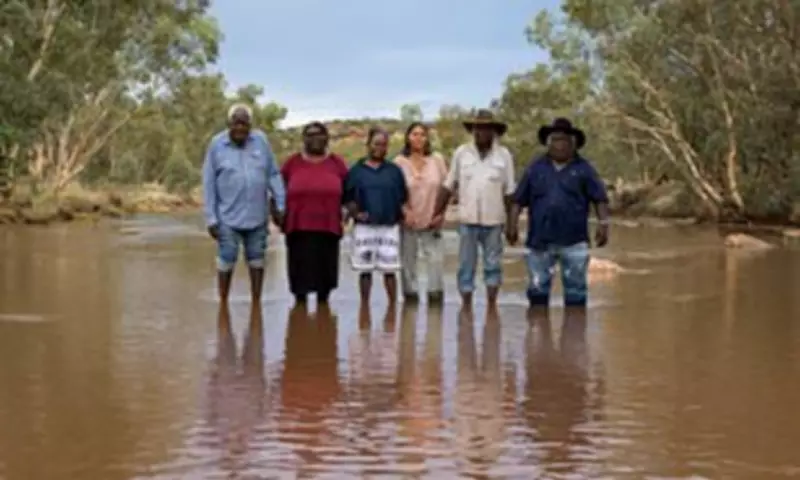
Traditional Owners Take Water Rights Battle to High Court Over Massive Desert Allocation
Six native title holders from the Mpwerempwer Aboriginal Corporation have escalated their fight to the High Court of Australia, challenging a monumental water allocation granted to a horticulture company in the arid desert region. The group attended a crucial hearing in Canberra this Tuesday, contesting a licence issued freely by the Northern Territory government that permits Fortune Agribusiness to extract vast quantities of groundwater annually.
Unprecedented Water Licence Threatens Ancient Aquifer
The contested licence authorises Fortune Agribusiness to draw 40 gigalitres of groundwater each year from Singleton Station, located south of Tennant Creek, for a staggering thirty-year period. To put this volume into perspective, it equates to draining Sydney Harbour twice over annually. This represents the largest groundwater licence ever issued in the Northern Territory, forming a cornerstone of a plan to transform thousands of hectares at Singleton Station into an intensive irrigated horticulture enterprise for fruit and vegetable production.
Traditional Owners assert that this industrial-scale project poses a severe threat to sacred sites, cultural survival, and the delicate balance of the desert water system. They warn of permanent damage to an ancient aquifer, at least forty groundwater-dependent sacred sites, and essential community water supplies. 'When groundwater levels drop below the reach of roots of sacred trees and plants, they die. Animals connected to dreaming stories disappear,' the owners stated emphatically in a public declaration.

Cultural Identity and Survival at Stake
Alyawarr Traditional Owner Frankie Holmes articulated the profound cultural significance of water, describing it as central to people's identity and very survival. 'Looking after land and country, especially sacred trees, is very, very important for us. Ancestors hand it over to us to look after these waters and these lands,' Holmes explained, highlighting the deep spiritual and custodial responsibilities carried by Traditional Owners.
Dawn Swan, a native title holder and director of the Mpwerempwer Corporation, expressed cautious optimism after six years of relentless opposition. 'We have people living on the land and this is their dream to stay here for future generations,' she said, noting that the High Court's decision to hear the case has provided a renewed sense of hope for the community.
Legal and Financial Controversies Surround the Licence
The Central Land Council, which is backing the owner corporation, has characterised this legal challenge as a vital opportunity to have Traditional Owners' concerns taken seriously. The council estimates the water licence's value at between seventy million and three hundred million dollars, yet points out the Northern Territory government granted it to Fortune Agribusiness without charge. 'Yet the NT government is granting the licence free of charge to Fortune Agribusiness,' the council noted in an official statement, raising questions about the allocation's fairness and transparency.
The Mpwerempwer Corporation has presented arguments to the High Court alleging that the Northern Territory government failed to adequately consider the impact on Aboriginal cultural values when issuing the licence. This follows an unsuccessful appeal by Traditional Owners in the Northern Territory Supreme Court in May 2025. The NT government has defended its position, stating that the courts have correctly determined that the law does not impose a statutory obligation on a government minister to consider such cultural impacts. Meanwhile, Fortune Agribusiness has formally requested the court to dismiss the appeal, setting the stage for a landmark legal confrontation over water rights, native title, and environmental stewardship in Australia's fragile desert regions.