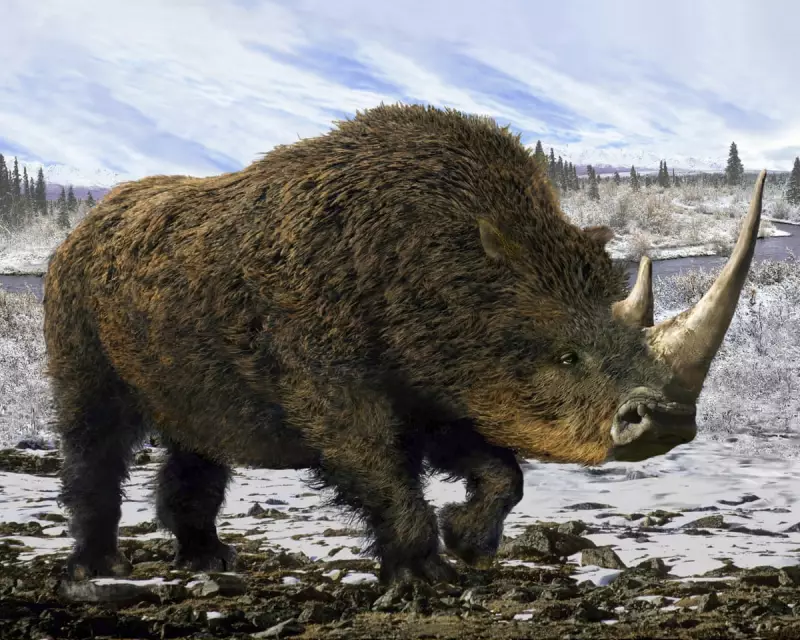
Scientists have unlocked crucial details about the final centuries of the woolly rhinoceros by examining a remarkable piece of prehistoric evidence: the stomach contents of a mummified wolf cub preserved in Siberian ice for 14,400 years.
A Frozen Time Capsule from Siberia
The story begins in 2011, near the remote village of Tumat in northeastern Siberia, where researchers discovered the exquisitely preserved remains of a two-month-old female wolf cub. Experts believe the young animal perished when a landslide collapsed its den, entombing it and others in the permafrost. This deep freeze acted as a natural freezer, preserving the cub and its last meal for millennia.
Upon examination, scientists made a stunning find. Inside the pup's stomach was a chunk of partially digested meat, which genetic analysis later confirmed belonged to a woolly rhinoceros—a colossal, hairy herbivore that went extinct roughly 14,000 years ago.

Decoding a Genome from a Prehistoric Predator's Belly
This discovery presented a rare opportunity. Dr Camilo Chacón-Duque, formerly of the Centre for Palaeogenetics in Stockholm, explained that obtaining genetic material from a species in its twilight years is exceptionally challenging. The preserved rhino tissue offered a potential window into the animal's genetic health just before its disappearance.
As detailed in the journal Genome Biology and Evolution, the team successfully sequenced the woolly rhino's genome from this matted lump of flesh. This marks the first time a genome from an Ice Age creature has been recovered from inside another animal's stomach. "To our knowledge this is the youngest woolly rhinoceros for which we have the genome," stated Dr Chacón-Duque.
Surprising Findings Challenge Extinction Theories
The researchers anticipated signs of severe genomic erosion—a loss of genetic diversity and an accumulation of harmful mutations that typically cripples a species on the brink. However, the DNA told a different story.
By comparing this genome with those from older specimens dated to 18,000 and 49,000 years ago, the scientists concluded the woolly rhino population remained fairly large and stable until very near its end. "Whatever killed the species was relatively fast," Chacón-Duque noted, likely occurring in the 300 to 400 years before their final demise.
This finding, according to Professor Love Dalén of the Centre for Palaeogenetics, points away from human hunting as the primary cause, as the rhinos coexisted with humans for about 15,000 years. Instead, the evidence suggests a rapid environmental shift was responsible. The prime suspect is a sudden warming period during the last ice age, known as the Bølling-Allerød Interstadial, which dramatically altered the landscape between 14,700 and 12,900 years ago.
The research also paints an intimate picture of Ice Age life. It remains unclear how the wolf cub came to dine on rhino, but scientists speculate it may have scavenged from a carcass or been fed regurgitated meat by an adult pack member. A second cub, believed to be its sibling, was found at the same site in 2015, and both showed signs of having just begun to eat solid food while still nursing.