
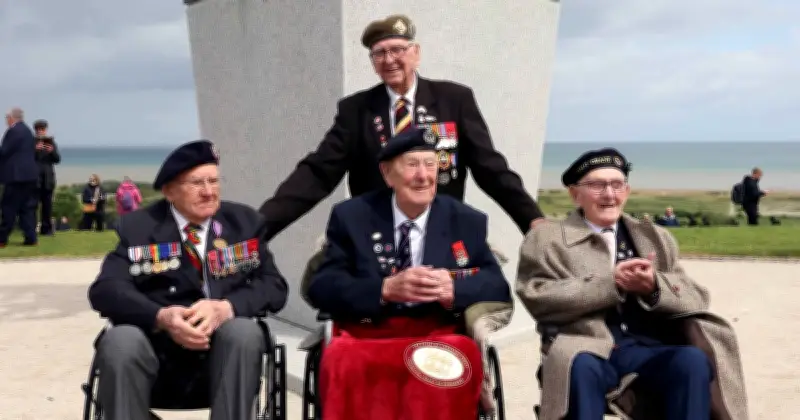
A monument honoring British D-Day heroes is set to receive an extraordinary honor, placing it on par with iconic landmarks such as the Taj Mahal and the Egyptian Pyramids. The British Normandy Memorial, which lists the names of 22,540 soldiers killed during the D-Day invasion, is part of a 50-mile stretch of French coastline that will be designated a UNESCO World Heritage Site.
The protected area includes the British Normandy Memorial in Ver-sur-Mer, which was opened by the then Prince Charles on June 6, 2021. This sacred site overlooks Gold Beach and was chosen by British Second World War veterans as a place to remember those who fell during the liberation of Nazi-occupied Europe.
UNESCO will announce the recognition at a special session in Busan, South Korea, next month. Last week, the memorial hosted a moving service on the 82nd anniversary of D-Day, attended by the last surviving veterans of the Normandy landings.
Historical Significance
General Lord Dannatt, former Chief of the General Staff and Chairman of the Normandy Memorial Trust, said: "The Normandy landing beaches are among the most important historic landscapes in the world. It was here that the liberation of Western Europe began on June 6, 1944, at immense human cost." He added that UNESCO status would provide global recognition and help safeguard these sites for future generations.
The Allied invasion on June 6, 1944, remains the largest military invasion ever mounted, with troops storming five beaches codenamed Omaha, Gold, Juno, Utah, and Sword.
The Memorial's Creation
The campaign to build the memorial was led by George Batts, an 18-year-old sapper on D-Day who later became National Secretary of the Normandy Veterans' Association. He was appalled that there was no single point of remembrance for those killed during the liberation of France. The site was selected by veterans in April 2017 and officially opened on June 6, 2021.
The memorial features 160 limestone columns inscribed with the names of servicemen and women from 38 nationalities who died on D-Day and the subsequent Battle of Normandy. The youngest soldier killed was 16, the oldest 64.
Veterans' Stories
Among the last surviving witnesses are Richard Brock, 102, Ken Hay, Henry Rice, and Ken Benbow, all 100. George Batts, who died in 2022 at age 97, recalled: "No-one who landed will ever forget it. As we approached the coast the noise was phenomenal." He spoke of losing friends and the horrors of the beaches.
Harry Billinge, another veteran who campaigned for the memorial, collected funds in his hometown of St Austell until his death in 2022 at age 96. He said: "It is my duty to do all I can for the blokes who never came back."
UNESCO Recognition
UNESCO documents state that the D-Day beaches "outstandingly and tangibly embody, symbolically commemorate and evoke memories of the concerted, multinational collaboration... and the immense human sacrifice required to break an entrenched authoritarian occupation."
There are currently 1,248 UNESCO World Heritage Sites across 170 countries. Only a few war-related sites are inscribed, including Auschwitz-Birkenau and the Genbaku Dome in Hiroshima. The Normandy region submitted the application, and a delegation of UNESCO assessors attended the recent commemorative service.
A spokesman for the Normandy region said: "The British Normandy Memorial is well within the zone we have requested... we have our fingers crossed." UNESCO added that inscription brings international recognition and encourages preservation.




