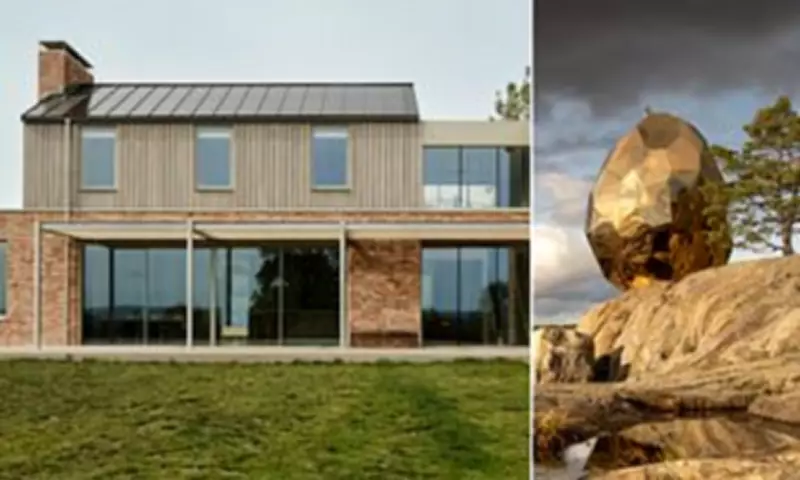
The Solar Panel Design Revolution
Solar panels, long considered the "ugly ducklings" of renewable energy and often criticized as eyesores on British homes, are poised for a dramatic aesthetic transformation. Design experts predict that new, sophisticated formats will soon make solar installations desirable architectural features rather than functional necessities.
Changing Perceptions and Property Values
Middle-class homeowners who have traditionally avoided installing unsightly black panels could find themselves drawn to designs so sleek they might actually enhance property values. According to Josh Raffo, spokesman for North East-based Thrift Energy, the mindset around solar technology is already shifting, driven by improved designs that echo the trajectory of once-controversial home improvements like double glazing.
"Thirty years ago people worried double glazing would ruin the look of a Victorian terrace. Now no one gives it a second thought," Raffo explains. "Solar is on exactly the same trajectory, and the pace of design innovation means we'll get there much faster."

Raffo envisions a near future where prospective homebuyers question why properties lack solar installations rather than why they have them.
Innovative Designs on the Horizon
The coming generation of solar technology includes period-style sash glass windows that capture solar energy, invisible roof tile formats, and even "spray-on" solar applications. These innovations aim to appeal to increasingly design-led consumers who prioritize aesthetics alongside environmental benefits.
Mart Mustkivi, business development manager at Nordic-inspired company Roofit.Solar, highlights how colour technology now addresses heritage concerns. "Not every 17th-century cottage suits a black roof," he notes, pointing to their Velario® Slim range that allows discreet solar integration in sensitive conservation areas through colour matching with local materials.
Current Market Realities and Government Push
While these advanced designs develop, many homeowners will initially encounter more basic options. Energy Secretary Ed Miliband recently announced that plug-in solar panels costing approximately £400 will soon be available through retailers including Lidl and Amazon. These panels connect directly to a home's mains electricity system via standard plugs, allowing households to generate their own power.
The Labour government is actively promoting solar panel adoption as part of national decarbonization efforts. "Ed Miliband and the government have been absolutely clear that decarbonising our homes is a national priority, not a lifestyle choice," emphasizes Raffo.
Heritage Concerns and Rural Resistance
Despite technological advances, significant opposition persists, particularly in rural areas where residents fear industrial-scale solar farms and inappropriate installations on historic properties. Recent controversies include planning permission being denied for 20 panels on a 17th-century Grade II-listed farmhouse in Low Bentham, North Yorkshire, and residents of the 700-year-old Hertfordshire hamlet Potters Crouch protesting a proposed solar farm with up to 100,000 panels they claim would "completely wreck" their green sanctuary.
Andy and Gilly Morris, residents near Potters Crouch, express concern that their "beautiful countryside view" will become "absolutely and completely surrounded" by solar panels.
Demographic Differences in Adoption
Research reveals generational divides in attitudes toward solar aesthetics. Roofit.Solar reports that 82% of 18- to 39-year-olds consider design aesthetics important in their solar installation decisions, compared to just 18% of 40- to 59-year-olds and 13% of those over 60. Younger generations appear to be driving demand for visually appealing renewable energy solutions.
Future Technological Developments
The solar revolution extends beyond current innovations. Raffo points to emerging technologies including solar roof tiles, building-integrated photovoltaics, transparent solar glass, perovskite cells offering higher efficiency at lower cost, flexible ultra-thin solar films, indoor solar harvesting from artificial light, and solar noise barriers that generate electricity while dampening traffic sound.

Simon Edwards, chief executive at EE Renewables, notes the growing preference for in-roof solar panels that integrate flush with roof structures rather than traditional framed panels mounted atop tiles. "This gives the solar installation a sleeker, cleaner appearance," he explains.
Global Inspiration and Quality Assurance
Internationally, innovative solar designs are already demonstrating what's possible. The "solar egg" - a gold-exterior sauna created by Swedish artists Bigert & Bergstrom in 2017 - continues to operate successfully in Kiruna, Swedish Lapland, nearly a decade after installation.
Raffo adds an important caveat about quality standards: "The Microgeneration Certification Scheme, the quality and accreditation framework that governs what can be properly and safely installed in UK homes, all need to mature before these innovations become genuinely accessible to everyday homeowners."
As solar technology evolves from functional necessity to architectural feature, the industry faces the dual challenge of meeting national decarbonization targets while respecting Britain's architectural heritage and diverse aesthetic preferences across generations.