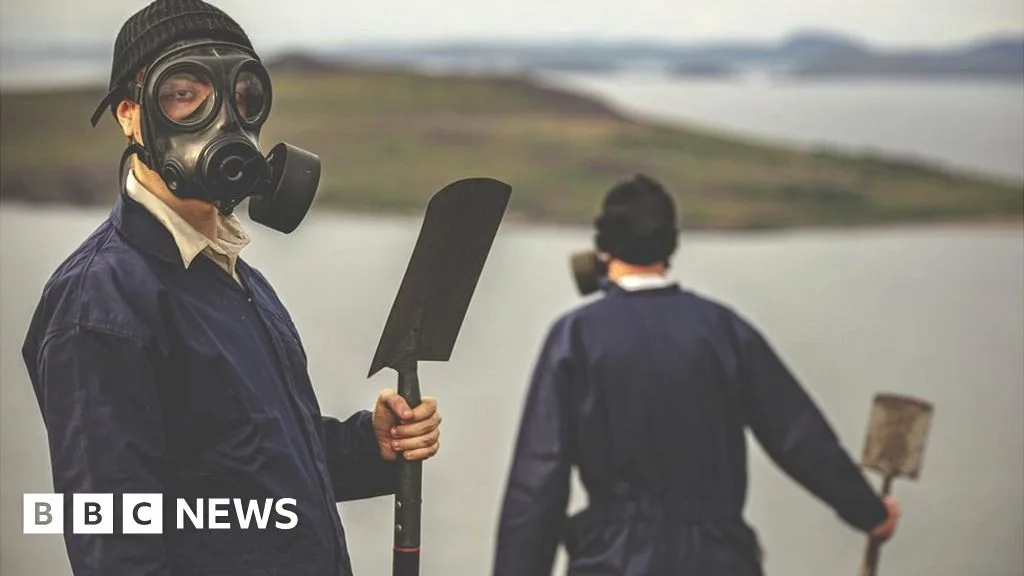
Exploring Scotland's Forbidden Anthrax Island: A YouTuber's Terrifying Journey
In a daring exploration of locations shrouded in mystery and prohibition, content creator Ellie Whitby embarked on a chilling investigation to a remote Scottish island with a deeply disturbing past. The island, deliberately removed from official maps and strictly off-limits to the public, presented both a physical and psychological challenge for the intrepid explorer.
The Sinister History of Gruinard Island
Ellie Whitby, who operates the popular EllieMarieTV channel on YouTube, specifically targeted Gruinard Island in northwest Scotland for her latest documentary project. This location, infamously nicknamed "Anthrax Island", earned its ominous reputation during the Second World War when it became the site of clandestine biological weapons experiments.
The island's transformation into a testing ground occurred in 1942 under the directive of Prime Minister Winston Churchill. Concerned about potential Nazi Germany advancements in biological warfare, British scientists selected the 522-acre island in Gruinard Bay to investigate weaponising anthrax, a potentially fatal infectious disease caused by the Bacillus anthracis bacterium.
"The aim was to test whether the anthrax would survive an explosion in the field," explained Edward Spiers, emeritus professor at the University of Leeds, in a 2022 documentary. "They didn't know that, and then would it remain virulent thereafter. Eighty-odd sheep were tethered at various stages downwind of the likely explosion."
A Landscape of Death and Secrecy
The experiments produced devastating results. Following controlled detonations, a draught of highly potent spores swept across the island, infecting and killing the test sheep within days. The animal carcasses were subsequently incinerated or buried under debris, but the contamination proved alarmingly persistent.
Anthrax spores demonstrated remarkable resilience, capable of surviving in soil for decades. This longevity transformed Gruinard Island into a permanent hazard zone, leading authorities to impose strict access prohibitions. The location became so sensitive that it was deliberately erased from some maps, reportedly to prevent terrorist groups from procuring samples of the deadly bacteria.
Local residents in nearby settlements remained largely unaware of the experiments initially, though rumours began circulating as livestock deaths occurred. The covert trials concluded in 1943, but their environmental legacy would endure for nearly half a century.
Confronting the Forbidden Zone
Undeterred by the island's grim reputation, Ellie Whitby traveled to the Scottish northwest determined to uncover truths about this government-secreted location. "I want to know their opinions on this," she explained regarding local inhabitants. "What do they think about this massive, secret government cover-up that happened a mile off their shores?"
Her investigation involved interviewing area residents, one of whom confirmed the government's efforts to keep the island "under wraps," while another alleged the tests caused sheep deaths on the mainland. Eventually, Ellie secured passage with a kayaker named Will, who agreed to ferry her across to the forbidden island.
"It was time to be one of very few people to ever step foot on an island hidden from the entire world," she remarked, acknowledging the extraordinary nature of her undertaking. "I literally never used to leave my room out of fear of germs, and now I'm going all the way to an Anthrax Island. I think my therapist would be proud of me or, actually, very concerned."
The Island's Eventual Decontamination
Following the war, Churchill's proposed biological weapon was never deployed, but Gruinard Island remained contaminated and quarantined. Pressure for cleanup mounted over decades, notably from a militant group called the Dark Harvest Commando of the Scottish Citizen Army, who even left a bucket of contaminated soil outside Porton Down, the secretive government facility where the research originated.
Extensive decontamination efforts eventually proved successful. In 1990, the UK government officially declared the island free from anthrax, concluding a 48-year quarantine period. The scientists who conducted the original experiments had long since returned to Porton Down in Wiltshire, where research into diseases and chemical weapons continues.
Upon landing near a cave system during her visit, Ellie experienced a sudden change of perspective. After determining there were no "nuclear bunkers" immediately apparent, she decided she wasn't "stupid enough" to remain on the island longer than necessary, despite her initial determination to investigate potential conspiracies.
The journey to Gruinard Island represents more than mere adventure tourism; it serves as a stark reminder of wartime secrecy, environmental consequences of weapons testing, and the enduring psychological impact of places marked by tragedy and contamination.




