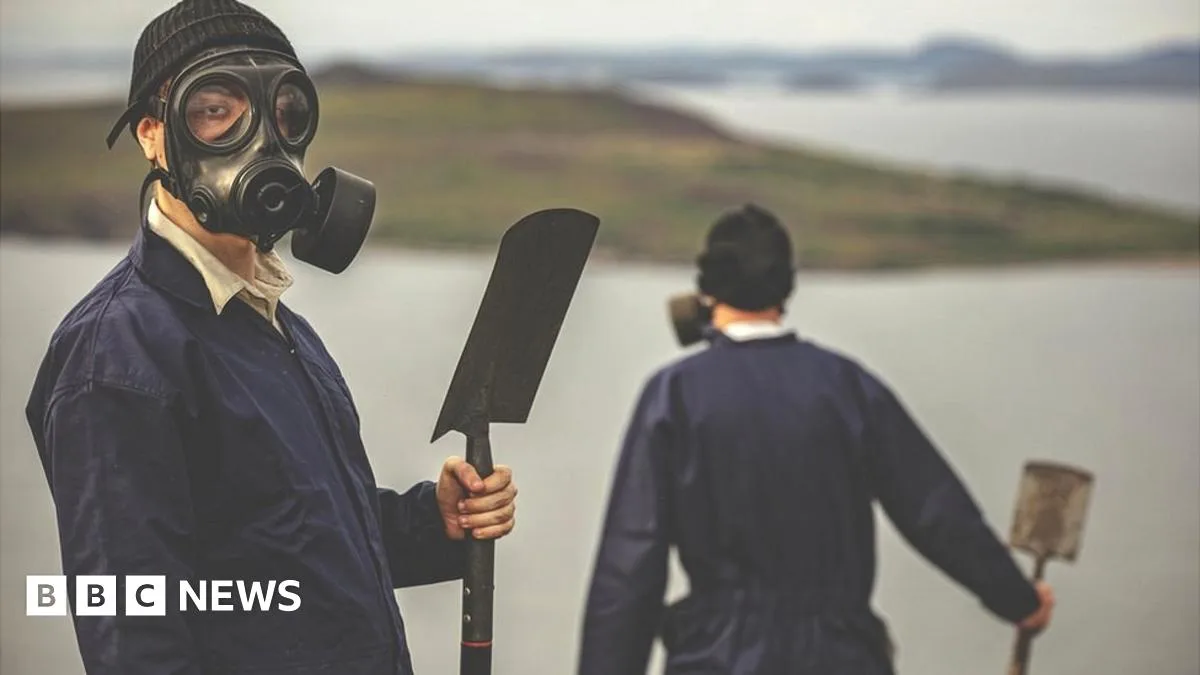
Nestled just off the rugged west coast of Scotland lies the uninhabited and infamous Gruinard Island, a location shrouded in a chilling historical legacy. This remote landmass, measuring a mere two kilometres in length by one kilometre wide, earned the grim nickname 'Anthrax Island' following its use in British biological warfare experiments during the Second World War. In 1942, tests involving the deadly anthrax bacteria left the island severely contaminated, rendering it off-limits to humans for decades. It was not until 1990 that the Ministry of Defence finally declared Gruinard Island free from the lethal disease, though its dark reputation persists.
An Intrepid Quest for Hidden Truths
Undeterred by this ominous past, a keen British explorer named Ellie, who shares her adventures on YouTube under the moniker EllieMarieTV, made it her mission to visit this forbidden locale. In a video uploaded last year, as part of a series exploring 'banned Google Map locations,' Ellie set her sights on Gruinard Island. She claims the land is 'totally erased off Google Maps' and expressed her determination to venture there, stating, 'I want to try and find a local crazy enough to take me to this island, to see for ourselves, can we still see the Anthrax.' During her preparations, Ellie spoke with several locals who shared various conspiracy theories about the island, adding to its mysterious allure.
A Kayaking Journey to the Unknown
Eventually, Ellie enlisted the help of a local kayaker named Will, who agreed to row with her to the mysterious island. Navigating her kayak through treacherous caves and dodging rocky outcrops, Ellie sought a safe spot to land and disembark. 'After an hour of kayaking, we had finally made it to the back of the island,' she recounted. Despite admitting her fear, Ellie pressed on with her quest, driven by curiosity. 'As much as I'm scared right now, this might be our only opportunity to explore an island totally erased and hidden from the entire world, to see if the crazy conspiracy theories about this place are true,' she added.
Discovering Beauty Amidst the Creepiness
Upon arriving at a pebbled cove, Ellie surveyed her surroundings and noted that the destination did not appear particularly strange. She acknowledged that she 'doesn't see any Anthrax' or 'anything suspicious.' Reflecting on her experience, Ellie concluded, 'And after exploring these banned locations, despite their dark pasts, what we actually discovered was some very beautiful, yet creepy adventures.' This juxtaposition of natural beauty and historical horror encapsulates the eerie charm of Gruinard Island.
The Legacy of Anthrax as a Biological Weapon
Anthrax, caused by the spores of the bacteria Bacillus anthracis, is a potentially deadly disease that can survive in harsh climates for years. Its spores have been weaponised by at least five countries: Britain, Japan, the United States, Russia, and Iraq. The disease can be contracted through touch, inhalation, or ingestion, with inhalation being the most lethal form, resulting in death for about 80% of cases even with medical intervention. British trials on Gruinard Island in 1942 exemplify its use as a biological weapon, contaminating the land for nearly half a century.
Notably, anthrax's first documented use in warfare was by the Japanese in the 1930s, and it gained infamy during the 2001 Anthrax attacks in America, where letters containing spores infected 22 people and killed five. The spores' ease of cultivation with minimal training makes anthrax a persistent threat in bioterrorism discussions.
Recent Events and Public Awareness
In 2022, wildfires engulfed Gruinard Island, visible from the mainland, prompting warnings to the Scottish public. Witnesses described the blaze as 'apocalyptic' and akin to 'hell fire,' highlighting the island's ongoing presence in local consciousness. This event, coupled with Ellie's exploration, underscores how Gruinard Island continues to captivate and unsettle, blending natural phenomena with its grim historical narrative.
Overall, Gruinard Island stands as a testament to the dark chapters of wartime experimentation, now explored by modern adventurers seeking to unravel its secrets and confront its haunted past.