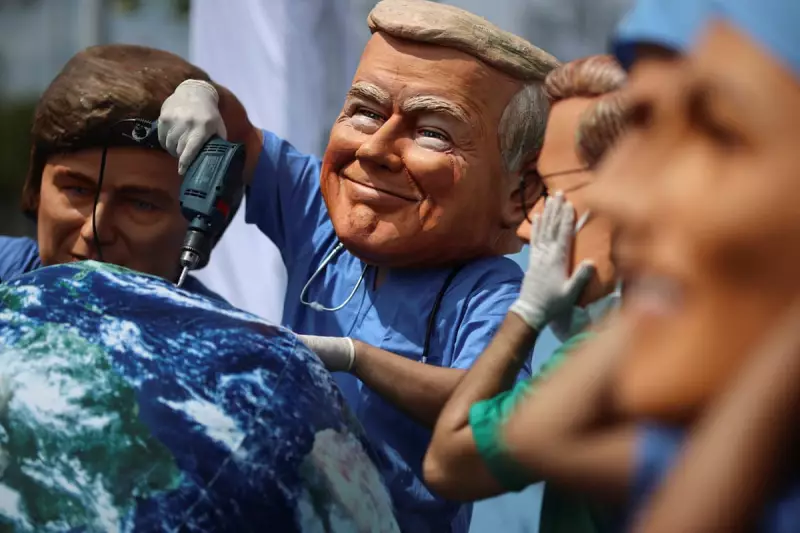
The latest round of international climate talks, Cop30 in Belem, Brazil, has concluded with a whimper, failing to secure a global commitment to phase out fossil fuels. The event was marked by the conspicuous absence of the United States, which, for the first time in 30 years of UN climate summits, sent no official delegation.
A New Axis of Obstruction
This American no-show, coupled with fierce opposition from other major oil and gas producers, has led analysts to identify a new 'axis of obstruction' in global climate politics. According to Michael Jacobs of ODI Global and the University of Sheffield, this group, comprising the US, Saudi Arabia, the UAE, and Russia, is actively resisting the scientific consensus that the world must wean itself off fossil fuels to tackle climate change.
Jacobs stated that the Trump administration's separate dealings with Saudi Arabia and Russia in the preceding week solidified this alliance. 'Geopolitically, this is the creation of a new axis of obstruction – actively promoting fossil fuels and opposed to climate action,' he said.

Stalled Progress and Stark Contrasts
Even without US officials present to 'bully and cajole', as described by Jean Su of the Center for Biological Diversity, petrostates successfully blocked any meaningful progress. The final agreement text from the summit, which involved 194 countries, did not even include the words 'fossil fuel'.
While the talks faltered, the Trump administration engaged in stark counter-programming at home. It rolled back environmental protections for streams and wetlands, weakened the Endangered Species Act, and opened up more than one billion acres of US waters to new oil and gas drilling. This includes pristine areas of the Arctic and, in a move timed to coincide with California Governor Gavin Newsom's visit to Cop30, the potential for new oil rigs off the Californian coast.
A White House spokeswoman, Taylor Rogers, defended the administration's position, stating, 'President Trump will not jeopardize our country’s economic and national security to pursue vague climate goals.'
A Glimmer of Hope and Shifting Global Dynamics
Despite the frustration at Cop30, observers noted that the global transition away from fossil fuels continues unabated. Last year, global investment in renewables like wind and solar was double that of traditional energy sources.
Furthermore, China is emerging as a clean energy superpower, now earning more from exporting green technology than the US makes from exporting fossil fuels. Domestically, Trump's climate stance is also out of step with US public opinion, with two-thirds of American voters opposing the withdrawal from the Paris Agreement.
In response to the UN impatience, a coalition of around 90 countries, including much of Europe, plans to convene a separate summit in Colombia this April to advance the goal of a fossil fuel phase-out. As former US Vice President Al Gore remarked, 'Ultimately, petrostates, the fossil-fuel industry, and their allies are losing power... They may be able to veto diplomatic language, but they can’t veto real-world action.'