
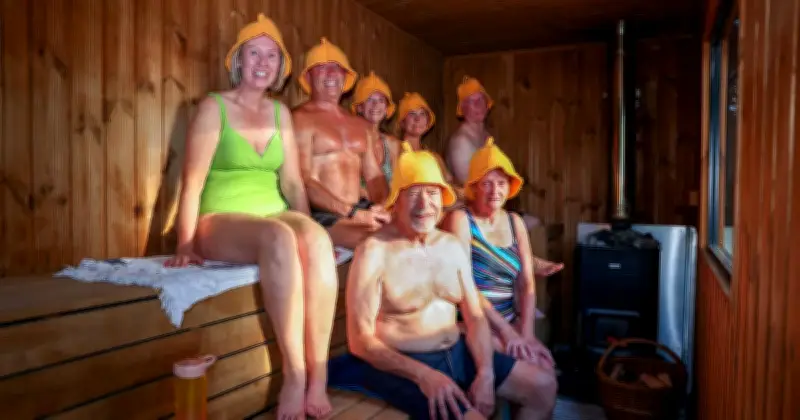
Saunas are opening at a rate of one per day in the UK in 2026, as the Scandinavian tradition becomes one of the country's fastest-growing social activities, according to installation company Finnmark. The trend persists even during extreme heat, with Britons embracing contrast therapy—moving from a hot sauna to an ice-cold plunge pool—for physical and mental wellbeing.
Thaxted Sauna Company: A Community Hub
In Thaxted, Essex, husband-and-wife team Andrew and Abigail Baker launched their contrast therapy business nine months ago. Andrew, 48, a London black cab driver, and Abigail, 38, a former graphic designer made redundant while pregnant, rent a small space in a meadow. The wood-fired communal sauna seats eight and is heated by a log-burning stove. “Abi had been to Cornwall and had seen the popularity of sauna clubs on the coast and in woodlands, and she was convinced it would be a real benefit to any community,” says Andrew. “She was right.”
Abigail adds: “Once you have a young child, popping to the pub in the evening to meet people isn't quite so straightforward. The sauna has become the place where we connect with our community, and that's probably the part I'm most proud of.”
Health Benefits and Personal Testimonies
Regulars report significant health improvements. Melissa Sangha, 58, a sauna devotee, says: “I have suffered with migraines for over a decade and tried everything – prescription pain killers, acupuncture, you name it. Since coming here in March, I haven’t had a single attack.” Paula Thurston, 55, a hairdresser from Saffron Walden, adds: “I’m on my feet all day as a hairdresser and coming here eases the stress and physical niggles, giving me more energy and motivation in general. When I arrange to meet with friends we will come here rather than go to a bar or restaurant.”
Married couple Simon, 70, and Mel Aked, 67, initially thought the idea was “a bit mad,” but after one session, they were converted. Mel, a retired social work manager, says: “I feel so much more energised as a result of the sessions and have noticed my sleep has improved. We’ve also been able to make lots of new friends which is important to us being newcomers.” Simon, a former accountant, notes: “The sauna has been great for meeting new people. I can honestly say I have never been here and not found myself chatting to others in the sauna and outside.”
Ian Whitcombe, 66, a glue salesman, tried sauna therapy after a chest infection. “After just one session my breathing improved and I felt more upbeat about fighting it off. Some days it was so cold I had to break the ice on the cold plunge to get in and by the time I’d gone back for another sauna it had frozen back up again!”
Expert Medical Perspective
Dr Uzair Khalid, a GP with a special interest in nutrition and longevity, explains: “Step into a sauna and you activate many systems your body relies on to survive a heatwave. Your blood vessels dilate, heart rate climbs and you begin to sweat. Do this regularly and your body adapts. Research shows repeated exposure trains people to sweat earlier, expands blood plasma volume and improves how well the heart copes with thermal strain, almost like a mild cardiovascular workout.” He advises starting with short sessions of five to ten minutes and hydrating well, and cautions that those on blood pressure medication, diuretics or beta-blockers should consult their GP first.
Social and Economic Impact
The sauna craze is spreading across the UK, from Cornish coastlines to city-centre sanctuaries. Saunas originated in Finland in 7,000BC as a pit in the ground, with the wooden sauna we know today first built around 2,000 years ago. Today, they come in containers, mobile barrels, horseboxes and pop-up tents. The dry heat, between 70°C and 100°C, aims to induce relaxation, sweating and health benefits such as strengthening the immune system, improving cardiovascular health, and offering temporary relief from some chronic pain conditions.
Abigail Baker sums up the appeal: “Some of the magic of the sauna and cold plunge is impossible to explain. You really have to experience it to understand it. I think it's that intangible magic that has made it such a popular craze in the UK, plus the health benefits. It's perfect guilt free hedonism.”




