
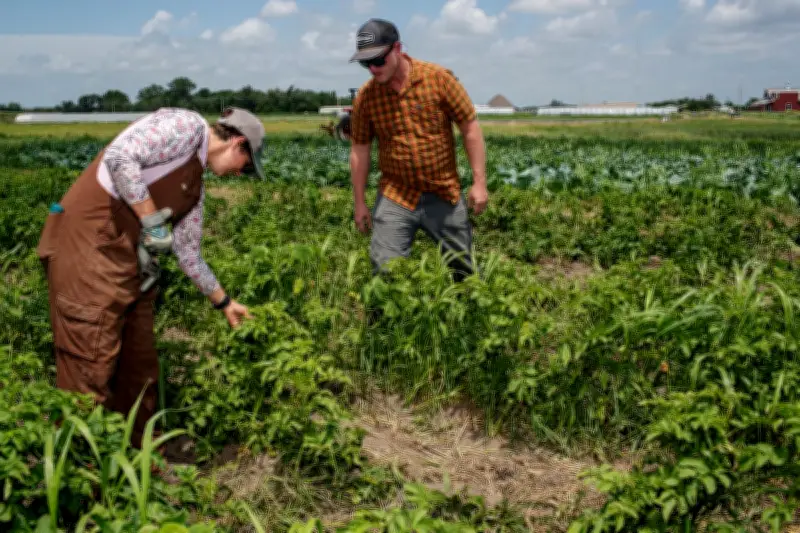
The USDA cancelled a $2.5m grant for Iowa Valley RC&D, ending a fellowship for new farmers like Lawrencia Rogers. A federal judge ordered reinstatement of $127m in grants, but the program remains disrupted.
Fellowship Cut Short
Lawrencia Rogers, 33, began a two-year fellowship in March 2025 with Iowa Valley Resource Conservation and Development (RC&D), funded by the USDA. The program provided land, equipment, and mentorship. Two and a half weeks later, the USDA cancelled the $2.5m grant, calling it wasteful spending and a DEI initiative.
"You feel like a slingshot," said Jason Grimm, executive director of Iowa Valley RC&D. The non-profit put the fellowship on hold, affecting trainees like Rogers, who lost her living wage, health insurance, and paid time off.
Impact on Small Farmers
Anna Pesek, who farms poultry, pigs, and flowers in eastern Iowa, said the cancelled funding is "the cherry on top" for farmers already facing hard times from tariffs and the war with Iran. James Nisly, a farmer near Iowa City, lost 20% of his cashflow when the USDA ended a program that purchased local food for schools and food banks.
"All of the policy activity that I’ve seen is hugely beneficial to the very large corporations, and detrimental to the small-business operators," Nisly said.
Economic Turmoil
Agriculture accounts for a third of Iowa's economic output and a fifth of its jobs. After Trump levied tariffs, China bought fewer US soybeans, impacting Iowa, the second-largest soybean producer. The war with Iran raised costs for fertilizer, gasoline, and diesel. In 2025, 18 Iowa farms declared bankruptcy, a 220% increase from the previous year, according to the American Farm Bureau Federation.
The USDA lost 20,000 employees nationwide since Trump returned to office, including 17% of its staff in Iowa, amid efforts to shrink the federal workforce.
Program Cancellations
The USDA cancelled the Local Food Purchase Assistance Cooperative Agreement Program (LFPA) and the Local Food for Schools Cooperative Agreement Program (LFS), which funded purchases of local produce. A USDA spokesperson described LFPA as a pandemic-era program not intended to be permanent. Farmers say these programs were crucial revenue sources.
Carly McAndrews, a vegetable farmer in Iowa City, said when the USDA announced $1bn in assistance for specialty crops, her local office couldn't help because the deadline was the same week. "It was a functionless program, in my experience," she said.
DEI Label Disputed
The fellowship Rogers was enrolled in was part of the Increasing Land, Capital, and Market Access Program, created under Biden to assist underserved producers. Grimm disputed the USDA's claim it was a DEI initiative. "There was no requirement of a specific cultural or racial background to be able to participate in our programs," he said.
Rogers, whose father is Egyptian, said the DEI label felt like "an extra slap in the face." She and the other fellow, an immigrant from Sudan, were hired based on qualifications. "It's not that nobody else wanted these positions," she said. "People are not begging to be farmers, but we are."
Midterm Implications
Democrats hope to capitalize on farmer discontent in Iowa's 2026 midterm elections, targeting the open US Senate seat, governor's mansion, and three House seats. The first congressional district, where Republican incumbent Mariannette Miller-Meeks won by about 800 votes in 2024, is a key battleground. Farming and food are expected to be major voter issues.




