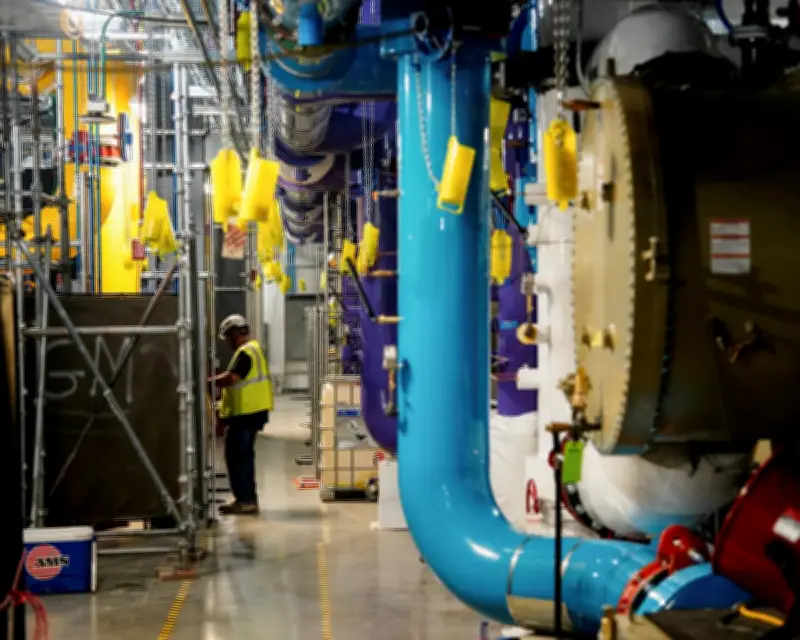
Microsoft, Amazon and Google's collective carbon emissions have increased by nearly a fifth over the past year, driven largely by datacentre construction for artificial intelligence. In the financial year ending March 2026, the three tech companies emitted 119 million metric tonnes of carbon dioxide equivalent (mTCO₂e), about a third of France's total emissions. The previous year, they emitted roughly 101 million mTCO₂e, equivalent to Czechia's 2024 emissions.
Datacentre Expansion Fuels Emissions Growth
The US companies' climate ambitions have been hit by a boom in demand for cloud services related to training and operating chatbots and other AI products. In its sustainability report released Thursday, Microsoft said its carbon emissions increased by 25% over the past year to 20 million mTCO₂e, driven primarily by datacentre infrastructure expansion. Google reported an 18% increase in emissions, citing supply chain activities supporting rapid business expansion. Amazon reported a 16% overall increase and a 20% rise in supply chain emissions, including datacentre construction.
Criticism of Net Zero Claims
Cecilia Rikap, an economics professor at University College London, said: "Claims by Microsoft, Amazon and Google about their clouds being ecologically friendly and sustainable are a marketing strategy. Governments should remember these expanding carbon footprints when the very same companies offer addressing the ecological crisis with AI solutions." She added that shifting to the cloud helps other corporations obscure their environmental footprint.
AI Infrastructure Investment Surge
The bulk of these emissions comes from a global push to build AI infrastructure. The world's biggest tech companies are on track to spend $765 billion this year, mostly on building AI datacentres in locations from Norway to North Tyneside. This reverses a years-long trend of cutting emissions. Prior to this year, Microsoft's emissions had flatlined at 16 million mTCO₂e in 2023 and 2024. All three companies still aim for net zero: Google and Microsoft by 2030, Amazon by 2040.
Carbon Credit Shortage
Shaolei Ren, a professor of electrical engineering at the University of California, Riverside, noted a correlation between emissions increases and AI investment. He pointed out that Microsoft's report suggested fewer carbon credits available globally to offset emissions. "While companies are actively investing in or purchasing carbon credits, the figure suggests a possible lack of credit supply in the carbon market to meet the technology companies' needs," he said.
Future Datacentre Construction
JLL, a US property consultancy, expects about 1,200 datacentres to be built globally by 2030, with demand overwhelmingly driven by AI. The Uptime Institute estimates that big datacentre projects announced last year would consume 1.3% of the world's electricity usage, nearly doubling current datacentre demand, with most new power demand coming from US projects.