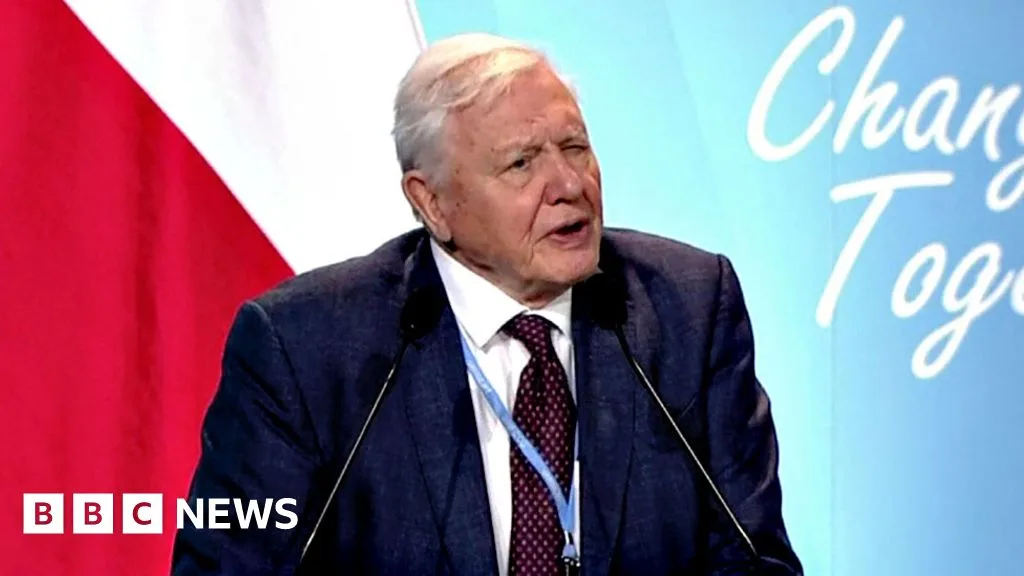
Legendary broadcaster Sir David Attenborough has issued a dire warning about humanity's future, predicting that the state of the planet will worsen significantly by 2030 and beyond. The iconic naturalist, who celebrates his 100th birthday on Friday (May 8), has long been heralded as the natural world's biggest champion and has been vocal about the threats facing Earth.
In 2020, as the world was in lockdown due to Covid-19, Sir David made what he called a 'personal witness statement' about the threat of climate change. Many of the dire predictions he made are beginning to come true. Back then, he warned that within ten years, with much of the Amazon rainforest becoming a dry desert and the polar icecaps shrinking, the effects of climate change would become truly irreversible and threaten the extinction of humanity.
A Personal Appeal to World Leaders
As he released his Netflix documentary A Life on Our Planet, Sir David made a personal appeal to world leaders. He said: 'There are short-term problems and long-term problems. Politicians are tempted to deal with short-term problems all the time and neglect long-term problems. [Climate change] is not only a long-term problem, it is the biggest problem humanity has ever faced. Please examine it, and please respond.'
The Prognosis for the Century
The prognosis for the rest of the century looks bleak if Sir David's predictions are to be believed. He said that if he had been born in 2020, instead of 1926, he would witness the full range of climate collapse. In the 2030s, the Amazon Rainforest, cut down until it can no longer produce enough moisture, degrades into a dry savannah, bringing catastrophic species loss and altering the global water cycle. At the same time, the Arctic becomes ice-free in the summer. Without the white ice cap, less of the sun's energy is reflected back out to space, and the speed of global warming increases.
By the 2040s, just 14 years from today, Sir David predicts that throughout the north, frozen soils thaw, releasing methane, a greenhouse gas many times more potent than carbon dioxide, accelerating the rate of climate change dramatically. Through the 2050s, as today's schoolchildren reach middle age, the world's seas will become a sterile desert: as the ocean continues to heat and becomes more acidic, coral reefs around the world die, and fish populations crash.
Into the 2080s, mankind truly becomes an endangered species: global food production enters a crisis as soils become exhausted by overuse, pollinating insects disappear, and the weather becomes more and more unpredictable. The stable climate that has endured longer than human civilisation will be lost forever by 2100, Sir David says. 'Our planet becomes four degrees Celsius warmer,' he adds. 'Large parts of the earth are uninhabitable. Millions of people rendered homeless. A sixth mass extinction event... is well underway.' He describes these various tipping-points as 'a series of one-way doors,' with each bringing irreversible change.
Humanity Under Threat
Average global temperatures have risen by more than 1°C since the 1850s. Since 2015, every successive year has brought record high temperatures, causing heatwaves, floods, droughts, and fires as well as irrevocable habitat loss for many species. Sir David thinks that humanity is the species most under threat. He said: 'I used to think this was about saving the planet, and now I realise it's not... nature will always look after itself. It's about saving us.'
He was one of the first to sound the alarm about humanity's impact on the environment. In 1937, the total human population was around 2.3 billion. Carbon in the atmosphere was measured at 280 parts per million, and 66% of the planet remained unspoiled wilderness. 'Everywhere you'd go, there was wilderness. Sparkling coastal seas. Vast forests. Immense grasslands. You could fly for hours over the untouched wilderness,' Sir David said.
By 1960, less than 30 years later, the change was already measurable. The global population was now three billion, atmospheric carbon was measured at 315 parts per million, and the remaining wilderness had shrunk to 62%. Fast forward to 1997, the population had more than doubled to almost six billion, carbon in the atmosphere had increased to 360 parts per million, and much more wilderness had been lost – now down to 46%.
'The global air temperature had been relatively stable till the '90s,' Sir David said. 'But it now appeared this was only because the ocean was absorbing much of the excess heat, masking our impact. It was the first indication to me that the earth was beginning to lose its balance.' Unsustainable logging, overfishing, and above all the reckless use of fossil fuels was pushing the planet to a tipping point, he warned: 'The average global temperature today is one degree Celsius warmer than it was when I was born, a speed of change that exceeds any in the last 10,000 years. Summer sea ice in the Arctic has reduced by 40% in 40 years.'
Wildlife Pushed to the Margins
The wildlife that has been Sir David's lifelong interest has been pushed to the margins: 'Half of the fertile land on earth is now farmland. 70% of the mass of birds on this planet are domestic birds. The vast majority, chickens. We account for over one-third of the weight of mammals on earth. A further 60% are the animals we raise to eat. The rest, from mice to whales, make up just 4%.'
Despite the bleak outlook, Sir David says all hope is not lost. One solution is to stabilise population growth, and another is to switch to renewable energy.






