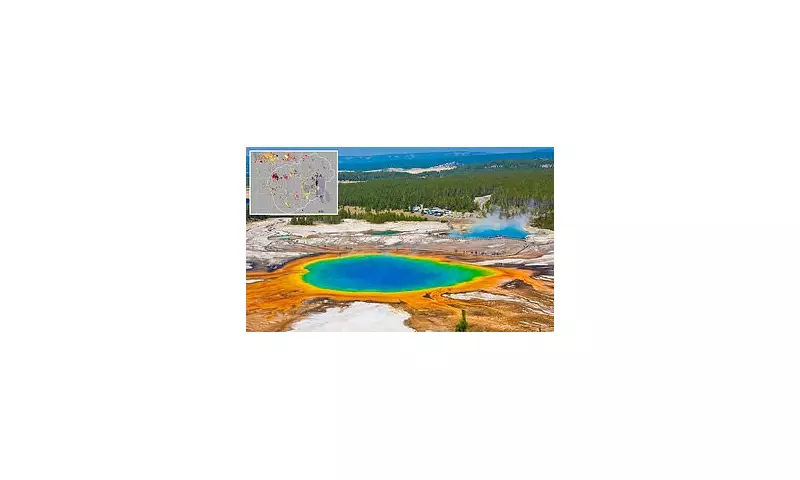
In a seismic revelation, artificial intelligence has uncovered tens of thousands of tiny earthquakes that went undetected for years beneath the Yellowstone supervolcano, offering a transformative new tool for predicting future natural disasters.
The AI Seismic Detective
An international research team, including scientists from the US Geological Survey (USGS), Canada, and Columbia, employed advanced machine learning to analyse 15 years of seismic recordings from Yellowstone National Park. The AI sifted through data from 2008 to 2022 with incredible speed and precision, discovering a staggering 86,276 previously hidden earthquakes. This figure is roughly ten times more seismic activity than experts had previously catalogued.
Unlike traditional methods that require manual inspection of vast datasets, the AI programme meticulously identified every minor tremor. Crucially, it placed each event on a highly accurate 3D map, allowing scientists to visualise the unseen seismic patterns of Yellowstone during its quiet, non-eruptive periods for the first time.

Yellowstone's Water-Driven 'Heartbeat'
The results painted a surprising picture of the supervolcano's inner workings. The research, published in the journal Science Advances, revealed that more than half of these tiny quakes occurred in connected groups known as swarms.
These swarms are driven almost entirely by the movement of hot underground water and steam through cracks in the rock, not by rising magma. This discovery proved that Yellowstone has a steady, repeating 'heartbeat' of hydrothermal activity. The swarms come and go in the same areas every few years, which scientists confirm is normal behaviour with no indication of an impending eruption.
Professor Valentin Troll, a volcano expert from Uppsala University in Sweden, who was not involved in the study, emphasised this point to the Daily Mail, stating the clusters are "not associated with deep seismicity" and show "no direct evidence of magma recharge from greater depths."
A Blueprint for Future Disaster Prediction
While the study found no immediate danger at Yellowstone, its true significance lies in the future. The AI has effectively built a perfect seismic fingerprint of the supervolcano's normal activity.
This breakthrough will be critical for detecting hidden earthquake patterns at volcanoes and major fault lines worldwide, which can serve as early warning signs. Scientists can now look for deviations from this baseline, such as swarms that start much deeper, last longer, or migrate in abnormal ways. These could signal magma movement or the impending rupture of a major fault like California's San Andreas.
Dr Bing Li, a study author, highlighted the broader application: "While Yellowstone and other volcanoes each have unique features, the hope is that these insights can be applied elsewhere." The same machine learning techniques can be used to review historical seismic records globally, allowing scientists to listen to 'Earth's volcanic heartbeat' and spot missed patterns.
The implications are vast, from improving public safety measures and risk communication to guiding geothermal energy development away from hazardous zones. The research stands as a powerful demonstration of how artificial intelligence can sharpen our understanding of the planet's most powerful and potentially destructive forces.