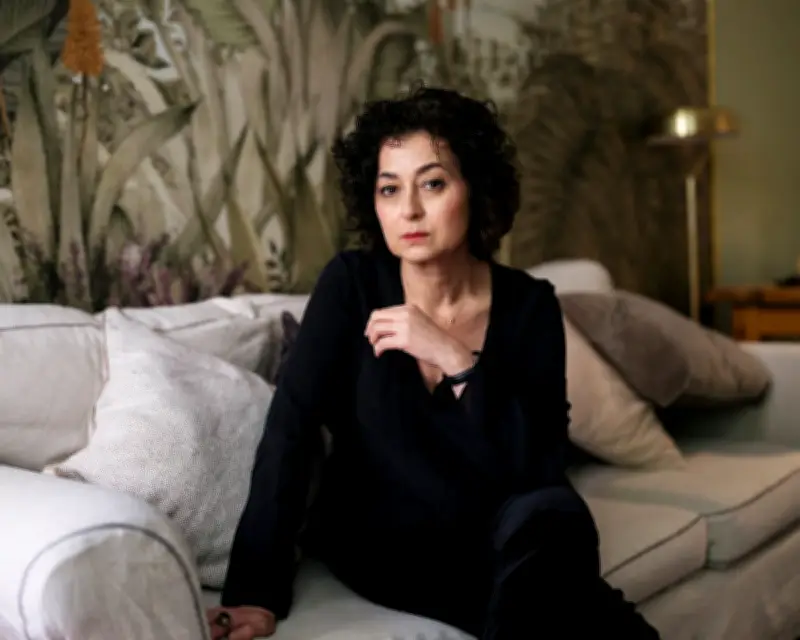
One summer evening in 2022, Turkish writer Ece Temelkuran found herself in a doctor's office in Hamburg, Germany, lying on a stretcher with an IV drip. After six intense years of work and travel, her body gave out. In her latest book, Nation of Strangers, shortlisted for the 2026 Women's Prize for Nonfiction, she writes: 'I now know that I need to talk. I fear that not speaking will make me really sick. And when homeless, you cannot afford to get sick.'
Temelkuran had not been silent before. She published How To Lose a Country: The Seven Steps from Democracy to Fascism (2019) and Together: A Manifesto Against a Heartless World (2021). She warned audiences across the West: 'This is what happened to us in Turkey – make sure it doesn't happen to you.' She is not technically homeless; she lives in Berlin. But by 'speaking' and 'home,' she means something vast. Nation of Strangers argues that the idea of home is a dominant political force of our time.
From Journalist to Exile
Temelkuran became a journalist at 19 while studying law. She worked as a senior reporter for CNN Türk and a political columnist critical of President Recep Tayyip Erdoğan. She published novels and prose poems. For years, she thrived in male-dominated newsrooms in a patriarchal, nationalistic culture. But as Erdoğan tightened his grip, life grew harder: death threats, rape threats, and emails 'reporting my life minute by minute' to show she was watched.

She and her colleagues laughed it off. 'And then our friend Hrant Dink was killed,' she says, referring to the Armenian journalist assassinated by a Turkish nationalist in 2007. 'One day before that, we were joking – comparing death threats.'
Her books were used as evidence in arrests. Soon, columns called for her detention. One night, she woke to find the iron bars on her windows removed and a window open. Nothing was taken, but she saw it as a message: 'We could do it.' On 6 November 2016, she called her mother from Zagreb, Croatia, to say she wasn't coming back. 'A one-minute phone call; half of it was silence. That's all it took for me to become homeless.' She was 43.
The Struggle of Speaking
Temelkuran despises telling her story. It makes her 'cringe – politically, morally, emotionally.' She fears appearing as 'a whining exile demanding recognition.' She hates the objectification the label brings. She writes three books to urge caution about fragile havens, merging novelist, poet, reporter, and columnist with a lifetime of absorbing culture. She wrote them all in English.
English was a way to deny her feelings. 'It was really complicated what I went through,' she says. She moved to Zagreb, knowing only one person, drawn by a billboard reading 'Why Zagreb?' People asked why she chose Zagreb over London or Berlin. 'This is exactly why I stayed,' she says. 'I wanted to be alone and understand what happened to me. How people let go of those they should support. Fascism doesn't happen with evil guys taking over. It happens with a million complacencies. That breaks your heart in an impossible way.'
Emotion and Politics
She also dealt with what she saw before leaving: reporting on earthquakes, interviewing a mother who ran over her daughter with a tractor to prevent an 'honour' killing, charting how people kill each other for nationalist stories. She wouldn't tell westerners because 'they'd be traumatised.'
Writing in Turkish would be 'too emotional.' English allowed her to 'be a brain, only a brain.' She refused to listen to Turkish music or meet Turkish people. Then she ended up at the doctor's. In Nation of Strangers, she ventures into Berlin's Turkish area and has a Turkish coffee. The world doesn't disintegrate; it becomes more whole. That is her point: national stories need to be told differently. Emotion is political, especially as more people feel unhomed due to war, political shifts, AI, cost of living, or climate crisis. The left ignores this at its peril, she argues, while the right hasn't.
On her book tour, she met 'American exiles' who feel under threat. Many Germans feel it too. 'Those who write and think have a new moral responsibility to care about how people feel,' she says. 'Loneliness, fear, anxiety – these emotions are weaponised by the far right.'

Calling It Fascism
Temelkuran is impatient with those who avoid the term 'fascism.' She believes westerners think fascism cannot exist in a free-market economy, or they cling to a strict historical definition to keep it in the past, or they fear being seen as 'crazy countries.' 'Once you call it fascism, you have to do something,' she says. 'If you call it authoritarianism, you can sit back and treat it as a passing fancy.'
She thinks the UK is stuck at the laughter stage. 'Nothing is hilarious at the moment. People should allow themselves to be very serious. I'm afraid when Nigel Farage comes to power, or when Trump shows up in London, they will still laugh to feel safe.'
She acknowledges that those marching with Tommy Robinson may feel loss of home. 'Home stands at the heart of the zeitgeist. I lost my home because of fascism, but those afraid of losing their homes weaponise that to build fascism.'
Temelkuran believes in paying attention as a moral act. 'Paying attention is being there, not observing. It means accepting messiness and seeing common ground.' She says audiences get teary when she speaks of human love in politics. 'They're exhausted from survival mode.'
Politics as Morality
Her parents got together after her father, a lawyer, had her mother, a militant-left activist, released from jail by sending a general photos of his daughter at a demonstration. For Temelkuran, politics is morality. 'Your political choice makes you who you are – whether you're a good person or a bad person. Our political vocabulary will be less soft. We will have to talk about sacrifice. Gaza was an experiment. Are you going to sacrifice your career? That question will absorb all of us.'
Each summer, her family meets on Lesbos, the Greek island that hosted the Moria refugee camp. They chose it because it's easy for her parents. For a week, they try not to discuss dark topics – but it's hard when, in clear weather, they see the Turkish coast.