
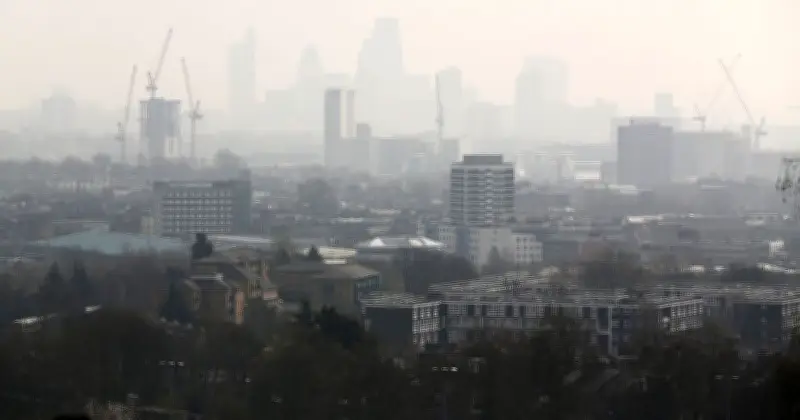
New figures from the Geographic Data Service show that parts of Camden, including Holborn, St Giles, and Covent Garden, are the most polluted in the UK. Residents breathe in an average of nearly 21 micrograms of fine particulate matter (PM2.5) and over 34 micrograms of nitrogen dioxide (NO2) every year. The World Health Organisation (WHO) recommends levels should not exceed an annual average of five micrograms of PM2.5 and 15 micrograms of NO2. Scientists stress that even these limits are not "safe" as pollutants can cause damage at any level.
Residents report health issues and double washing
Mohammed Rahman, 72, who lives in an estate in the area, told the Daily Express: "My eyes get very itchy. The pollution is very bad here especially now [during summer]. I see it in my home. The dust comes up and comes inside. I do my washing in the bath and when I dry it it gets covered in particles again. I then have to do my washing again." He has been forced to keep his windows shut this summer despite the hot weather, explaining that black particles get blown inside if he keeps them open for a long time.
A second man named Mohammed, 47, who did not want to give his surname, lives near the HS2 at Euston and says living conditions have got noticeably worse. He also leaves his windows shut and is forced to do "double washing" due to dust. He said: "It's shocking. I'm one of the victims of HS2, I live right next to it and the conditions we are living in now are worse than before. In the summer time, when we leave windows open, we have to do double washing as it's so dusty. It's been worse this summer. My kids have itchy noses and it's like hayfever." He was recently diagnosed with a breathing problem and is questioning whether it is related to pollution.
HS2 construction adds to pollution
Work is underway for the HS2 at Euston, a planned central London terminus for the high-speed railway, with underground tunneling toward the station. The construction work has negatively impacted local air quality, contributing to dust, particulate matter and nitrogen dioxide emissions from heavy machinery.
Alice Ray, 38, who lives with a chronic illness, says she avoids travelling on the Tube because of concerns about air pollution. "I avoid the tube because when I come off, I have like black soot in my nose. We don't know what's in there. It's kind of everywhere - the waterways, the air, the earth, it's all connected," she said. She has lived in Chalk Farm for around 10 years but has considered relocating due to the pollution.
Fly-tipping and health concerns
Lynda Henman, 60, who has lived near Brill Place for around 15 years, says fly-tipping and littering have become increasingly prevalent. "A lot of people dump rubbish on the estate where I live and it's filthy," she explained. "More needs to be done as there's so much rubbish all over the place. It no doubt contributes." Her sister, who passed away recently, experienced itchy eyes and coughing.
Evalyn Tudisco, 21, recently started a new job in Holborn. Although she knew pollution was bad in London, she wasn't aware the area was the worst affected in the UK. She has moved from Leighton Buzzard, Bedfordshire, and already notices a change in air quality, suffering from itchy eyes and coughing which she initially attributed to hayfever.
Data on health impacts and responses
Long-term air pollution exposure causes 36,000 early deaths each year in the UK, and 4,100 in London. According to Imperial College London, air pollution in Camden causes around 109 early deaths every year. Their research shows commercial buildings are the main source of air pollution in the area, contributing to 47% of NO2 emissions and 51% of PM2.5 emissions.
A Camden Council spokesperson said: "Improving air quality is one of our top priorities, and we have made significant progress in recent years. This includes helping to tackle air pollution through cleaner transport, stricter planning policies, electric vehicle infrastructure, and educational sessions reaching thousands of residents and schoolchildren. Camden was the first local authority in the country to adopt World Health Organization air quality standards, which go further than national legal limits. Our extensive monitoring network shows a 21% reduction in annual average nitrogen dioxide in central Camden locations between 2023 and 2025, with pollution levels in areas including Holborn, Clerkenwell, Covent Garden and St Giles falling considerably and meeting the UK legal limit. Whilst we welcome that progress, we know there is still more to do. Too many people are still exposed to unhealthy levels of air pollution, which is why we're continuing to work towards meeting WHO standards across the borough by 2034 and calling for stronger national action to help improve air quality even further."
A spokesperson for the Mayor of London said: "Bold action taken by the Mayor, including introducing the world's largest clean air zone, has reduced pollution, improved Londoners' health and saved lives. It has helped to bring London within legal limits for NO2 pollution for the first time in 2024 – 184 years earlier than experts forecast meaning that all Londoners are now breathing cleaner air. Despite this significant progress, the evidence shows air pollution is still contributing to thousands of premature deaths. That's why the Mayor is committed to continuing his work to clean up London's air and build a greener, fairer city for everyone."




