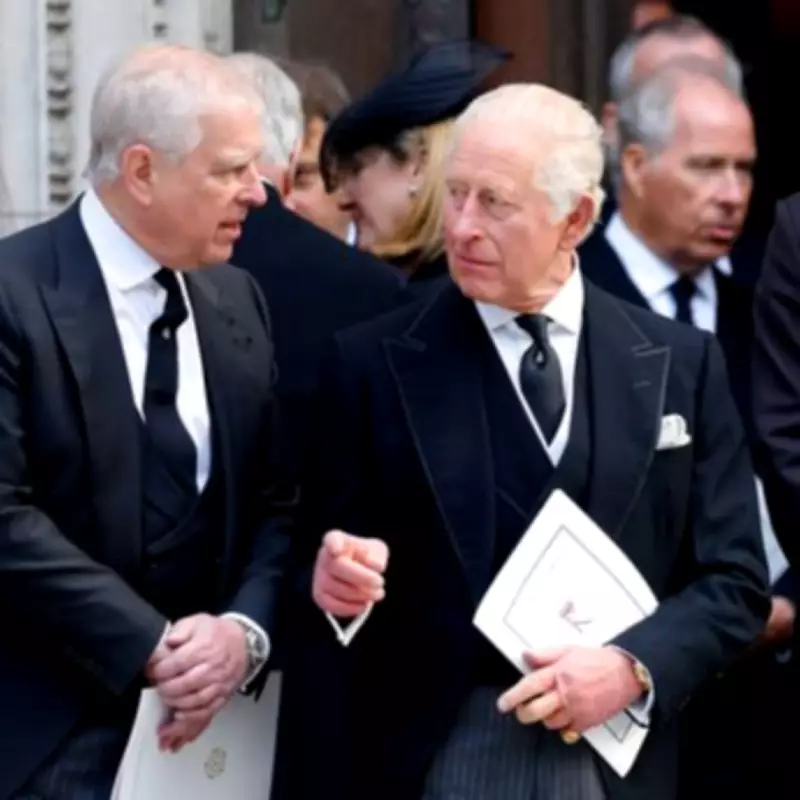
The relationship between King Charles and his younger brother, Prince Andrew, has deteriorated to an irreparable state, with royal insiders now asserting the two will never be seen together in public again. This profound estrangement follows the King's decisive actions against Andrew in the wake of allegations connected to convicted sex offender Jeffrey Epstein.
The Unbridgeable Divide
The rift reached its nadir last month when King Charles offered his "wholehearted support and co-operation" to authorities investigating Andrew on suspicion of misconduct in public office. Andrew was detained for approximately eleven hours following allegations that he shared sensitive information with Epstein during his tenure as the UK's trade envoy. This arrest occurred despite Andrew's previous denials of any wrongdoing concerning his links to the disgraced financier.
Palace Actions and Statements
Buckingham Palace has taken significant steps, stripping Andrew of his remaining royal titles in October and relocating him from the Royal Lodge in Windsor to a cottage on the Sandringham estate. A palace statement, which notably did not refer to Andrew as the King's brother, declared: "These censures are deemed necessary, notwithstanding the fact that he continues to deny the allegations against them. Their Majesties wished to make clear that their thoughts and emotions remain with the victims and survivors of any and all forms of abuse."

Historical Resentments Surface
Royal biographer Andrew Lownie, author of Entitled: The Rise and Fall of the House of York, reveals that the resentment runs so deep that "I don't think we'll see Andrew at Charles's funeral." Lownie explains that tensions existed long before the Epstein scandal, with Andrew resenting Charles for perceived privileges and Charles resenting Andrew for opportunities he himself was denied.
"Andrew resented Charles. He felt that he could do a better job. Charles resented Andrew. He felt that Andrew was allowed to do things he couldn't do," Lownie states, citing Andrew's ability to fly missions in the Falklands War while Charles was kept from naval service as a particular source of friction.
Betrayal and Broken Trust
Robert Jobson, author of The Windsor Legacy: A Royal Dynasty of Secrets, Scandal and Survival, claims the King feels profoundly betrayed by revelations from the "Epstein files" released by US authorities. According to Jobson, citing a source close to the King, Charles and Andrew had a significant conversation around 2013 or 2014 where Andrew gave "complete and utter assurance" and "unequivocal reassurances" that he had done nothing wrong regarding Epstein.
Public Manifestations of Estrangement
The estrangement has become visibly apparent in royal engagements. Senior royals, including the Prince and Princess of Wales, attended Westminster Abbey last week for the Commonwealth Day service—their first joint engagement since Andrew's arrest. Led by the King, they ignored protesters holding placards referring to the former prince, who hasn't attended the service since 2019.
The brothers haven't been seen together publicly since the funeral of the Duchess of Kent in September, where the King did not acknowledge Andrew, and Andrew's attempts to engage Prince William were met with only stiff nods. Royal commentators now suggest this separation will extend even to family Christmases at Sandringham, traditionally occasions for royal unity.
Andrew's Current Situation
Andrew now lives in relative solitude under strict rules imposed by King Charles following his arrest. Lownie adds that "Andrew is not a forgiving type. He feels that Charles has thrown his family under a bus to cover the problem," indicating the bitterness runs both ways and suggesting any reconciliation appears increasingly improbable as the royal family distances itself from the ongoing controversy.