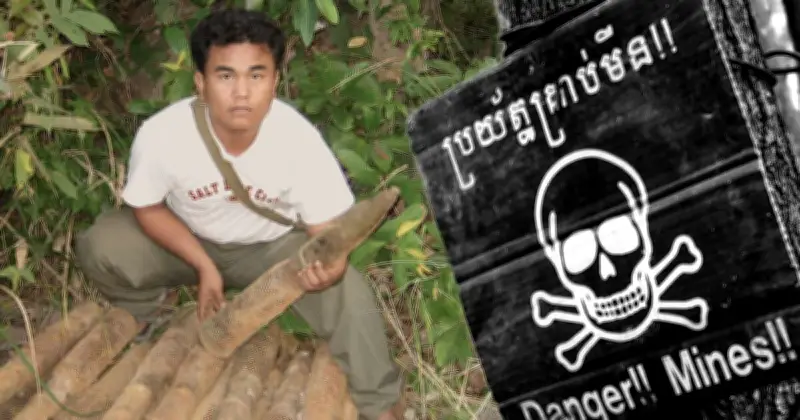
Aki Ra, a slight Cambodian man in his 50s, sits in a London coffee shop and grins as he demonstrates pulling an imaginary firing pin from his coffee cup. He is explaining how simple it is to lay a landmine. This former child soldier of the Khmer Rouge has an extraordinary story, now told in the documentary My Husband the Child Soldier, which has been winning awards at film festivals worldwide.
A Childhood of War
Aki Ra was too young to remember when the Khmer Rouge arrived in his village. They killed many adults, including his parents—his father was a teacher, considered a threat by the regime. Under Pol Pot, literacy was dangerous, and teachers were executed. Aki Ra's first memories are of living on a farm with hundreds of other children, cared for by women soldiers. He recalls being sent to hunt with rocks and sticks, and a makeshift school where they wrote on boards cut from the jungle. 'Very happy,' he says, describing his childhood as 'very fun.'
Forced to Fight
By age ten, Aki Ra was handed a Chinese SKS rifle and sent into battle. He fought against Vietnamese soldiers, witnessing friends die regularly. 'We feel a little bit sad, but it's just normal,' he says. At night, children were sent to clear paths through enemy minefields by moonlight, feeling for mines with their hands. 'It was like a game,' he recalls.

From Laying to Clearing Mines
Aki Ra became one of Cambodia's most prolific minelayers. When the UN arrived in 1993, they offered him work clearing mines for $60 a month. He took the job and decided to spend his life removing the mines he had laid. 'I did lay a lot of landmines in my country. Then I want to clear them all. Make feel better,' he says. Working alone with homemade tools, a bicycle, and two oxen, he estimates he decommissioned more than 50,000 mines between 1993 and 2007 without any official equipment.
A New Mission
Aki Ra now runs a small demining team, funded by donations and visitors to his Cambodia Landmine Museum near Siem Reap. With his late wife Hourt, he fostered dozens of children maimed by mines. After Hourt's sudden death, he stepped back but soon returned to clearing mines. He proudly introduces a team member called Mr Lucky, who lost his leg to a mine and then stepped on three more. 'He stood on every mine with his plastic leg,' Aki Ra laughs.
Forgiveness and Peace
Film director Tom Peppiatt, who has followed Aki Ra for 20 years, says, 'He is the embodiment of a humanitarian. He was indoctrinated into one of the cruellest regimes, yet everything he has done since is the opposite.' One of the most powerful moments captured is Aki Ra's annual visit to a pagoda where he shares food with a monk believed to have executed his parents. When asked about forgiveness, Aki Ra says, 'We don't want to fight again. We want peace. From bad to good. Like me.'