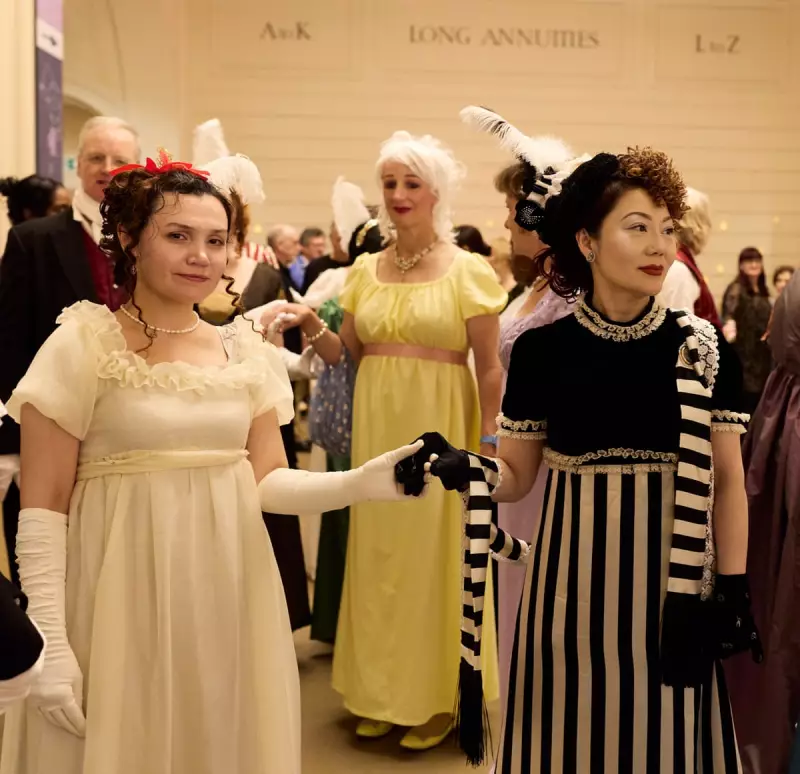
In the grand, high-arched lobby of London's Bank of England Museum, the air hums with the sound of violins and animated chatter. Rows of dancers, women in flowing satin gowns and men in formal tailcoats, twirl and step in time. This scene, a celebration for the 250th anniversary of Jane Austen's birth, is part of a growing movement where enthusiasts of the Regency period gather to revive the social dances of the early 19th century.
The Social Fabric of Historical Dance
These events, organised by historical dance societies across the country, attract a diverse group. They include devoted Austen readers and fans of the popular Netflix series Bridgerton, all seeking connection through shared steps. Irina Porter, who became friends with 73-year-old David Symington through dancing, highlights the communal spirit. "People who take part get a lot of personal interaction – something we are gradually losing," she says. The practice of changing partners fosters introductions and a unique sense of community.
Gemima Lodge, 40, agrees, calling it "a really effective socialising space" where regulars build lasting connections. The commitment often extends to authentic costume. Attendees commission tailors, craft their own garments, or buy Bridgerton-inspired outfits online. Friends Mary Davidson, 26, and Lian Cooper, 37, sew Regency dresses from repurposed bedsheets, curtains, and secondhand sarees. "Everyone is so disconnected, stuck behind their phones now," Davidson observes. "We're harking back to the old times... it's really fun and social."

Decoding the Dances: From 1700s Manuals to Modern Algorithms
Recreating these dances requires meticulous study of original sources. Organisers interpret 18th-century manuals that detailed the popular contredanses, named for partners standing opposite each other. Key texts include John Playford's 1651 'The Dancing Master', with written instructions, and the work of Thomas Wilson, which used intricate swirling diagrams known as dance notations.
Dance historian Jennifer Thorp, an emeritus archivist at New College, Oxford, explains the significance of the Beauchamp-Feuillet system. First published by Raoul-Auger Feuillet in 1700 in his book Chorégraphie, it recorded courtly dance steps in geometric patterns. His 1706 manual for contredanses used a Simplified Feuillet system, translated into English by John Essex in 1710. "You get the tune at the top of the page and then these floor plans telling people where to go," Thorp says.
Today, Paul Cooper of the Hampshire Regency Dancers transforms these archaic instructions into animated guides. He sees a direct link to modern computing. "The instructions, as written, are close to being a computer programme," Cooper notes. "There's iterative activity and a sort of algorithm to it... Some of these dancing masters would probably do quite well as computer programmers." His work involves solving ambiguities in the often-terse original texts.
Adapting History for Contemporary Communities
Some dances are modified for modern preferences. The Triple Minor, a popular country dance in Austen's day, originally left the third couple with little to do—a chance for whispered conversation. "We're much more interested in enjoying the dance," says Cooper. His group adapted it so all three couples take a turn leading, ensuring equal participation.
The community also revives obscure dances. The Duke of Kent's Waltz (c.1802) is now a favourite, described as "quite a swishy" number by caller Jorien van der Bor. She also highlights the popularity of Mr Beveridge's Maggot, the dance from the 1995 Pride and Prejudice adaptation, despite it being historically anachronistic. "Many people in our community just love that particular adaptation," she admits.

At the Bank of England ball, caller Helen Davidge favours The Duchess of Devonshire's Reel, choreographed by Charles Ignatius Sancho. Sancho was sold into slavery as a child and later became a noted composer and abolitionist. Davidge founded the Georgettes of Oxford society in 2023, seeking community, a fusion of history and ballet, and escapism. "The world is so busy, and sometimes quite a scary place," she reflects. "To have a space to just come and focus on your body, dancing and sharing that with other people – it's a little break."
For participants like Jorien van der Bor, who met partner Paul Cooper after he kept steadying her on a trippy carpet, these events are more than historical re-enactment. They are living, breathing social traditions, offering a graceful step away from the digital age and into a shared, physical heritage.