Exit 8 Review: A Psychological Mystery Inspired by Video Game Horror
A glitch in the matrix, a tear in the fragile fabric of existence, and suddenly everything we thought we knew about the world is extinguished or perhaps unveiled for the very first time. We confront its arbitrariness, its cruelty, and its vast indifference to the lab rats scurrying frantically within it, heading toward an unimaginable death. Genki Kawamura's psychological mystery, Exit 8, draws inspiration from the Japanese video game of the same name, as well as the repetitive cycles of Groundhog Day and the vertiginous perspectives of the Overlook Hotel in The Shining, with corridors whose corners cannot be rounded without encountering something horrifying.
A Commuter's Entrapment in a Subway Station
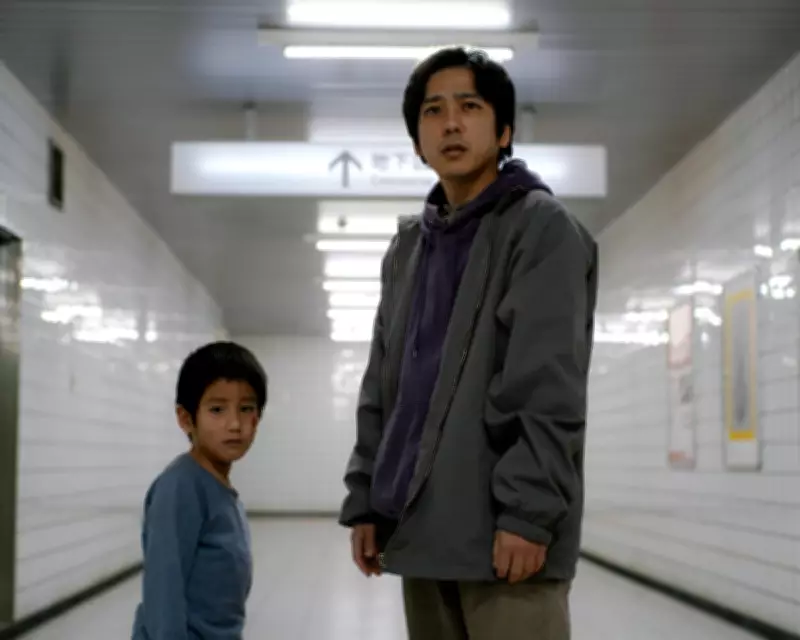
Kazunari Ninomiya portrays a depressed young man on a crowded rush-hour Japanese subway train. One day, he witnesses a boorish commuter screaming at a young mother for not keeping her baby quiet. Upon alighting at the platform, he receives a call from his ex-girlfriend, and that iPhone ringtone alone is deeply unsettling, likely to prompt every audience member to reflexively reach for their own phone with guilty dread. She reveals that she is pregnant, and the coincidence of these events unnerves the young man profoundly.
He navigates lengthy, echoingly empty white-tiled passageways, heading for the correct exit, Exit 8, a number that resembles a snake eating its tail, evoking the endless Möbius strip seen in posters for an Escher exhibition adorning the walls. Patiently, he follows the signs for Exit 8 until he realises he has returned to his starting point. Another eerie, fruitless circuit reveals the same impassive man walking past him at the same spot. With irritation, dismay, and then mounting existential panic, he understands that he cannot find the way out. The exit has vanished. He is trapped.

Rules and Anomalies in a Nightmarish Labyrinth
Or is he truly trapped? Some rules posted on the wall indicate that he can escape by simply continuing to walk forward, but he turns back in the opposite direction each time he notices anomalies or inconsistencies in his surroundings. These include the posters, photo-booth machine, pile of rubbish, and locked security doors, whose positioning and shape become as familiar to him and the audience as the layout of their own homes. Each successful circuit mastered thus becomes a completed level in a video game from hell. He begins to form a relationship of sorts with other lost souls in this liminal space, including the impassive man, played by Yamato Kochi, and a small boy, portrayed by Naru Asanuma.
Typically, a film's obvious resemblance to the video game that inspired it results in a fatal inertia or imaginative deficit. In Exit 8, however, this resemblance is the entire point. All these wage-slave commuters on the metro believe in the game of life, taking the blue pill, performing the same routines daily, and completing the levels of their professional careers. They trust that the rules, though fiendishly difficult, are fair on their own terms. But the young man cannot escape. Is his nightmarish paralysis a parable for expectant-father anxiety? Perhaps, but this film does not require a midlife metaphorical reading to be terrifying. It is crushing merely by taking place in featureless modern buildings, what Marc Augé termed the non-places of modernity, whose forms insist on our anonymity and insignificance.
Exit 8 is an elegant, chilly dream of despair, offering a taut, unnerving, and rare example of an adaptation that remains faithful to its video game source. The film is set to be released in UK, Irish, and Australian cinemas from 24 April, promising a haunting experience for audiences seeking psychological depth in horror.