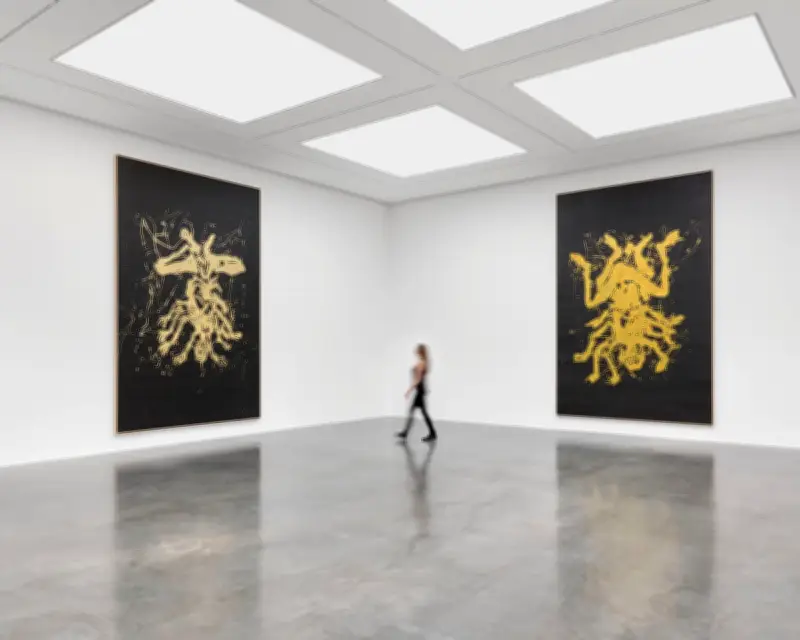
The White Cube gallery in Bermondsey is currently hosting a compelling retrospective of Georg Baselitz, one of Germany's most provocative and influential living artists. The exhibition, which runs until late summer, showcases Baselitz's signature inverted figures and raw, gestural brushwork that have defined his career since the 1960s.
A Career of Defiance
Baselitz, now 88, first gained notoriety in 1963 when his painting 'The Big Night Down the Drain' was confiscated by authorities for obscenity. Since then, he has consistently challenged conventions, notably by turning his subjects upside down from 1969 onwards—a move that forces viewers to focus on form and paint rather than narrative. This exhibition includes early works from that period, alongside later pieces that continue his exploration of the human figure.
The Inverted World
Walking through the gallery, visitors encounter a series of large-scale canvases where heads, limbs, and landscapes hang upside down. The effect is disorienting yet liberating. Baselitz's thick, impasto application of paint and his use of vibrant, often jarring colors create a sense of urgency and emotion. Works like 'The Great Friends' (1965) and 'Adieu' (1982) demonstrate his mastery of both abstraction and figuration.
Later Works and Legacy
The exhibition also features Baselitz's more recent 'Remix' series, where he reinterprets his own earlier paintings, adding new layers of meaning and technique. These pieces show an artist still in dialogue with his past, unafraid to revisit and revise. The show includes sculptures as well, including his iconic 'Model for a Sculpture' (1980), which echoes the distorted, fragmented forms of his paintings.
This retrospective at White Cube is a rare opportunity to see the breadth of Baselitz's work in one place. It confirms his status as a pivotal figure in post-war art, whose influence can be seen in generations of painters who followed. The exhibition is a must-see for anyone interested in the power of painting to provoke and inspire.