For the past 45 years, acclaimed photojournalist Ed Kashi has held what he describes as "a front row seat to witness history". His camera has captured the defining social and geopolitical struggles of our time, from the streets of Derry to the sugarcane fields of Nicaragua. A major new retrospective book, A Period in Time, published by The University of Texas Press, celebrates his prolific and eye-opening career, featuring images that are by turns harrowing, beautiful, and profoundly human.
A Life Through the Lens: From Conflict to Community
Kashi's work is defined by its deep immersion into complex worlds. His journey began in earnest with "Time Out of Mind: The Protestants of Northern Ireland" (1988–90), where he photographed children playing in the Fountain, a Protestant loyalist estate in Derry, against a backdrop of entrenched conflict.
He later turned his lens to the Kurdish struggle, capturing a Kurdish woman on trial in Turkey in 1991, accused of membership in the PKK. This project, When the Borders Bleed, first drew him to the Middle East, a region that would profoundly shape his understanding of his own heritage as a first-generation American.

Perhaps one of his most astonishing subjects is Cairo's "City of the Dead" (1993). Here, some 120,000 people, displaced by housing shortages, have created a thriving community within the city's main cemetery, with homes, schools, and even a glass factory operating among the mausoleums.
Illuminating the Unseen: Human Stories Across Continents
Kashi's photography consistently highlights the resilience of the human spirit in the face of adversity. In Ageing in America: The Years Ahead (1995–2003), he documented the poignant wedding of Gerald Gross and Ricky Caminetti, who fell in love in their 80s in Florida.
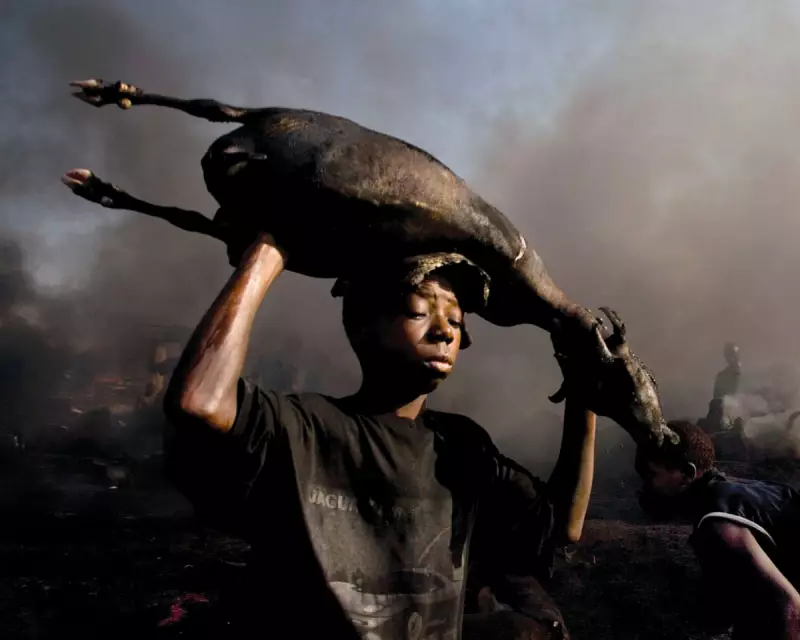
His work also exposes harsh realities. In Nigeria's Niger Delta (2004–06), his series Curse of the Black Gold includes a powerful and distressing image of a 14-year-old boy carrying a goat carcass at the Trans Amadi Slaughter abattoir, a scene set against the environmental degradation caused by the oil industry.
He has chronicled the exodus of Arab Christian communities from the Middle East (2008), the trauma of Syrian refugee children in Iraq (2013), and the epidemic of chronic kidney disease among sugarcane workers in Nicaragua (2013–2023).
The Photographer's Mission: A Living Archive
For Kashi, photography is more than a profession; it is a mission. "Photography is a kind of diplomatic passport to worlds unseen," he states, allowing him to unveil issues that need illumination and document history in the making. He acknowledges the dual nature of this life: witnessing both exquisite beauty and profound suffering.
His archive, built over 45 years, is now a "living library" of our world. From the reunified Berlin of 1991, where he found a city in malaise, to the streets of Saigon in 1994, where traditional ao dai dresses had made a comeback, his images form a unique and expansive historical record.
The new book serves as a testament to his belief that photojournalism must "seek the common good, treat people with respect and dignity, and expose the problems that exist", while always remaining open to capturing the resilience and beauty of the human spirit.