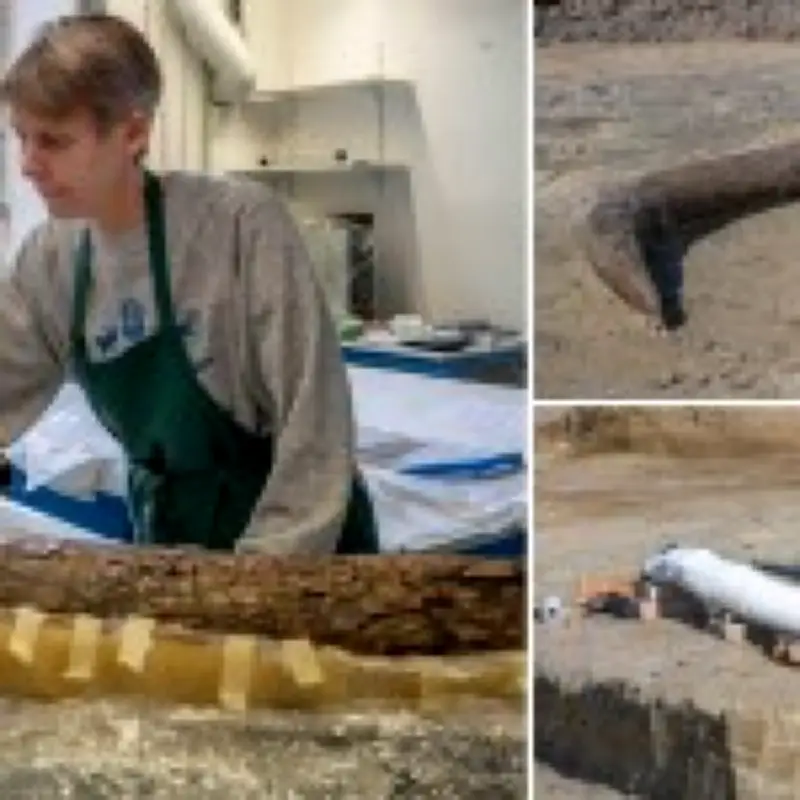
A woolly mammoth whose remains were unearthed in Germany likely met its end at the hands of human ancestors 25,000 years ago, according to new research. Archaeologists discovered an exceptionally well-preserved twisted 2.5-metre tusk at a construction site in Taimering, Bavaria, six years ago. Alongside it, 70 other bones and fragments—mostly from the rib cage, hands, and feet—were recovered.
Experts believe the specimens belong to a very large but not fully grown mammoth, standing roughly three metres tall. The animal probably died very close to where it was found, according to a report in the Journal of Archaeological Science.
Exceptional Preservation Reveals Details
Lead author Dr Kerstin Pasda stated: 'The bone surfaces, preserved intact down to the finest detail, rule out both prolonged transport by water and disarticulation by predators. The animal was buried in the sediments of a pond or a slow-flowing tributary of the prehistoric Danube River during the Ice Age.'
Researchers now believe cut marks on the tusk were made by humans, likely Paleolithic hunters who butchered the animal. One rib bone even showed signs of having been used as a cutting board.
Uncertainty Remains Over Cause of Death
However, it remains unclear whether humans killed the mammoth or simply scavenged its carcass. Dr Pasda noted: 'Whether the mammoth was killed by humans or had already been dead when people processed the carcass remains unclear.'
Pollen analysis indicates the mammoth’s habitat was herbaceous tundra-like vegetation. The mammoth steppe, or steppe tundra, was a cold, dry, treeless ecosystem stretching from Scandinavia to the southern Alps between 20,000 and 30,000 years ago.
Paleontologist Dr Gertrud Rössner described the discovery as 'extremely rare,' since most large mammoth specimens are found in eastern Eurasia. Professor Andreas Maier from the University of Cologne added that there is little evidence of human activity in the steppe tundra during that period, as hunter-gatherers migrated south and east due to climate change.