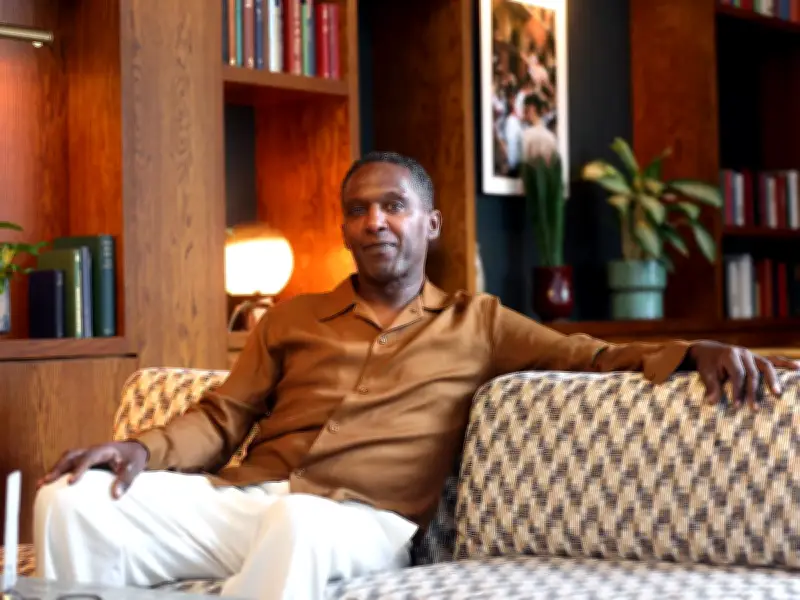
The Makerfield by-election has had an unexpected side effect for Lemn Sissay. It has given the celebrated poet a new perspective on the town where he spent his formative years.
He has returned to Ashton many times, speaking in depth about the mother he was taken from, the foster family who abandoned him at the age of 12 and years of abuse that followed in care homes around Wigan. Much of his art is based on these experiences and their after effects.
But this nationally significant byelection has afforded Sissay a chance to return and concentrate on the town, its people, its businesses, churches and pubs. To view the community through the lens of an expat deeply tied to the streets, villages and towns of the place.
“It's been a really good time for me because I've been able to say positive things about Makerfield and I think that's really important in this present climate of toxicity,” he says. “But it's also a shock.
“Nobody told them it was going to happen. Then suddenly you wake up and you've got all of these sort of lemmings looking up at your house from when you open the door to ask which way you're going to vote. And actually voting is a very private choice.
“What we see on these occasions is the concentrated juice of politics. You see politicians for who they are. Because they have to present themselves eye to eye to their constituents. So who they are will come out.
“What their true motivation is or form is. Are they acting? Are they genuine? Do they believe in what they say? Are they just saying this for me, you know, or do they believe it, or where's the proof?
“We get a chance to really investigate who they are. It's like a poet going on stage and there's no lighting. You’re not hidden on stage.”
Sissay is a prolific Facebook poster and he’s written a fair amount about Makerfield in recent weeks. He has enjoyed reading the replies, many from people he knows or knew - including some he played Kurby with as a child.
“It's actually quite beautiful. It means a lot to me,” he says. But he also thinks the byelection has been ‘traumatising’ for some living there.
On using that word, he stops himself and questions if it’s too dramatic. “I don't know,” he says.
“What's happening at the moment is quite traumatic for anybody's town. In any of our towns if this was happening, it would be quite a shock to the system.”
Sissay shows me a comment from his Facebook page from a local woman. It reads: “Most people here, like me, are not racist. We’ve been thrust into the “limelight” for a few weeks. I can’t wait until I can nip to Galloways for a pasty without being asked who I intend to vote for. I am hopeful that the majority of decent people around here will do the best they can for the town we live in.”
Sissay himself has shown support for Andy Burnham in the run up to polling day and has appeared in a video with the Labour man talking about the beauty of Jubilee Park and how his old school, Byrchall High, is a rival to 'Eddie Arrows' where the mayor's kids studied.
He has also allowed Mr Burnham to use one of his poems to support his pitch to Makerfield and appears in a campaign video reading extracts from ‘Anthem of the North’. “This is our power, our house”. An excerpt of my poem 'Anthem of The North' finds its place at last. Vote hope,” he posted on X this morning.
Sissay’s formative years in Makerfield are still fresh in his mind’s eye. He recalls with clarity the smile of the lollipop lady; Mr and Mrs Jolly who ran the corner shop selling sweets and bonbons in big glass jars; the clip-clop of the Rag and Bone man’s Shire horse emerging through the mist.
If it all sounds like something from a Warburton’s advert, Sissay says that’s a fairly accurate analogy of the 1960s Lancashire he knew.
Though he is probably best known as a Manchester poet, Sissay’s Lancashire inflection reveals he is a true Makerfield man. He describes Jubilee Park as the ‘flower park’, calls the M.E.N the ‘Evening News’ and pronounces ‘bus’ as ‘buzz’.
He talks with distinct clarity about the laburnum tree in the front garden of his foster parents home on Osborne Road and the leaves that would carpet the ground - along with the toxic seed pods.
“At this time of year the postage stamp garden with yellow leaves, these beautiful yellow leaves from the punnets of the laburnums. That really is rich in my memory and has found its way into a few of my poems over the years.”
He describes Ashton as “a village of three parks” and says the ‘flower park’ played a big part in his childhood.
“Osborne Road is the road that I learned to cross. Then I learned to cross it on my own, which was a big deal. And then I could go to the park on my own. So it was the beginning of the rest of the world.
“It was ringed with these massive beech trees that rattled in the winter. And I remember the sycamore tree helicopters carpeting the floor of Osborne Road.”
He tells me how he would scrub the wooden boards at the local butcher’s shop on the high street as an 11-year-old doing his first Saturday job. I ask how the place has changed from the Ashton of his youth.
“A lot of people who live in Ashton now don't use the high street as much as they used to. It was butcher, baker and candlestick-maker and remember they were all independent shops.”
The people, he says are ‘salt of the earth’ and it was, and remains, a town where everyone knows each other. “It was really community oriented around what church you went to, what school you went to.
“I guess under the surface there were very complex interwoven behaviours by people who all worked together. You had the business of religion and then the business of business.”
The Makerfield that Sissay was born into in the 1960s was a predominantly white working-class town. And he has spoken before about growing up as the 'only black child in a sleepy market town outside Wigan' in the 1970s.
He was born in Wigan to an Ethiopian mother who had come to Britain to study and ended up in a mother and baby unit. She refused to sign adoption papers but Sissay was placed in care and handed to long-term foster parents.
When he was 12, he was handed back to social services by his religious foster family. They had caught him stealing biscuits and decided the devil was in him.
He was left to fend for himself within the care system where he was abused physically, emotionally and racially. Decades later he received an apology and compensation from Wigan Council.
It wasn’t until he was 15 that Sissay learnt his real name, having been named Norman after the social worker who handed him to his foster family. Despite experiencing the most difficult of childhoods, Sissay speaks with great affection about the people of Makerfield.
“I have been back so many times for so many different reasons over the years,” he says. “The reason we go back to the places that we are from is because our family are there, right?
“That's what you do, that's why you go back to your hometown and then your home bedroom. Well, I didn't have that.
“I would mention it in articles ‘this is where I'm from’ even though there was no family there who wanted me. I can't have lived my formative years in a place and then spend the rest of my life pretending I wasn't there because somebody got rid of me.
“So I fought for my memory. I go back to Ashton and people are just so kind.
“They say ‘if we knew then’. And I even have people saying they’re sorry. It’s not their fault.
“People call me ‘Lemn’ even though I was only known as ‘Norman’ when I was there. So the kindness just blows my mind.”
Much of the narrative around this byelection has focussed on concerns about immigration. Sissay believes Ashton is not a town disproportionately affected by an influx of immigrants. He also believes it is not a particularly racist town.
“It's really important to say that Ashton was no more reactionary about other races than anywhere else in the 1960s,” he says. “In fact, it was probably a better place to live regarding other races, regarding me for example, especially in the 1960s.
“I’d be lying if I didn't say there weren’t some people who didn't like people from other races but then that was a 1960s stance.”
In this byelection period, Sissay has written a new poem, Eight Games, to mark the start of the World Cup. Published in collaboration with the Department for Culture, Media and Sport, it celebrates football’s ability to bring people from different backgrounds, cultures and generations together, marking the tournament as a powerful opportunity to put hatred aside.
He has also spoken to several newspapers about Makerfield and visited old friends. It has, undoubtedly, made him nostalgic and introspective.
“There's something about memory,” he says. “You're supposed to not recall something when there's nobody to recall it with. The experience is one that only you have had.
“Going to children's homes you get moved from one place to another. Those places disappear and there's nobody to anchor you back to the memory.
“Because I have no family, I have to have my memory. So I've done it through articles and documentaries and through speaking about it.”
A few years ago, Sissay started the project Tell Me Something About Family - which asks people from across the globe to write about moments from their own familial experiences. Contributions come from all over the world, as far flung as Tasmania. Some are just a line, some are huge essays. The poet reads every single one of them.
“It’s really emotional,” he says. “It’s little, private, beautifully-sculpted pieces of loss, of family and love. I can see just the breadth of what family is.
“Everyone does things in their own way. You see adopted families, blended families, mixed race families. Families where people have split up, where two sisters have not spoken, where fathers have died.
“If you want to know what diversity is just look at family. It's who we are.
“Sometimes I'll read something on here and I'll have such an opinion on it. I’ll think ‘well all you've got to do is to call your auntie and you'll be all right’. But it's not my job. It's not my place.”
Sissay speaks about family as an observer and says he has met many people “very hurt” by family and by their own unwillingness to forgive.
“The beauty of family, that I've observed, is that you never have to forgive,” he says “You can hold that gripe forever. You can build a house on that gripe. You can have children on that gripe. You can get married on that gripe.
“One of the privileges of family is that you don't have to forget. You can take that to the grave. And people do.
“When I forgave my foster mother I could then empathise with her. But I couldn't empathise before forgiving because I was so angry. After I forgave, I started to be able to breathe a little bit more.”
As we chat about people and place, Sissay brings up his close friend the Bolton comedian and writer Sophie Willan, who was also brought up in care. He immediately says “look what she was has done for Bolton”.
“It's us who were held on the outside - who were cast out, who were told that we were worthless - it's us that bring worth to the places we are from.”