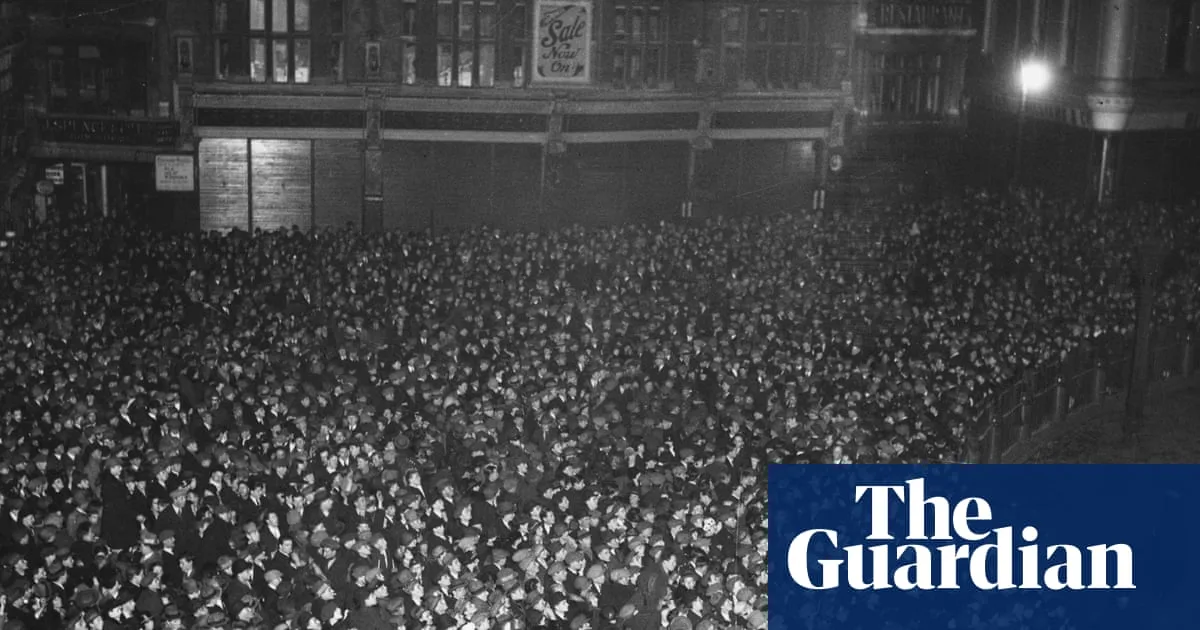
To the dawning new year Manchester extended the usual heterogeneous welcome. Many thousands of citizens of a communal turn of mind assembled in Albert Square to see the old year out together, and to linger a little while after the midnight chimes which seem to mean so much more on New Year’s Eve than at any ordinary time. Up and down the city other thousands were disporting themselves upon the innumerable floors which had been beeswaxed and advertised for their delight.
At the Midland Hotel, decked out for the event as a great garden, Miss 1926 descended among the dancers from the ceiling of the Octagon Court and bestowed her smiles and favours upon them. Bells and trumpets announced the mystical moment to the guests at the Queen’s Hotel, and they were wished a happy new year through the channel of electric signs. At the Ice Palace they skated up to midnight; in the great ballroom at Belle Vue they kept it up till 1am; and on varying scales there were carnival dances and masked dances and dances unqualified all over Manchester.
In the churches and chapels people were praying at the watch-night services. Is this quieter form of observance dwindling, or is it that its adherents do not advertise as extensively as their rivals? Unmasked but enigmatic—when 1926 unmasked at midnight did they see what they had expected? The features were surely too enigmatic to be made out very clearly by anyone. In effect Manchester of the new year looked very much as it had looked in the final moments of the old.
It was not raining, though there had been rain, and heavy rain, in the earlier evening hours. But Albert Square was characteristically dirty underfoot, with mud churned almost to a froth by dancing and promenading and – here and there – staggering feet.
The New Year’s Eve celebrations in London were probably the gayest of any since the war. Hotel, restaurant, and amusement caterers had set themselves out to provide generous programmes. Would-be revellers, finding the rain had kept off, made their way to the West End early in the evening, and scenes of animation were to be witnessed everywhere as trains, tubes, trams and ‘buses discharged their lighthearted loads. One of the principal celebrations was at the Albert Hall, where several thousands of dancers, the majority in fancy costume, bade farewell to the old year and welcomed the new.
Thousands of people observed the time-honoured custom of gathering in the precincts of St Paul’s to mark the passing of the old year and greet the new one by singing Auld Lang Syne. Long before the midnight hour people made their way in crowds from the City, West End, and suburbs to St Paul’s Churchyard, where the time of waiting was passed in the singing of popular songs and by dancing as well as the limited space permitted. Towards midnight the Churchyard and its approaches were packed by a boisterous but good-humoured crowd armed with balloons and rattles. Just on the stroke of midnight there was a marked silence. As the new year was heralded by the striking of the clocks cheers were raised, Auld Lang Syne was sung with great heartiness, and then began the homeward journey to face what 1926 had in store.