Ancient Roman Travertine Quarries Still Supply Stone for Global Temples
The same travertine quarries near Rome that provided the distinctive pock-marked stone for St. Peter's Basilica and the Colosseum centuries ago remain active today, continuing to extract the porous rock that now graces a new generation of churches, temples, and mosques across the globe.
Historic Origins and Modern Applications
Long ago, when ancient Romans needed to construct a new temple, they would journey to the nearby quarries of Tivoli. There, they would chisel out blocks of the porous rock known as lapis tiburtinus—what we now call travertine—and transport the cargo downstream on rafts to craftsmen in the city. This exact method was used to build the Colosseum two millennia ago, and later for St. Peter's Basilica and Bernini's magnificent colonnade.
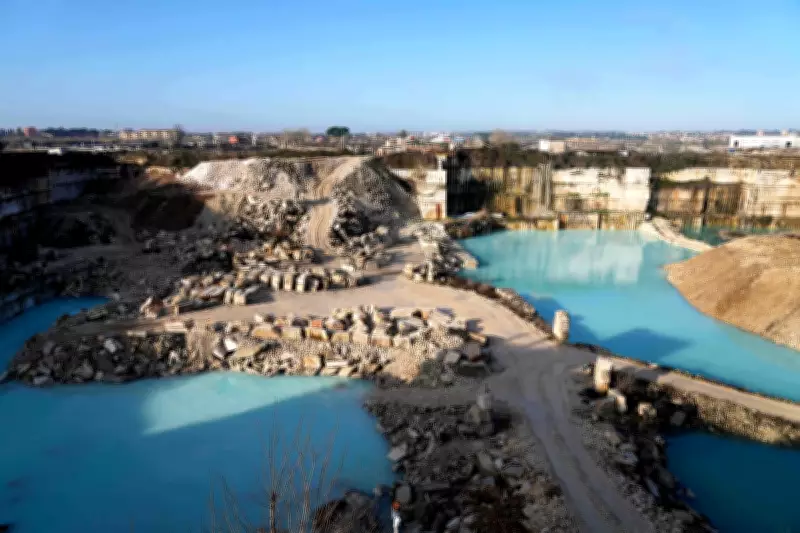
Today, these same quarries continue to be excavated, supplying travertine not only for religious structures worldwide but also for banks, museums, government buildings, and private residences. While other nations produce variations of this sedimentary limestone, Roman travertine stands apart due to its unique underground extraction process in the sulfuric springs and basins surrounding Tivoli.

The Unique Composition and Appeal of Roman Travertine
Composed primarily of calcium carbonate minerals, Roman travertine formed hundreds of thousands of years ago through deposits of calcium, sulfur, and other minerals. Its striated layers reveal the region's geological history of volcanic eruptions, ancient forests, and preserved fossils.
Architects prize this stone for several compelling reasons:
- Exceptional durability that withstands various climatic and environmental challenges
- Abundant availability from the extensive quarry network
- Versatile appearance ranging from rough to sleek textures
- Diverse coloration from warm white with irregular black holes to sandy beige with gray, brown, or even greenish veins
Four Generations of Stonecutting Excellence
The Mariotti Carlo SpA stonecutting firm has operated for four generations, carving travertine to fulfill some of the world's most prestigious architectural commissions. Their portfolio includes the Getty Center in Los Angeles, the Bank of China headquarters in Beijing, and the Great Mosque in Algiers, Algeria.
Recently, the company has been preparing travertine pieces for the reconstruction of a temple by The Church of Jesus Christ of Latter-day Saints. These precisely cut puzzle pieces will be assembled on-site in New York City, continuing a relationship that began when Mariotti supplied travertine for the Latter-day Saint temple in Rome.
"Travertine is a classic stone known all over the world," explained Fabrizio Mariotti, head of the family business. "It's a bit like carrying the light of Rome everywhere, because the way travertine reflects light is very special."
Bernini's Beloved Quarry and Modern Operations
Around the Tivoli quarries, the air carries the distinctive scent of sulfur alongside the constant sounds of giant jackhammers breaking ancient rock formations. At the Degemar quarries, which extend 30 meters below sea level, bright blue sulfur spring ponds collect travertine residue as flat-bed trucks transport 33-ton stone slabs to street level.
This very location provided the brilliant white travertine for Gian Lorenzo Bernini's Baroque masterpieces, including the 284 columns and 88 pillars of the colonnade embracing St. Peter's Square. Bernini spent so much time selecting his stone here that he maintained a residence overlooking the quarry—a building that still stands today.
"It is special, a special stone because it is a living stone, a stone that is born in a cocktail of mineral waters," said Vincenzo De Gennaro, current head of the quarry, as he navigated earth movers and sulfur pools.
Proven Durability and Cultural Significance
For those questioning travertine's longevity, De Gennaro points to Rome itself as evidence: "There is the concrete experience of a civilization dating back thousands of years that stands in the light of day and has been shining undisturbed for 2,000 years. That is the guarantee."

Marco Ferrero, professor of civil engineering at Rome's La Sapienza University, notes that part of travertine's appeal lies in its connection to ancient Rome "and therefore also to the magic of the classical world." He describes the stone as embodying Rome's spirit—solid, resistant, and noble without being ostentatious.
"We can make this comparison: Marble speaks to us in beautiful Italian, in literary Italian, while travertine speaks to us in Roman dialect," Ferrero explained. "It is truly the stone of the Romans. And like Roman cuisine, which is made up of simple dishes, often using discarded ingredients, travertine is a genuine and traditional stone."
Today, these historic quarries fulfill orders for projects as distant as the new airport in Riyadh, Saudi Arabia, and the new headquarters of China's governing party in Shenzhen, proving that this ancient Roman stone continues to shape architecture across continents and cultures.