Michelangelo or Bust? Rome Sculpture Sparks Art World Controversy
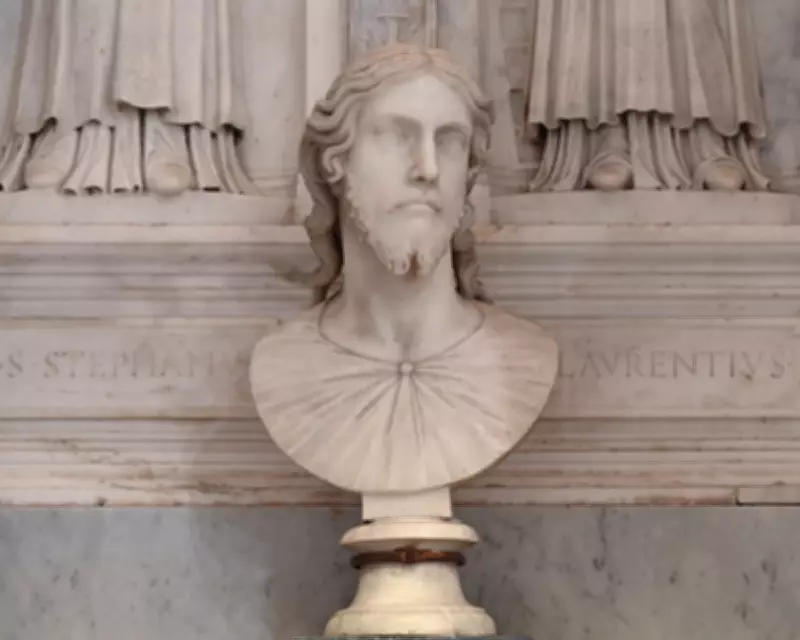
A marble bust of Christ the Saviour, housed for centuries in a Roman church, has become the centre of an intense art historical debate following a bold attribution to Michelangelo. The sculpture, located in the church of St Agnes Outside the Walls since 1590, was thrust into the spotlight by independent researcher Valentina Salerno, who claims newly discovered archive documents link it to the Renaissance master.
Researcher's Discovery Challenges Established Theories
Valentina Salerno, a fiction author and actor without formal art historical training, presented her findings at a press conference that has divided experts across Italy and beyond. Salerno spent over a decade sifting through Italian and Vatican state archives, focusing on the final days of Michelangelo's life in Rome, where he lived for approximately thirty years until his death in 1564.
"I found it impossible to believe that nobody had studied the last days of his life in a deep way," said Salerno, who published her research on academia.edu. "There are so many mysteries."

Her most significant discovery involves documents describing a secret room, secured with multiple keys, where Michelangelo allegedly ordered his close associates to hide drawings and sculptures. This challenges the long-accepted theory that the artist destroyed his works before dying.
Documentary Evidence and Historical Connections
Salerno claims the documents show the secret room was eventually emptied, with its contents distributed to religious institutions. She believes this could mean approximately twenty unknown Michelangelo works exist, with the Christ the Saviour bust being one of them.
The researcher points to several pieces of supporting evidence:
- Historical documentation following Michelangelo's death that attributes the bust to him
- The sculpture's resemblance to Tommaso dei Cavalieri, a young nobleman Michelangelo was infatuated with
- Significant attention from notable figures including British painter JMW Turner, who sketched it in 1819
- German sculptor Emil Wolff created a copy now housed at Charlottenburg Palace in Berlin
- French writer Stendhal expressed belief in the Michelangelo attribution
Despite this historical interest, a scholar debunked the attribution in 1984, leading Italy's culture ministry to categorise the work as by an unknown sculptor.
Expert Reactions and Public Interest
The announcement has generated mixed reactions from art historians and institutions. Francesco Caglioti, a professor of medieval art history specialising in Renaissance studies, praised Salerno's archival work while rejecting her conclusion.
"I have encouraged Valentina as she is looking into a part of Michelangelo's legacy which has never systematically been studied," Caglioti stated. "But this bust is not a Michelangelo. It does not have his style, but above all, it does not have his quality."
The church of St Agnes has embraced the research, with abbot Franco Bergamin calling it "one of the surprises" their complex holds. However, the Italian culture ministry declined to attend Salerno's press conference, and members of a Vatican scientific committee appointed to plan a Michelangelo exhibition have remained silent.
Increased Security and Public Fascination
As the debate intensifies, Italian art police have implemented enhanced security measures around the sculpture. A laminated sign now warns visitors with the message "Alarm armed," reflecting concerns about the bust's protection during this period of heightened attention.
Public interest has surged, with visitors like Fabio Orazzo, an art and history teacher from Naples, making special trips to examine the sculpture. "I've read all the cynical comments," Orazzo remarked while studying the bust. "But perhaps they were made in different periods of his life and so in my humble opinion, this is a Michelangelo too."

Another visitor, Gori Magnani, travelled from a town near Rome specifically to see the disputed work. "I find it fascinating," she said. "Maybe it is a Michelangelo. Either way, this research should be supported and scientific experts should establish whether it is true or not."
Researcher's Challenge to the Art Establishment
Salerno has openly challenged experts to disprove her theory with documentary evidence. "I'm being attacked as some kind of charlatan but all the documents point in this direction," she asserted. "I don't have the technical capabilities to say 100% that it is or isn't a Michelangelo. It could be plastic for all I know."
The controversy emerges against the backdrop of recent high-value art sales, including a sketch attributed to Michelangelo that sold for £16.9 million at Christie's in February, despite some experts dismissing it as a copy. This context adds significance to any potential new attribution of the master's work.
As the art world awaits further scientific analysis and expert commentary, the Christ the Saviour bust remains both a religious artefact and the subject of one of the most intriguing attribution debates in recent memory, testing established art historical methodologies against persistent mysteries surrounding Michelangelo's final years and undiscovered works.