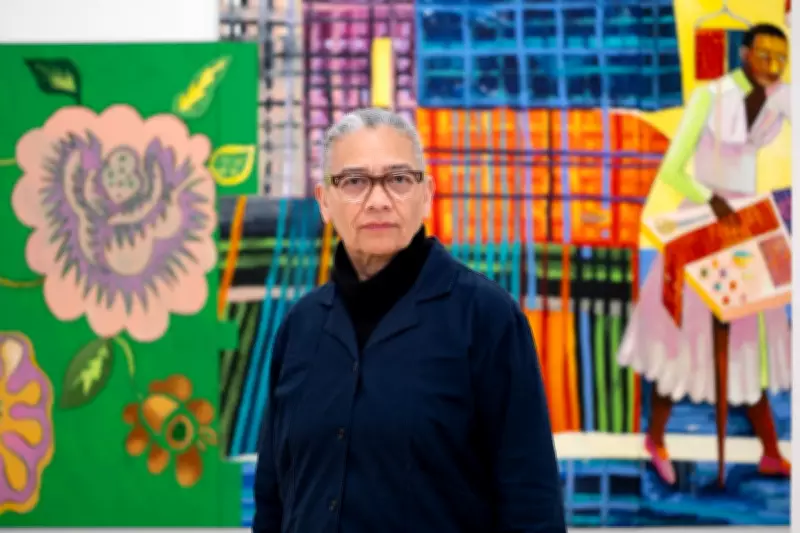
Representing Britain at the world's largest art festival, the Turner Prize winner Lubaina Himid puts the very concept of 'belonging' under the microscope in the British Pavilion at the 61st Venice Biennale.
The Theme of Belonging
Belonging, the theme of the British Pavilion at this year's incarnation of the world's biggest art festival, used to be such a cosy concept, with its sense of connection to a place or cultural milieu where we are known and loved. Over the past half-decade, however, belonging—like that other great buzzword 'identity'—has become a liability. From Ukraine and Gaza to St George's flags in suburban gardens, there has barely been a news story that has not hinged on people's sense of moral and spiritual, let alone legal and political, entitlement to be where they are.
So Turner Prize winner Lubaina Himid, representing Britain at the 61st Venice Biennale, seems right on the money in opening her installation in the British Pavilion with '26 Questions for Today' that address the visitor's own sense of belonging. Emblazoned on the wall beside one of her eye-blastingly colourful paintings, they range from posters that will be relevant to just about any visitor—'Do you know the place your family calls home?' and 'Do you want to go back to the old place?'—to questions that appear specifically aimed at people whose cultural roots are not in the country they live in, such as 'Can you find the food of your homeland in the markets of the new place?'

Himid's Background and Artistic Journey
There will no doubt be those who will baulk at the idea of Britain being represented by an artist with a non-British name, let alone one who clearly has a complex, if not downright problematic relationship with what she calls her 'homeland'. Yet it becomes clear moving through this exuberant exhibition that the resonances of Himid's notions of 'the old place' and 'the new place' extend far beyond simply being born in one country and living in another.
Born in Zanzibar in 1954, but resident in Britain since she was four months old, Himid was a key figure in the Black Art movement which carved a space for Black British art in the 1980s, and the first Black woman to win the Turner Prize in 2017. She is best known for vibrantly coloured, magic realist paintings of Black British life past and present, with a penchant for hidden histories such as the 18th century Black underground of 'dog-trainers, toy makers, dancing masters and musicians' represented as life-size painted cut-outs in her much-exhibited 2004 work 'Naming the Money'.
The Exhibition's Visual Core
Five wall-filling multi-panel paintings form the visual meat of her Venice exhibition. Showing 'industrious figures'—all crop-headed Black women—'grappling with how to adapt to an unfamiliar place', as it says on the information panel, they appear at first a shade tangential to the show's bigger theme as expounded in that opening questionnaire. In the largest, 'Architects', which confronts us as we enter, two fantastically dressed women, one in an immense crinoline, the other in a fringed quasi-African carnival costume, hold mysterious objects. These, we are told, are models of buildings, one cylindrical and solid, representing permanence (settlement in the 'new place'?), the other, on wheels, ready for flight (back to the 'old place'?).
While it is eye-poppingly bold in colour and impressively vigorous in its juxtaposition of figurative and abstract elements—the central canvas could stand alone as a piece of Rothkoesque colour field painting—I was left wondering whether these stylistic contrasts were designed to express the opposition of 'old' and 'new' places. Himid's imagery, meanwhile, requires as much contextual explanation as any of the Renaissance masterpieces to be found in nearby Venetian churches.

Interpreting the Paintings
If 'Tailors' and 'Chefs' appear at first glance equally opaque, it is clear on closer examination that their resolution by the 'old' and the 'new' places represent current realities rather than future utopias. The huge, stylised flowers splashed across 'Tailors' may look simply decorative, but they are clearly drawn from African wax-print fabrics which have been used in everything from high fashion to home-made garments on market stalls, not to mention endless artworks by Yinka Shonibare. The female protagonists could be making an 18th century frock coat, as the accompanying text suggests, or running up threads for a rave party.
As for the figures in the joyously colourful 'Chefs', experimenting with new recipes against a background of dripping pink and turquoise, is not creating hybrid versions of the cuisine of the 'old place' exactly what has allowed so many immigrant groups to thrive in the 'new place', while shifting the axis of British culture in the process? 'Boatbuilders' features a portrait of a young man staring quizzically from the bottom of a drawer projecting from the gallery wall: a representative of the 'old place' perhaps, sceptically regarding his descendants in the new.
The figures harmoniously engaging in horticulture in 'Gardeners', with its antique botanical illustrations rendered on a gigantic scale, might be taken at first glance as a man and woman, judging by their dress. The fact that they are, like all the many gender-ambiguous figures here, no doubt intended to be women does not feel remotely exclusive. Himid's notions of the 'old place' and the 'new place', quirkily played out in these paintings, feels generously all-embracing.
Conclusion
Aren't we all haunted by the idea of a formative 'old place', a point of origin we cannot quite put our finger on, whether it is somewhere remote in our grandparents' worlds or a suburban house we have not visited for decades? Himid shows that is a far more fruitful question than rushing to judgement on who 'belongs' and who does not.
'Lubaina Himid: Predicting History: Testing Translation' is at the Venice Biennale from 9 May until 22 November.